

Here are ready-to-use, age-appropriate affirmations you can start using with girls today, organized by age group, plus simple daily routines that make them stick. You’ll find phrases for young children, tweens, and teens, backed by research on stress reduction, along with quick practice tips like morning mirror work or bedtime repetition. If you want more support on the emotional side of growing up, there are resources built specifically for puberty-related conversations.
TL;DR:
- Repeating affirmations daily during calming moments enhances their effectiveness by reducing stress hormones and building genuine self-belief.
- Short, specific phrases tailored to each age group help address social pressures, body changes, and confidence challenges more effectively than generic praise.
- Personalizing affirmations through writing or ownership increases their impact, especially when aligned with real efforts or experiences.
- Incorporating affirmations into routines like mindful breathing or pairing with tangible support tools amplifies their benefits during puberty transitions.
- Peer-sharing and visual cues across school and social environments strengthen affirmation practices and normalize self-acceptance during adolescence.
Table of Contents
- Affirmations for Young Children (Ages 3–7)
- Affirmations for Tweens (Ages 8–12)
- Affirmations for Teens (Ages 13–19)
- How to Practice Affirmations So They Actually Work
- Dos and Don’ts for Parents Using Affirmations
- Pairing Affirmations With Puberty Preparation
- Affirmations for Self-Esteem, Body Image, and Peer Pressure
- Bringing Affirmations Into School and Social Life
- Affirmations That Celebrate Diversity and Inclusion
- Combining Affirmations With Mindfulness and Meditation
- Helping Her Write Her Own Affirmations
- Why Small and Consistent Beats Big and Perfect
- Sources
- FAQ
Affirmations for Young Children (Ages 3–7)
Little kids respond to sound and rhythm before they respond to logic. A phrase that rhymes or has a beat sticks better than a long, reasoned sentence, because their brains are wired for pattern and repetition at this stage.
Try these with your daughter:
- “I am kind.”
- “I am brave.”
- “My body is strong.”
- “I can try new things.”
- “I am loved just as I am.”
- “My feelings matter.”
- “I am a good friend.”
- “I can ask for help.”
- “I am learning every day.”
- “My voice matters.”
- “I am safe.”
- “I am important.”
- “I can do hard things.”
- “I like who I am.”
- “I am a good helper.”
Turn these into a song, a sticker chart, or a two-minute mirror game before school. Pairing a phrase with a sensory cue, like a specific hand motion or a silly voice, helps a preschooler remember it without ever asking her to “practice.”
Affirmations for Tweens (Ages 8–12)
Tweens are starting to notice effort, fairness, and where they fit socially. Affirmations that acknowledge growth and belonging land better here than generic praise, because Motherly’s list of affirmations for tweens shows this age group responds well to phrases tied to their social and emotional development.
Give her a mix like these:
- “I am proud of my effort, not just my results.”
- “It’s okay to make mistakes. I learn from them.”
- “I get to decide who my real friends are.”
- “My body is changing, and that’s normal.”
- “I can say no and still be kind.”
- “I am allowed to take up space.”
- “I don’t have to be good at everything to be worthy.”
- “I trust myself to figure things out.”
- “My opinions matter, even when I’m the only one who has them.”
- “I can be a good friend and still set boundaries.”
- “Growing up is uncomfortable, and I can handle it.”
- “I am more than my grades.”
- “I can ask questions without feeling dumb.”
- “My body belongs to me.”
- “I am becoming who I want to be.”
Slip a card into her backpack, or hand her a small notebook with a one-line prompt each night: “One thing I did well today was ___.” That’s enough. Tweens tune out anything that feels like a lecture.
Affirmations for Teens (Ages 13–19)
Teens want autonomy, and they can smell a fake compliment from across the room. Affirmations for this age need to sound like something she’d actually say, not something a greeting card would say about her. Give her language around agency, values, and body acceptance rather than pure cheerleading, and let her push back on any phrase that doesn’t feel true yet.
Some starting points:
- “I am allowed to change my mind.”
- “My worth isn’t up for debate.”
- “I get to define what confidence looks like for me.”
- “My body doesn’t need to look a certain way to be good enough.”
- “I can disagree with people I care about.”
- “I trust my gut, even when others don’t understand it.”
- “I am allowed to rest without guilt.”
- “Comparison steals my energy, and I can choose not to give it away.”
- “I am learning to advocate for myself.”
- “My past doesn’t decide my future.”
- “I can be uncertain and still be capable.”
- “I don’t owe anyone constant positivity.”
- “I am figuring out who I am, one day at a time.”
- “I can set boundaries with people I love.”
- “My value doesn’t shrink when someone else’s grows.”
Journaling works well here, but so do phone wallpapers with a single line, or a 15-second voice memo she records for herself before a big test or tryout. Teens are far more likely to keep an affirmation practice going when it lives somewhere they already look, like their lock screen, instead of on a card taped to the bathroom mirror.
How to Practice Affirmations So They Actually Work
Saying a phrase once in the car on the way to school won’t do much. Repetition is what moves an affirmation from words she’s heard to a belief she holds, and pairing it with a small real-world action makes it credible instead of hollow.
Research backs this up directly. People who affirmed their core values before a stressful task showed measurably lower cortisol responses than those who didn’t, and a broader review of self-affirmation research found the practice shifts how the brain processes information about the self. Affirmations aren’t just feel-good filler. They change the body’s stress response.
Here’s a simple routine to build the habit:
- Pick one phrase per week instead of rotating through ten. Repetition beats variety here.
- Say it out loud during a fixed moment, like brushing teeth or right before bed.
- Pair it with proof. If she says “I am capable,” have her name one small thing she did that day that backs it up.
- Let the language evolve. “I am learning to speak up in class” can graduate to “I speak up in class” once she has real evidence behind it.
Pro Tip: If a phrase feels like a lie to her, that’s a sign it needs to shrink. “I am confident” can feel impossible to a shy 11-year-old, but “I am learning to feel more confident” is something she can actually believe today.
Dos and Don’ts for Parents Using Affirmations
The biggest mistake parents make is turning affirmations into another performance metric. If a phrase only shows up after a good grade or a soccer win, it stops being an affirmation and starts being conditional praise wearing a disguise.
Do:
- Model the language yourself, out loud, so she hears you affirming your own effort and mistakes.
- Co-create phrases with her instead of handing down a finished list.
- Validate the feeling first (“that sounds really hard”) before offering an affirming reframe.
Don’t:
- Default to appearance-based praise as the main affirmation category.
- Force a phrase on a day she’s clearly not in the mood for it.
- Tie affirmations to performance, grades, or wins.
Pro Tip: Turn compliments into self-owned language. Instead of “You’re so smart,” try asking, “What’s one thing you’re proud of figuring out today?” and let her answer become the affirmation.
Pairing Affirmations With Puberty Preparation
Words alone rarely calm a nervous kid facing her first period. Emotional language works best when it’s backed by something tangible she can hold, which is the whole idea behind Themonthliesbox’s Amethyst Method: affirm the feeling, explain what’s happening in her body, then equip her with the supplies to handle it.
The Amethyst Box pairs affirmation cards with educational materials and practical period supplies, so a phrase like “I am ready for this” comes with an actual answer to “ready with what, exactly?” For parents who want a smaller, portable version for backpacks or sleepovers, the on-the-go kit covers the same ground in miniature. If you’re still mapping out what’s ahead developmentally, the guide on signs your daughter is approaching puberty is a useful next read.
Affirmations for Self-Esteem, Body Image, and Peer Pressure
Girls hit specific pressure points at fairly predictable moments, and affirmations work best when they’re aimed at the actual challenge instead of a vague mood boost.
For self-esteem dips, try: “I don’t need everyone to like me to like myself,” or “One bad day doesn’t define who I am.” For body image, especially as puberty changes her shape and she starts comparing herself to friends or social media, phrases like “My body is doing exactly what it’s supposed to do” and “I don’t owe anyone a certain appearance” carry more weight than generic beauty talk. Avoid affirmations that only mention how she looks, even positively. “You’re so pretty” reinforces the same appearance-based scorecard as criticism does, just from the other direction.
Peer pressure calls for language around choice and boundaries: “I can say no to something everyone else is doing,” or “Real friends don’t need me to prove anything.” These land better than “be yourself,” which is true but too abstract for a 12-year-old standing in a hallway trying to decide whether to go along with something that feels wrong.
The common thread across all three challenges is specificity. A girl facing a body image spiral doesn’t need “I am beautiful.” She needs language that separates her worth from her mirror. Keep a small rotating set of phrases matched to whatever she’s actually dealing with that week, rather than one all-purpose affirmation stretched to cover everything.
Bringing Affirmations Into School and Social Life
Affirmations don’t have to live only at home. A locker mirror note, a sticky note tucked into a pencil case, or a one-line phrase written on the inside cover of a notebook can carry her through a tough hallway moment or a test she’s nervous about.
Some schools and classrooms build affirmation moments into morning routines, a short “I am” statement before the day starts. You can recreate a version of that at home by having her pick her own phrase for the day during breakfast, so it’s already loaded in her head before she walks through the door.
Social settings, including group chats and sleepovers, are where peer-driven affirmations can actually outperform parent-given ones. Encourage her to swap affirmation cards with a friend, or start a tiny tradition where she and a friend text each other one good thing about their day. Girls tend to trust affirmations more when they come from a peer rather than a parent, especially by the tween years, so giving her tools to pass along rather than just receive can matter more than another list from you.
If a friend group or classroom situation is a repeated source of stress, pair the affirmation with a concrete plan, not just a phrase. “I am allowed to sit somewhere else at lunch” works better alongside an actual backup plan for where she’d sit.
Affirmations That Celebrate Diversity and Inclusion
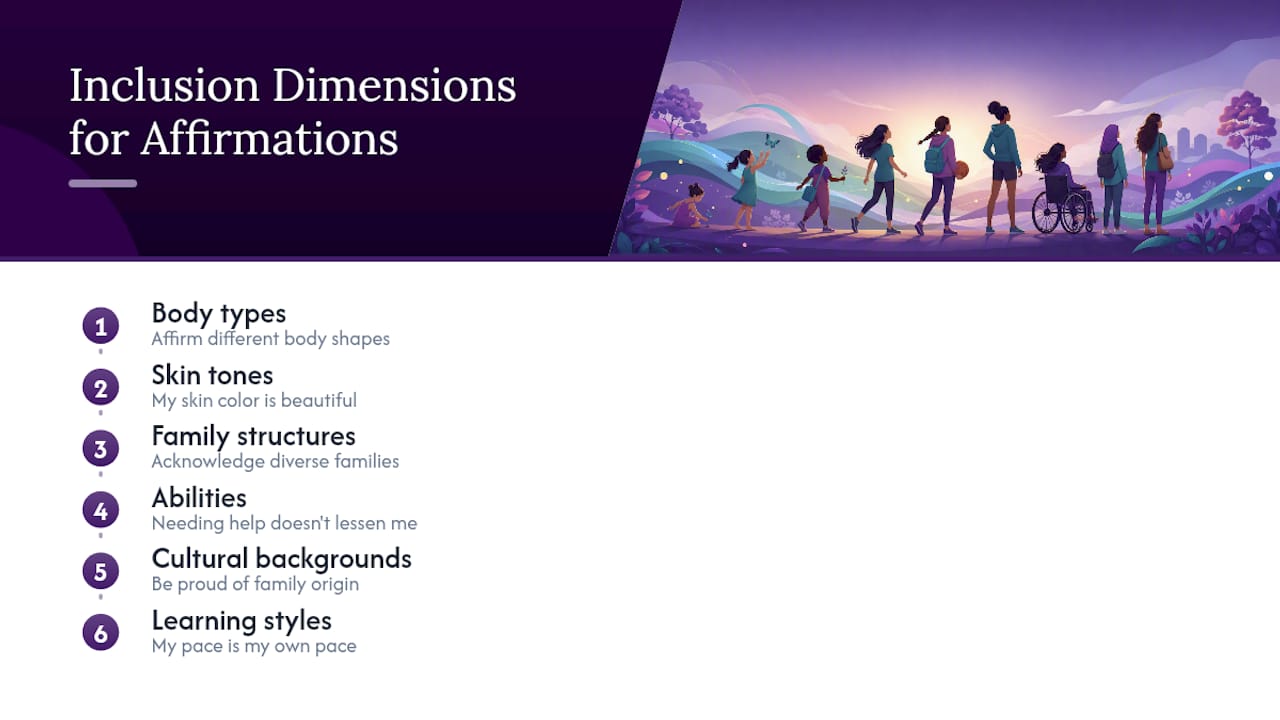
Every girl deserves affirmations that reflect who she actually is, not a narrow, one-size-fits-all version of confidence. Phrases that celebrate different body types, skin tones, family structures, abilities, and cultural backgrounds help her build self-worth that doesn’t depend on matching a single image of what a “confident girl” looks like.
Some options to include in her rotation: “My skin color is beautiful and it’s mine,” “My hair does exactly what it’s supposed to do,” “My family looks different from other families, and that’s okay,” “I can be proud of where my family comes from,” “There’s more than one way to be strong,” and “I don’t have to look like everyone else to belong.”
For girls with disabilities or different learning styles, affirmations like “My pace is my own pace” or “Needing help doesn’t make me less capable” matter just as much as any confidence phrase about appearance. The goal is to widen the picture of what a good, capable, worthy girl looks like, so she never feels like she has to shrink or hide a part of herself to qualify for the encouraging words other kids get.
Combining Affirmations With Mindfulness and Meditation
Affirmations work better when a girl’s nervous system is actually calm enough to absorb them. Saying “I am safe” while anxious and rushed doesn’t land the same way as saying it during a slow, quiet moment, which is where a little mindfulness goes a long way.
A simple combo: three slow breaths, then one affirmation, then three more breaths. That’s it. You don’t need a meditation app or a 20-minute session. For younger kids, pair the breath with a hand motion, like tracing fingers on the opposite hand while saying the phrase. For teens, a 60-second guided breathing moment before bed, followed by a single affirmation spoken or written down, tends to work better than a long journaling session she won’t have energy for.
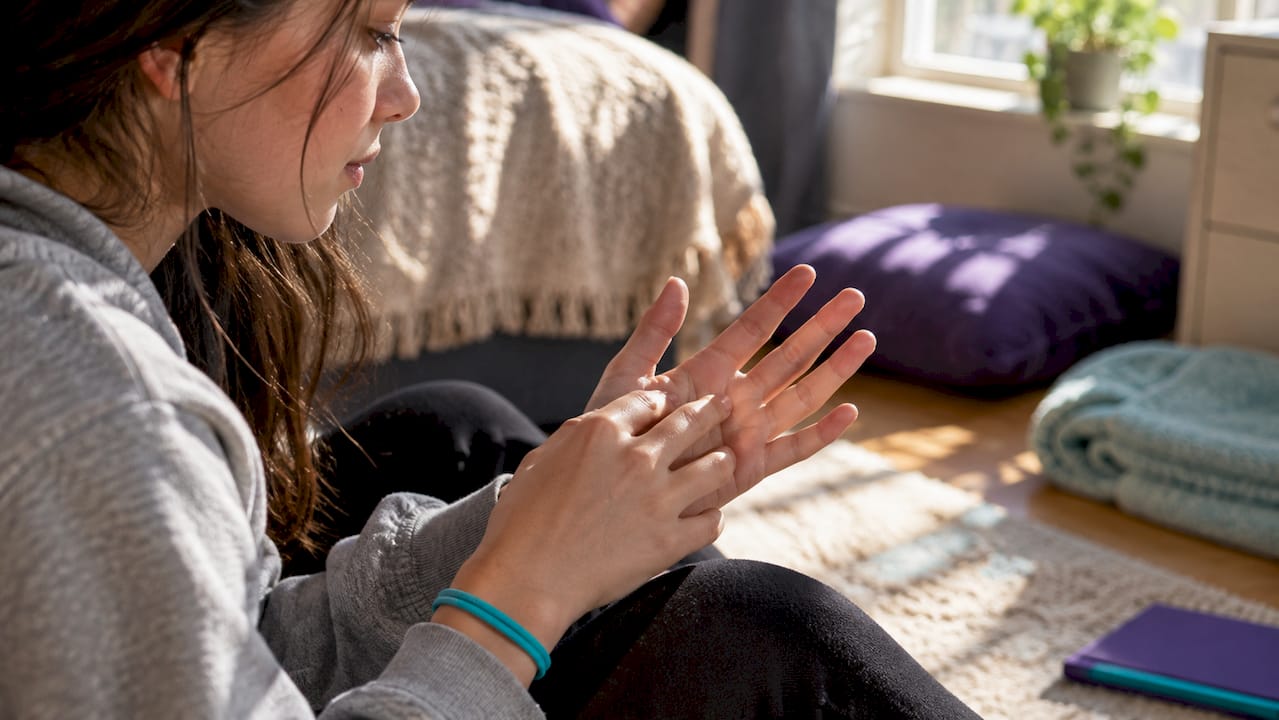
This pairing also reinforces the stress-reduction research already mentioned. Since self-affirmation lowers physiological stress markers, doing it during an already-calm moment, right after a few mindful breaths, likely amplifies that effect rather than fighting against a racing heart rate.
Helping Her Write Her Own Affirmations
The affirmations that stick longest are the ones she writes herself. Borrowed lists are a great starting point, but ownership is what turns a phrase into a genuine belief instead of a script.
Start by asking her what she’d want to hear on her worst day, then help her turn that answer into a short, first-person sentence. If she says “I wish people didn’t make fun of my glasses,” help her shape it into “I like how I see the world, glasses and all.” Keep her phrases specific to her, not generic. A personalized line about her actual struggle with math homework will do more than a borrowed line about “being smart.”
Let her reject phrases that feel fake. If a suggested affirmation makes her roll her eyes, that’s useful information, not defiance. Have her keep a small running list in a notebook or on note cards, adding a new one whenever she notices something she’s proud of or something she wishes she believed more fully. Over time, that list becomes a mirror of her own growth instead of a borrowed script.
Why Small and Consistent Beats Big and Perfect
Affirmations aren’t a fix for a hard day, a bad friendship, or a rough stretch of puberty. They’re a small tool that works best alongside real conversation, real support, and real evidence a girl builds for herself over time.
Don’t chase the perfect phrase. Adapt the ones here, let her reject what doesn’t fit, and celebrate the tiny wins, like a phrase she actually repeats without being asked. That’s the whole practice working.
— The
Sources
The stress-reduction claims in this article come from a PubMed study on self-affirmation and cortisol response and a broader NCBI review of self-affirmation’s effects on behavior and neural processing. Tween-specific phrasing draws on Motherly’s affirmations for tweens, and the pairing-with-action framework references Carnegie Mellon University’s summary of self-affirmation benefits.
- Self-affirmation reduces stress responses — PubMed entry
- Review of self-affirmation effects on behavior and neural processing — NCBI PMC
- Positive Affirmations For Tweens — Motherly
FAQ
What Are Words of Affirmation for a Girl?
Words of affirmation are short, positive, first-person statements a girl says or hears about herself, like “I am capable” or “I trust myself,” designed to reinforce a positive self-belief over time.
What Are 5 Good Affirmations for a Girl?
Five solid starting points: “I am proud of my effort,” “My body is doing exactly what it’s supposed to do,” “I can say no and still be kind,” “I trust myself to figure things out,” and “I don’t have to look like everyone else to belong.”
What Are Some Daily Affirmations for Girls?
Daily affirmations work best when tied to a routine, like one phrase said during a morning mirror moment or before bed, such as “I am learning every day” for younger kids or “I am allowed to change my mind” for teens.
What Are 10 Positive Affirmations for Girls?
A useful set of ten spans age and situation: “I am kind,” “I am brave,” “I am proud of my effort,” “My feelings matter,” “I can say no and still be kind,” “My body belongs to me,” “I trust my gut,” “I am allowed to rest without guilt,” “My worth isn’t up for debate,” and “I am becoming who I want to be.”
0 comments