

To develop a menstrual health resource library that actually gets used, follow five steps: Plan your scope → Curate medically reviewed materials → Stock supplies → Set access rules → Pilot and evaluate. You can start this week with free toolkits from the Menstrual Health Project, federal guidance from the Office on Women’s Health, and community templates from Project Local Access. For a ready-made demo kit, the Amethyst Box from Themonthliesbox gives you a hands-on option that covers supplies, affirmations, and age-appropriate education in one package.
Starter checklist (copy and use today):
- Download the Menstrual Health Project’s free U18 toolkit PDF
- Print 3 handouts from the Office on Women’s Health resources page
- Gather a product mix of varied pad and tampon sizes for a demo package
- Create a simple privacy sign for your display or folder
- Draft a one-paragraph pilot proposal using Project Local Access outreach language
Pro Tip: When asking an administrator for approval, lead with local school or district data on missed class days or nurse’s office visits — concrete, local numbers are far more persuasive than national statistics alone.
Table of Contents
- What age-appropriate topics should your library cover?
- Which materials belong in a well-vetted library?
- How do you set up a physical library space?
- How do you build the digital side of your library?
- How do you run a lesson or workshop that actually helps?
- What language and inclusivity practices should you follow?
- How do you fund the library and address period poverty?
- How do you pilot the library and measure whether it’s working?
- What are the best starter resources and templates to download?
- Key Takeaways
- Why the “just add a pamphlet rack” approach misses the point
- The Monthlies has a ready-made option for educators
- Useful sources
What age-appropriate topics should your library cover?
The content you include should match where learners actually are, not where we assume they are. A fifth grader needs cycle basics and product options. A seventh grader is ready for emotional changes, consent around bodies, and hygiene routines. A ninth grader can handle health conditions, red flags, and diagnostic pathways.
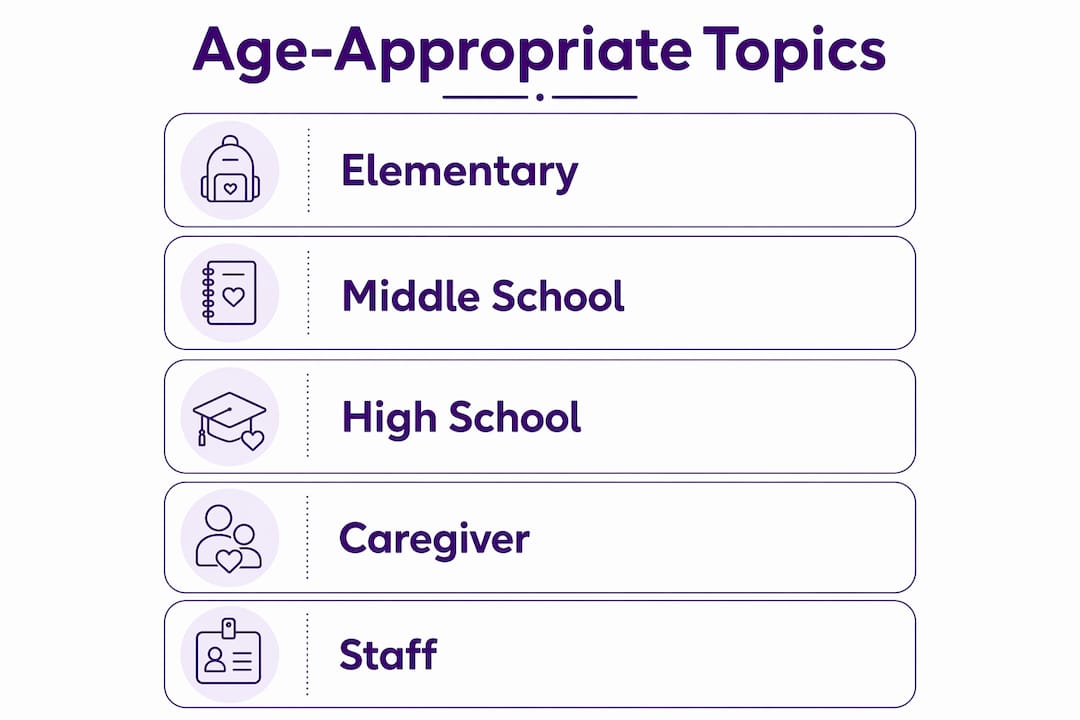
The Office on Women’s Health is clear that heavy, irregular, or severely painful periods are not normal and should prompt a clinician visit. That guidance belongs in every library, labeled plainly for both students and staff.
| Age Group | Learning Objectives | Suggested Resource Types |
|---|---|---|
| Elementary (grades 4–5) | Name cycle phases; identify 2 product types; understand privacy | Picture books, simple handouts, demo kit |
| Middle school (grades 6–8) | Track a cycle; choose products; recognize emotional changes | Toolkits, short videos, anonymous Q&A cards |
| Early high school | Identify red flags; discuss health conditions; advocate for needs | Complete guides, condition fact sheets, referral cards |
Which materials belong in a well-vetted library?
Start with medically reviewed content, then layer in community tools and hands-on supplies. The Menstrual Health Project’s U18 toolkit is free, PDF-ready, and reviewed by a Medical Advisory Board. It covers cycle basics, product options, and health conditions in accessible language. The Menstrual Health Hub (MH Hub) connects educators to a broader knowledge base spanning research, policy, and equity, which is useful when you want to go deeper or align your library with district-level goals.
When vetting any new material, run it through this quick checklist:
- Medical review: Is the content reviewed by a clinician or credentialed health organization?
- Currency: Has it been updated within the last three years?
- Reading level: Is it written for the age group you’re serving?
- Cultural inclusivity: Does it reflect diverse bodies, backgrounds, and family structures?
- Author credentials: Is the source a recognized health authority or advocacy organization?
Prioritized starter list (add in this order):
- One medically reviewed toolkit (Menstrual Health Project U18)
- One demo kit with a variety of products
- Three printable handouts (cycle basics, product guide, red flags)
- Privacy signage for the display area
How do you set up a physical library space?
Layout matters more than most people expect. Place the display where a student can access it without being watched by peers, but not so hidden that no one finds it. Clear, plain-language signage (“Period supplies — take what you need”) reduces hesitation. Avoid clinical or shame-adjacent language on labels.
| Item | Quantity | Notes |
|---|---|---|
| Pads (regular) | 8–10 | Tween-sized where possible |
| Pads (overnight) | 3–4 | For heavier flow days |
| Tampons (light/regular) | 4–6 | Include applicator and non-applicator |
| Panty liners | 3–4 | Good for spotting and discharge |
| Pain relief info card | 1 | Reference only; direct to nurse for medication |
| Privacy bag or pouch | 2–3 | So students can carry supplies discreetly |
For disposal, a discrete, lined bin near the restroom is the minimum. Lockable bins work well in shared spaces. For community or outdoor installations, repurposed newspaper boxes make weather-resistant, low-cost Little Library stations. Local neighborhood social media groups often generate the first wave of donations and keep restocking going.
Pro Tip: Before spending any budget, post a donation request to a local Buy Nothing group or neighborhood app. Many pilots get their first full inventory this way, at no cost.
How do you build the digital side of your library?
Keep it small and findable. A single shared folder with three subfolders (Elementary, Middle School, High School) is easier to maintain than a sprawling resource database. Name files in plain language: “Grade 5 Cycle Basics Handout” beats “MHP_U18_v3_FINAL.”
Accessibility is non-negotiable. Use fonts at 12pt or larger, add alt text to any images in PDFs, and test every file on a phone before publishing. For multilingual families, the Office on Women’s Health resources page aggregates federal materials that are available in multiple languages.
Set a review cadence: check all files once per semester, update any toolkit that has released a new version, and log changes in a simple shared doc with the date and editor’s name.
How do you run a lesson or workshop that actually helps?
Workshops work best when they are skills-focused, not just informational. A student who can demonstrate how to change a pad, read a product label, and log a cycle date leaves more prepared than one who only heard a lecture.
- State the learning objective (e.g., “By the end of this session, you can identify two product options and know when to ask for help”).
- Gather materials (demo kit, handouts, anonymous question cards).
- Open with ground rules (respect, no laughing at questions, all bodies are different).
- Run the 30–45 minute sequence: 10 minutes cycle basics, 15 minutes hands-on product demo, 10 minutes Q&A using anonymous cards, 5 minutes reflection.
- Close with a resource card students can keep.
For caregivers, a scripted opener helps: “I want you to know you can always ask me about this. There are no wrong questions.” Simple, calm, and it signals that the conversation is safe to continue at home. Connecting families to resources on supporting students’ first period gives them a concrete next step.
What language and inclusivity practices should you follow?
Use body-first, neutral language throughout. “People who menstruate” and “menstrual care” work alongside “girls” without excluding anyone. Avoid phrases that imply menstruation is shameful, secret, or only a female experience.
Inclusivity checklist:
- Offer pronoun options on any intake or feedback forms
- Use imagery that reflects diverse skin tones, body types, and family structures
- Include content warnings on materials that discuss health conditions or medical procedures
- Avoid euphemisms (“that time of the month”) in official library materials
Medical red flags to include verbatim in staff reference cards (sourced from the Office on Women’s Health): periods that are excessively heavy, severely painful, or irregular in ways that disrupt daily life warrant a clinician referral. Staff should have a simple referral script: “What you’re describing sounds like something worth checking with a doctor. I can help you connect with the school nurse.”
On confidentiality: in most U.S. school settings, staff are not required to notify parents about a student accessing period supplies or educational materials. However, if a student discloses a health concern, standard school reporting protocols apply. Always confirm your district’s specific policy.
How do you fund the library and address period poverty?
Combine small grants, PTA partnerships, local business donations, and community drives. The USOW Period Poverty Library Toolkit recommends leading with local data when approaching administrators. A single statistic about missed school days in your district lands harder than a national figure.
Copy-ready outreach email structure (Project Local Access pattern):
- Line 1: Name the local need (“In our district, X students visited the nurse’s office last year without supplies”).
- Line 2: Propose the pilot (“We’d like to run a 6–8 week trial in the library/health office”).
- Line 3: Request a 20-minute meeting to review the plan.
Funding ideas and partner roles:
- Microgrants from local community foundations or Alliance for Period Supplies
- PTA budget line for health and wellness supplies
- In-kind donations from local pharmacies or grocery stores
- Volunteer roles: one person restocks weekly, one tracks usage, one handles communications
How do you pilot the library and measure whether it’s working?
A 6–8 week pilot is enough to know if the library is being used and what needs to change. Keep metrics simple: supply usage rate, a short satisfaction survey, and staff time to maintain.
Pilot milestones:
- Week 1: Set up space, post signage, load digital folder
- Week 2: Check-in with staff on any questions or access issues
- Week 4: Distribute a 3-question anonymous survey to students and caregivers
- Week 8: Review usage data, survey results, and restocking needs
Sample survey questions: “Did you find what you needed?” “Was the information easy to understand?” “What would you add?” Keep surveys anonymous and paper-based for younger students to protect privacy while still collecting useful feedback.
For restocking, a simple tally sheet near the supply area (or a shared spreadsheet for digital tracking) gives you enough data to estimate monthly costs and make the case for ongoing funding.
What are the best starter resources and templates to download?
Start with these vetted sources:
- Menstrual Health Project U18 Toolkit: Free PDF, medically reviewed, covers cycle basics through health conditions. Best first download.
- Office on Women’s Health: Federal materials, multiple languages, links to CDC and NIH resources.
- Project Local Access toolkit: Ready-made outreach emails, period poverty definitions, and pilot guidance.
- MH Hub Knowledge Hive: Research and policy resources for educators who want to go deeper.
Templates to build or download:
- Outreach email (Project Local Access format)
- Privacy signage (plain language, no shame language)
- Lesson plan (30–45 minute format above)
- Inventory tracking sheet
- Caregiver notification blurb
Recommended demo kit contents: Several pads in varied sizes, a few tampons (light and regular), panty liners, a privacy pouch, a cycle tracking card, and a product guide handout. Present the kit by letting students handle products before any discussion, which normalizes them and reduces anxiety.
For educators who want a turnkey option, the Amethyst Box from Themonthliesbox includes supplies, affirmation cards, and educational materials in one package. It works well as a classroom demo kit, a caregiver gift, or a pilot starter for a nurse’s office. Bulk ordering options are available for schools and PTAs.
Key Takeaways
A well-built menstrual health resource library combines medically reviewed toolkits, a product mix of 20–25 pads and tampons in varied sizes, clear privacy measures, and a 6–8 week pilot to prove impact and secure ongoing support.
| Point | Details |
|---|---|
| Start with vetted toolkits | Download the Menstrual Health Project U18 toolkit and Office on Women’s Health materials first. |
| Stock a product mix of 20–25 pads and tampons in varied sizes | Include varied pad, tampon, and liner sizes so learners can find what works for them. |
| Build in privacy from day one | Plain-language signage and discrete access reduce shame and increase uptake. |
| Run a 6–8 week pilot | Track usage, run a 3-question survey at week 4, and review at week 8 to refine the library. |
| Themonthliesbox Amethyst Box | A ready-made demo kit with supplies, affirmations, and educational materials for classroom or nurse’s office pilots. |
Why the “just add a pamphlet rack” approach misses the point
Most schools that struggle with menstrual health education make the same mistake: they treat it as a supply problem, not an education and equity problem. A box of pads in the nurse’s office helps, but it doesn’t teach a student how to track her cycle, recognize a red flag, or ask for help without shame. The MH Hub frames high-performing libraries as part of an ecosystem connecting education, equity, and policy. That framing is right.
What actually moves the needle is pairing supplies with skills. A student who has handled a product, heard a calm explanation, and seen a referral card knows what to do when something feels wrong. That combination, not the pamphlet alone, is what builds confidence. The Amethyst Method’s three phases (affirm, understand, equip) reflect exactly this logic: you can’t equip a young person who hasn’t first been affirmed and given real information.
The other thing most guides underestimate is the caregiver piece. A library that sends a student home with a resource card but gives her parent nothing to work with creates a gap. Closing that gap, with a simple outreach email or a parent’s guide to period education, is what turns a one-time pilot into something that lasts.
The Monthlies has a ready-made option for educators
Building a library from scratch takes time. If you want a head start on the demo kit piece, Themonthliesbox has you covered. The Amethyst Box is designed specifically for first-period preparedness: it includes tween-sized supplies, affirmation cards, and educational materials built around the Amethyst Method (affirm, understand, equip). It’s a practical, thoughtful option for classroom demos, nurse’s office starter kits, or PTA gifts.
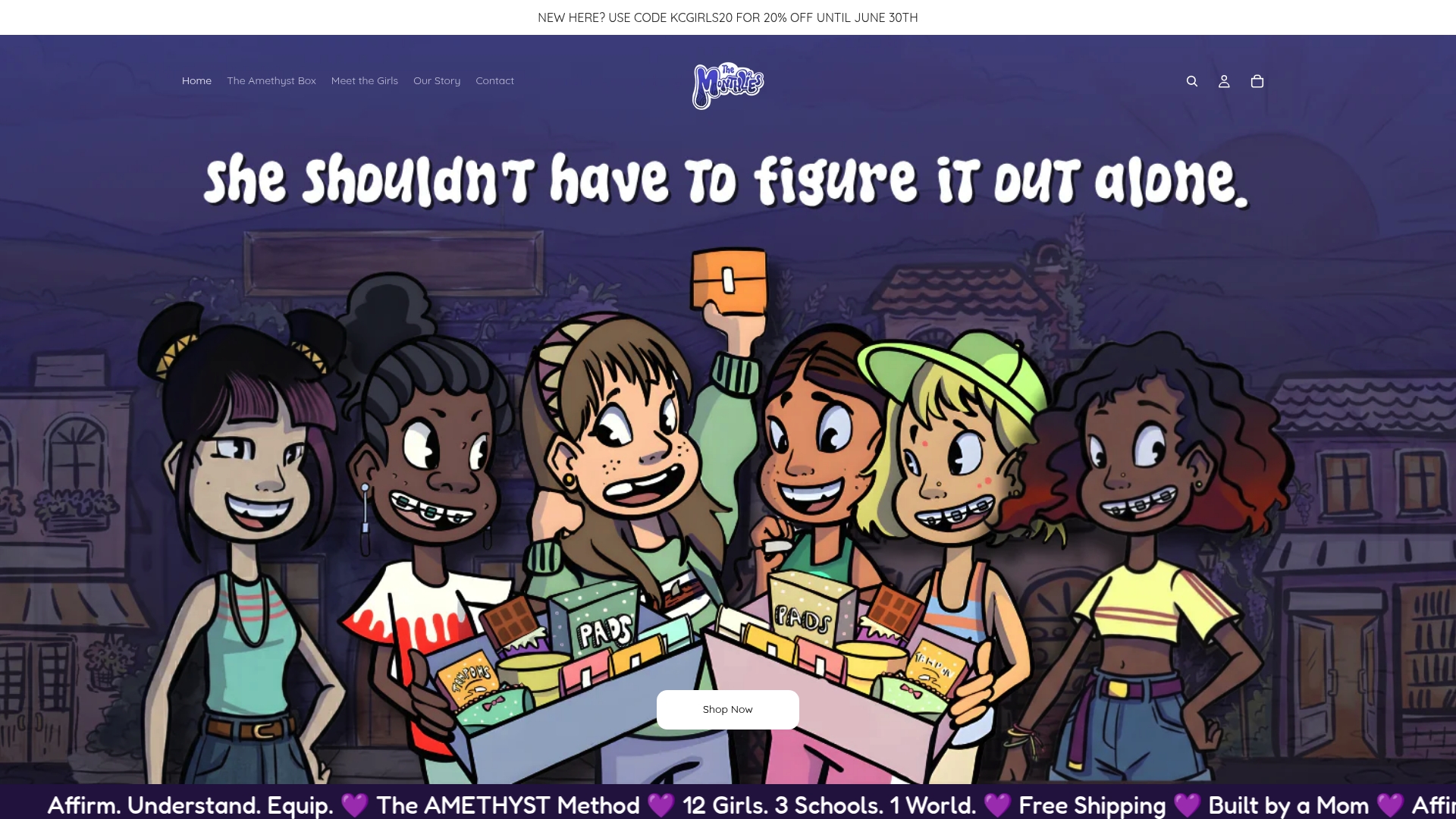
For multiple classrooms or a full pilot, the On-The-Go Kit is a compact, portable option that travels easily between rooms or buildings. Bulk and educator orders are welcome. Reach out through the Themonthliesbox website to ask about school pricing and quantities.
Useful sources
- Menstrual Health Project Toolkits: Free, medically reviewed PDFs for under-18s. Covers cycle basics, product options, and health conditions. Best first download for any library.
- Office on Women’s Health — Menstrual Cycle: Federal guidance on normal cycles and period problems. Use for red flag criteria and clinician referral language.
- Office on Women’s Health — Resources: Aggregates CDC, NIH, and FDA materials. Useful for multilingual handouts and authoritative sourcing.
- Project Local Access — The Flow Initiative: Community toolkit with outreach email templates, period poverty definitions, and pilot guidance. Medically reviewed; community-tool focused.
- MH Hub: Knowledge base connecting research, education, policy, and equity. Useful for educators who want policy-aligned or research-backed materials.
- USOW Period Poverty Library Toolkit: Advocacy framework with guidance on using local data to secure administrative approval.
0 comments