

A first period conversation guide is a structured approach parents use to prepare their daughters for menstruation with accurate information, emotional support, and practical readiness. Menstruation, the medical term for a monthly cycle where the uterus sheds its lining when pregnancy has not occurred, typically begins between ages 11 and 14 and lasts 3 to 5 days. The way you frame this milestone shapes how your daughter feels about her body for years to come. This guide gives you the words, timing, and tools to make that conversation count.
First period conversation guide explained: when and how to start
The right time to begin talking about periods is before your daughter gets hers. Physical signs like breast development, pubic hair growth, mood changes, and mild vaginal discharge typically appear 6 to 12 months before menarche. That window is your signal. If you wait until her first period arrives, you have missed the preparation phase entirely.
The average first period in the US happens around age 12, with a normal range of 10 to 15. That means some girls are ready for this conversation as early as age 9. Starting early does not mean overwhelming her with biology. It means planting seeds of comfort so the topic feels normal, not alarming.
Here is how to set the stage for a first menstruation discussion that actually works:
- Choose a low-pressure moment. A car ride, a walk, or a quiet evening at home works better than a formal sit-down. Relaxed settings reduce the feeling that something serious or scary is happening.
- Start with what she already knows. Ask open questions like “Have you heard anything about periods at school?” This surfaces misinformation early and tells you exactly where to begin.
- Use anatomically correct terms. Words like “uterus,” “menstruation,” and “menstrual cycle” normalize the body without shame. Neutral, correct-term conversations reduce stigma and prepare kids more effectively than vague or euphemistic language.
- Keep early talks short. One focused conversation of 10 to 15 minutes is more effective than a marathon session. You can always come back to it.
- Let her lead the pace. If she shuts down or changes the subject, that is fine. Acknowledge it and leave the door open for next time.
Pro Tip: If you feel awkward starting the conversation, say so. Telling your daughter “This might feel a little funny to talk about, but it matters to me that you feel ready” models honesty and makes the whole exchange feel more human.
Understanding why first period age varies can also help you calibrate when to start. Genetics, body weight, and stress all play a role, so there is no single right age for every girl.
What to actually cover in the first period talk
A strong first period conversation starter guide covers biology, hygiene, emotions, and safety signals. You do not need to cover everything in one sitting, but you do need to cover all of it eventually. Here is a numbered framework to work through across one or more conversations:
- What a period is and why it happens. The uterus builds up a lining each month in preparation for a possible pregnancy. When pregnancy does not occur, that lining sheds as blood through the vagina. This is healthy, normal, and not a sign that anything is wrong.
- What to expect physically. Periods typically last 3 to 5 days. Flow can be light, moderate, or heavy depending on the day. Mild cramping, bloating, and lower back discomfort are common, especially in the first year.
- Menstrual hygiene products and how to use them. Walk through pads, period underwear, and tampons. Explain how often to change each one and where to dispose of them. Hands-on familiarity removes the panic of figuring it out alone in a school bathroom.
- Safety signals that need a doctor’s attention. Heavy bleeding that soaks a pad within one hour or severe pain that disrupts daily life warrants a pediatrician visit. Knowing this distinction prevents both unnecessary fear and delayed care.
- Why irregular cycles are normal at first. Cycles may take up to two years to regulate after menarche. A period that skips a month or arrives early is not automatically a problem.
- How to track her cycle. A simple period tracking app or a paper calendar helps her recognize her own patterns and gives her a sense of control over her body.
Here is a quick comparison of the most common menstrual hygiene products to help you explain the options clearly:
| Product | Best for | Key consideration |
|---|---|---|
| Pads | First-time users | Easy to use, no insertion required |
| Period underwear | Backup or light days | Reusable, comfortable for beginners |
| Tampons | Active days, swimming | Requires comfort with insertion; not recommended for very young beginners |
| Menstrual cups | Older teens | Eco-friendly but has a learning curve |
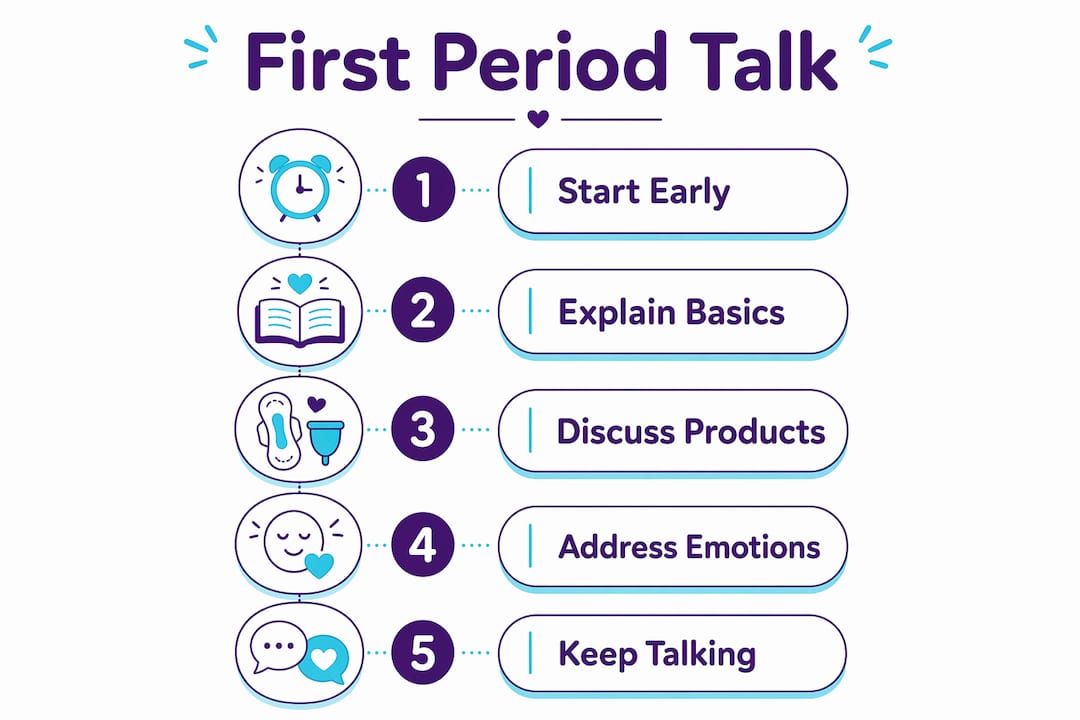
Covering how to talk to your daughter about periods with this kind of structured clarity gives her confidence instead of confusion.
How to handle emotions and keep the conversation going
Hormonal changes before the first period cause mood swings and emotional sensitivity. Your daughter may feel embarrassed, excited, anxious, or all three at once. Dr. Brytanie Marshall at Geisinger notes that calm, informed parents directly shape their daughter’s confidence through open conversation. Your tone is the most powerful tool you have.
Understanding emotional responses to the first period helps you respond without judgment. Here is how to keep the dialogue open and supportive:
- Validate every feeling. If she says she is embarrassed, do not dismiss it. Say “That makes sense. A lot of girls feel that way at first.” Validation builds trust faster than reassurance alone.
- Avoid making it a lecture. Ask more than you tell. “What questions do you have?” invites her into the conversation instead of positioning her as a passive listener.
- Adjust depth based on her maturity. A 9-year-old needs simple, calm facts. A 12-year-old may want more detail about symptoms, products, and what happens at school. Avoiding overwhelming detail and building on what she already knows reduces awkwardness for both of you.
- Offer trusted resources. Books like The Care and Keeping of You by American Girl, period tracking apps, and age-appropriate websites give her somewhere to go when she has questions she is not ready to ask out loud.
- Check in regularly. A single conversation is a starting point, not a finish line. A casual “How are you feeling about everything we talked about?” every few weeks keeps the door open.
Pro Tip: If your daughter shuts down during the talk, do not push. Say “We can come back to this whenever you’re ready” and follow through. Consistency matters more than completion.
Talking about periods from her perspective, not just yours, is what turns a one-time talk into an ongoing relationship of trust.
Practical steps to prepare your daughter before her first period
Preparation is what separates a daughter who panics at school from one who handles it with confidence. The practical side of period readiness is just as important as the emotional side.
- Build a first-period emergency kit together. A small pouch for her backpack should include at least two pads or a piece of period underwear, a spare pair of underwear, individually wrapped wipes, and a small pain reliever if age-appropriate. Walking her through the kit and practicing how to use each item removes the guesswork when it matters most.
- Show her, do not just tell her. Open a pad, demonstrate how it attaches to underwear, and explain how often to change it. Hands-on practice at home builds muscle memory she can rely on when she is nervous.
- Teach comfort measures for cramps. A heating pad on the lower abdomen, gentle movement like walking or yoga, and staying hydrated all reduce discomfort. Establishing a period self-care routine early gives her tools she will use for years.
- Plan for school scenarios. Talk through what to do if her period starts during class. Knowing she can go to the nurse, ask a trusted teacher, or use her kit independently removes the fear of being caught off guard.
- Model a positive attitude. How you talk about your own period shapes how she thinks about hers. Neutral or positive framing, “It is just part of how our bodies work,” communicates that this is manageable, not shameful.
- Schedule a well-child visit. A pediatrician check-in around age 10 to 11 gives her a chance to ask medical questions in a safe, professional setting and gives you a baseline for her health.
Knowing what to expect on her first period day helps both of you feel ready, not reactive.
Key takeaways
A first period conversation done well is not a single talk. It is a series of short, honest, and warm exchanges that build your daughter’s confidence over time.
| Point | Details |
|---|---|
| Start early | Begin conversations around age 9 to 10, before physical signs appear. |
| Use correct terms | Words like “uterus” and “menstruation” normalize the body and reduce stigma. |
| Cover safety signals | Teach her to recognize heavy bleeding or severe pain that needs medical attention. |
| Build a kit together | A school emergency kit with pads, wipes, and spare underwear prevents panic. |
| Keep talking | One conversation is a starting point. Regular check-ins build lasting trust. |
Why I believe the first talk is just the beginning
From everything I have seen working with parents and girls through Themonthliesbox, the biggest mistake parents make is treating the first period talk as a single event to get through. They prepare, they have the conversation, they feel relieved, and then they stop. But girls do not stop having questions. They just stop asking them out loud.
The parents who make the biggest difference are the ones who stay curious. They ask follow-up questions weeks later. They leave a book on the nightstand without making it a big deal. They say “I had cramps today too” at dinner and move on. Those small, unremarkable moments are where real body confidence gets built.
I also think we underestimate how much a daughter reads her parent’s comfort level. If you are tense and formal, she learns that periods are something to be tense and formal about. If you are calm and matter-of-fact, she learns that this is just part of life. You do not have to be perfect. You just have to keep showing up.
The goal is not one great conversation. The goal is a daughter who knows she can come to you with any question, at any age, without fear of judgment. That starts here, with this first talk, and it grows from there.
— Themonthliesbox
Ready to make preparation feel like a gift?
At Themonthliesbox, we believe your daughter deserves more than a pamphlet and a pad. The Amethyst Method, built around affirm, understand, and equip, is the heart of everything we create.
The Amethyst Box is a first period experience kit designed to give your daughter affirmations, educational materials, and practical supplies all in one thoughtfully curated package. For families who want to go further, the Monthlies Deluxe Box adds comfort essentials and a 40oz tumbler to the mix. If she needs something she can carry every day, the On-The-Go Kit keeps her prepared at school and beyond. Every product is parent-approved, girl-centered, and built to make this milestone feel supported, not scary.
FAQ
When should I start talking to my daughter about periods?
Start conversations around age 9 to 10, or earlier if you notice physical signs like breast development or mood changes. Early, calm discussions reduce fear and correct misinformation before it takes hold.
What words should I use when explaining menstruation?
Use anatomically correct terms like “uterus,” “menstruation,” and “menstrual cycle.” Neutral, accurate language normalizes the body and removes the shame that vague or euphemistic terms can accidentally create.
How do I know if my daughter’s period symptoms are normal?
Mild cramping, light to moderate flow, and irregular cycles in the first two years are all normal. Seek a pediatrician’s advice if she soaks a pad within one hour or experiences pain that disrupts her daily activities.
What should go in a first-period emergency kit for school?
A school kit should include at least two pads or a piece of period underwear, a spare pair of underwear, individually wrapped wipes, and an age-appropriate pain reliever. Practicing how to use each item at home builds confidence for when she needs it on her own.
What if my daughter refuses to talk about her period?
Keep the door open without forcing it. Say “I’m here whenever you’re ready” and follow through with casual check-ins over time. Ongoing, open dialogue matters more than a single perfect conversation, and consistency builds the trust that eventually gets her talking.
0 comments