

If your child gets their period at school, the single most important step is this: have them go directly to the school nurse or a private restroom, use a pad or a folded paper towel as a temporary option, and know that everything is going to be okay.
Here’s your quick action plan by phone:
- Reassure her first. Keep your voice calm. Say, “This is completely normal. You’ve got this.”
- Direct her to the nurse or nearest restroom. The nurse’s office is always a safe, private space.
- Ask if she has her kit. If she carries the Monthlies On-The-Go Kit or a small pouch in her backpack, she’s already set.
- Arrange a change of clothes or pickup if needed. A quick locker stop or a parent drop-off solves most stain situations.
- Offer a pain relief plan if it’s pre-approved. If the school nurse has ibuprofen on file, remind her to ask.
- Debrief later with praise. That evening, tell her she handled it well. That moment matters more than you think.
Nemours KidsHealth recommends that students carry at least one pad in their backpack before their period starts, and the NHS guidance on starting periods confirms that most girls start between ages 9 and 16, with many experiencing their first period by approximately age 12. School is one of the most common places it happens. Preparing now means she won’t be caught off guard.
Table of Contents
- What should you pack in a school period kit?
- How do you talk with your child so she feels ready?
- What should your child do when her period starts at school?
- How do you work with the school to support your child?
- When should you call the doctor?
- Key Takeaways
- Why dignity and small rehearsals matter more than any single product
- The Monthlies makes first-period prep simple and supportive
- Useful sources for U.S. parents
What should you pack in a school period kit?
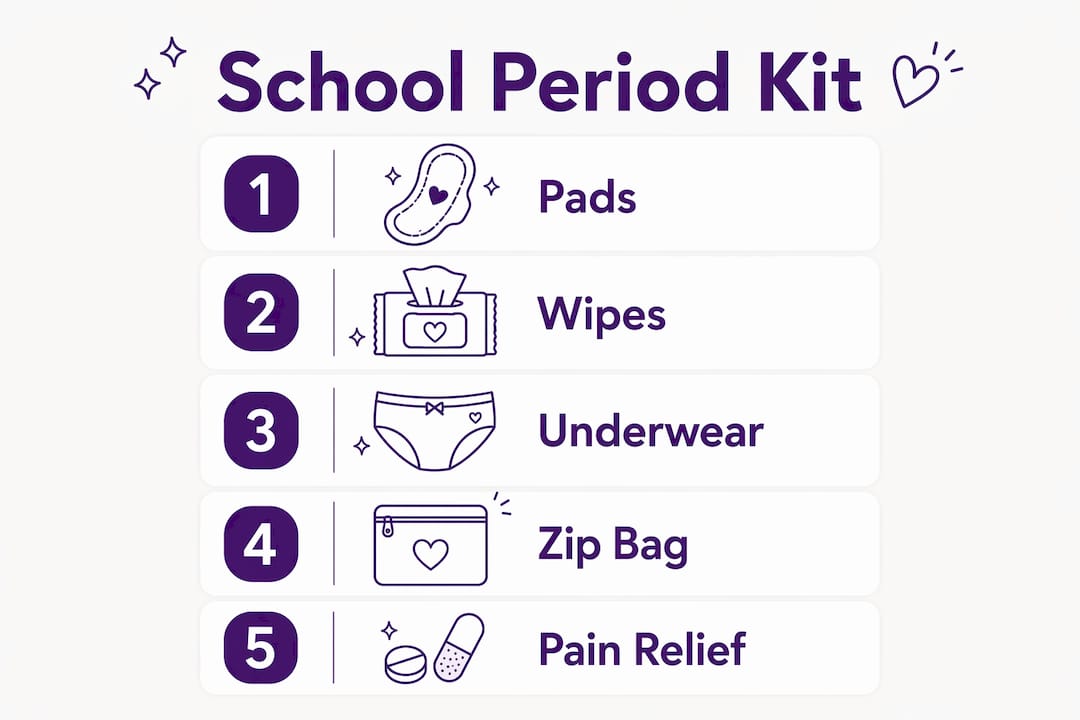
A good school period kit solves one problem: your child should never feel stranded. Check out this period bag must-haves list for a full breakdown, but here’s the core:
- Pads in various absorbencies
- A panty liner for lighter days or as backup
- Period underwear as a comfortable, leak-proof layer
- Individually wrapped wipes
- A sealable zip bag for used items
- One spare pair of underwear
- A small, discreet pouch to hold everything
- Pain relief (ibuprofen or acetaminophen, if school policy allows)
- Optional: a spare pair of dark leggings or shorts
For reusable products, the care routine is simple: store used period underwear or reusable pads in a sealed zip bag until she gets home, then rinse in cold water before washing. No drama, no odor issues.
| Kit Type | Problem It Solves | Portability | Age Fit | What’s Included |
|---|---|---|---|---|
| Emergency single-use kit | Unprepared first period | Fits in a pencil case | Any age | Pads, liner, wipes, spare underwear |
| Reusable-friendly kit | Ongoing comfort + sustainability | Slightly bulkier | Tweens ready for reusables | Period underwear, zip bag, wipes |
| Ready-made on-the-go kit | Everything in one, no assembly | Compact, school-bag ready | Tweens and teens | Supplies + educational support + comfort items |
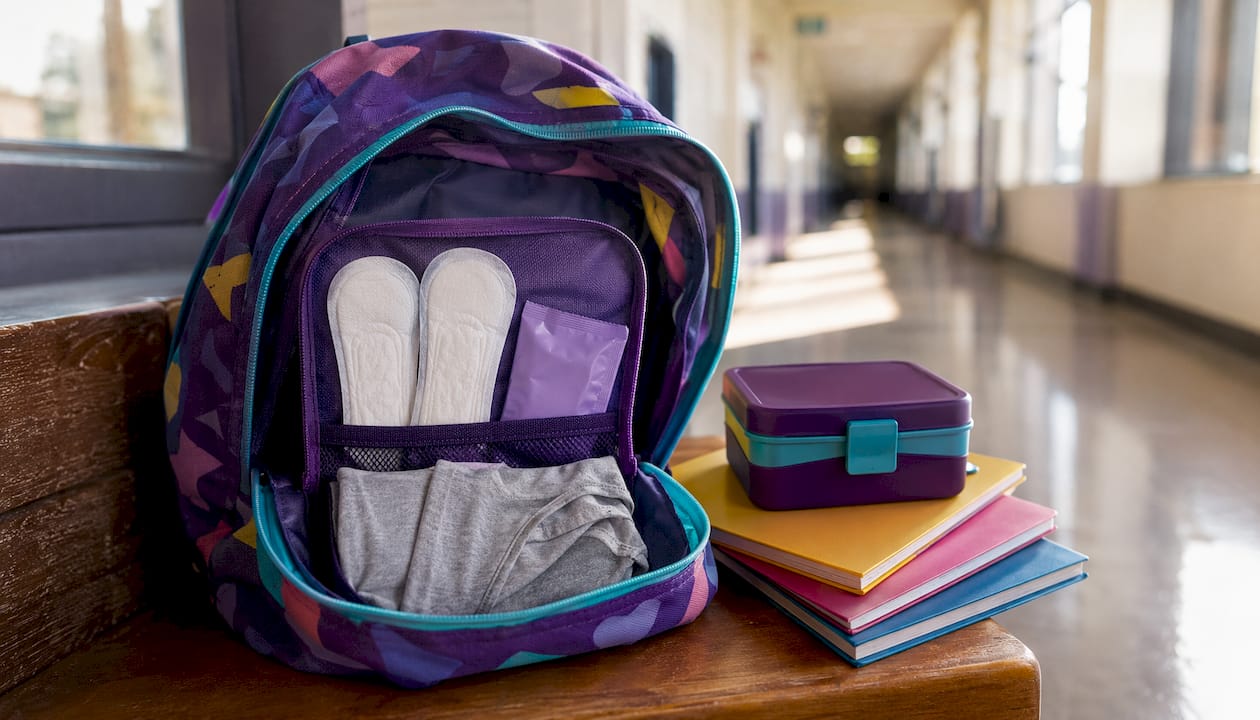
For a beginner tween, keep it simple: two pads, one liner, wipes, and a spare pair of underwear in a small zip pouch. That’s enough for most school days.
For an active teen who plays sports or has PE, period underwear worn under shorts is a game-changer. Add a backup pad and a change of bottoms in her gym bag.
For the low-maintenance student, a ready-made kit like The Monthlies On-The-Go Kit removes all the guesswork. Everything is already sized for tweens and packed discreetly.
How do you talk with your child so she feels ready?
The NHS recommends that caregivers have early, ongoing conversations using clear anatomical language, not just one big “talk.” That ongoing normalizing is what actually reduces shame and builds confidence.
Start simple and start early. You don’t need a formal sit-down. A quick conversation while folding laundry or driving to school works just as well.
That’s it. Short, clear, no drama. Use the word “uterus.” Use the word “period.” The more matter-of-fact you are, the more matter-of-fact she’ll be.
Run a four-step role-play at home:
- Set the scene. “Pretend you’re in math class and you feel something. What do you do first?”
- Practice the bathroom ask. “Excuse me, may I use the restroom?” That’s the whole script.
- Practice the teacher or nurse ask. “I need to go to the nurse. I’m not feeling well.” She doesn’t owe anyone details.
- Debrief together. Ask what felt awkward, what felt easy. Praise her for practicing.
For more talking points and scripts, Themonthliesbox’s guide on supporting your daughter’s first period walks through this in detail.
What should your child do when her period starts at school?
The immediate answer: excuse herself quietly, go to the nurse or restroom, and change into a pad or period underwear. If she’s in pain, the nurse can help.
Here’s the step-by-step she can memorize:
- Excuse yourself quietly. No explanation needed.
- Go to the nurse’s office or the nearest private restroom.
- Change your product. Use what’s in your kit, or ask the nurse for a pad.
- Dispose of used items in the provided bin or seal them in your zip bag.
- If there’s a stain, rinse with cold water and soap right away. Hot water sets blood stains.
- Tie a sweatshirt around your waist if you need extra coverage walking back to class.
- Return to class. You handled it.
Pro Tip: Have her stash a small go-bag in her locker, not just her backpack. That way, if her bag is in a classroom and she can’t get to it, she still has supplies nearby.
If she doesn’t have supplies and there’s no nurse available, a thick fold of toilet paper works as a short-term pad until she can get proper help. It’s a real solution, not a last resort to be embarrassed about.
For reusable products, used items go straight into the sealed zip bag in her kit. She washes them at home with cold water before laundering. That’s the whole routine.
How do you work with the school to support your child?
Schools can and should provide discreet access to period supplies and bathroom access. The Oregon Department of Education’s Menstrual Dignity Toolkit offers one of the most thorough U.S. frameworks for inclusive, dignity-first menstrual support in schools, covering access, privacy, and gender-affirming practices.
Here’s a simple email template you can adapt:
“Dear [School Nurse / Counselor Name], I wanted to let you know that my child, [Name], may be starting their period soon. I’d love to confirm that they can visit the nurse’s office discreetly if needed, and that period supplies are available. Please let me know the best process for them to follow. Thank you.”
| Who to contact | What to ask for |
|---|---|
| School nurse | Supply access, nurse visit protocol, pain relief plan |
| School counselor | Emotional support, private check-in space |
| Homeroom or trusted teacher | Quiet bathroom pass, no-questions-asked policy |
| Principal | School-wide supply access or policy questions |
Staff attitudes matter. When teachers treat period products as basic school supplies, students report feeling more dignity and less anxiety. If your school doesn’t have a clear policy, you have every right to ask for one.
For trans, non-binary, or gender-questioning students, the ODE toolkit specifically recommends neutral dispensers, private access options, and staff training so no student has to out themselves to get supplies. Inclusive language, like “period products” instead of “feminine hygiene products,” is a small shift that makes a real difference. Themonthliesbox’s guide on supporting students’ first period at school covers this further.
When should you call the doctor?
Contact your pediatrician if your child soaks through a pad or tampon in under an hour, if cramps stop her from normal activities, or if symptoms include fever or fainting.
Red flags to act on:
- Bleeding so heavy it soaks through protection in less than an hour
- Cramps severe enough to keep her home from school regularly
- Fainting or significant dizziness
- Fever alongside heavy bleeding
- First period before age 8
- Bleeding that lasts longer than 7 days consistently
Call the pediatrician for any of the above. Go to urgent care or the ER if she faints, has a fever above 101°F with heavy bleeding, or is in severe pain that doesn’t respond to over-the-counter medication. Tracking her cycle in a simple app or notebook gives the doctor useful context at the appointment.
Key Takeaways
A prepared child handles her period at school with calm and confidence. The most effective approach combines a packed kit, one practiced script, and a school contact who knows she may need help.
| Point | Details |
|---|---|
| Pack the kit now | Include pads, wipes, spare underwear, a zip bag, and pain relief in a small pouch. |
| Practice one script | “May I go to the nurse?” is all she needs. Role-play it once before school starts. |
| Contact the school | Email the nurse or counselor in advance so your child has a named, trusted adult. |
| Know the red flags | Call the pediatrician if cramps keep her home or she soaks through a pad in under an hour. |
| Themonthliesbox Amethyst Box | A ready-made kit with supplies, affirmations, and educational materials built for tweens. |
Why dignity and small rehearsals matter more than any single product
Most period anxiety at school comes from one thing: not knowing what to do next. It’s not the blood. It’s the blank moment of “now what?” That’s exactly what a small rehearsal fixes.
The Amethyst Method at Themonthliesbox is built around three moves: affirm, understand, equip. Affirm that her body is doing something normal and good. Help her understand what’s happening in clear, honest language. Equip her with the practical tools to handle it. In that order, every time.
A ready-made kit removes friction for busy caregivers. But a DIY kit built together at home can be just as powerful, because the act of packing it together is itself a conversation. Either way, the goal is the same: she walks into school feeling prepared, not scared.
The Monthlies makes first-period prep simple and supportive
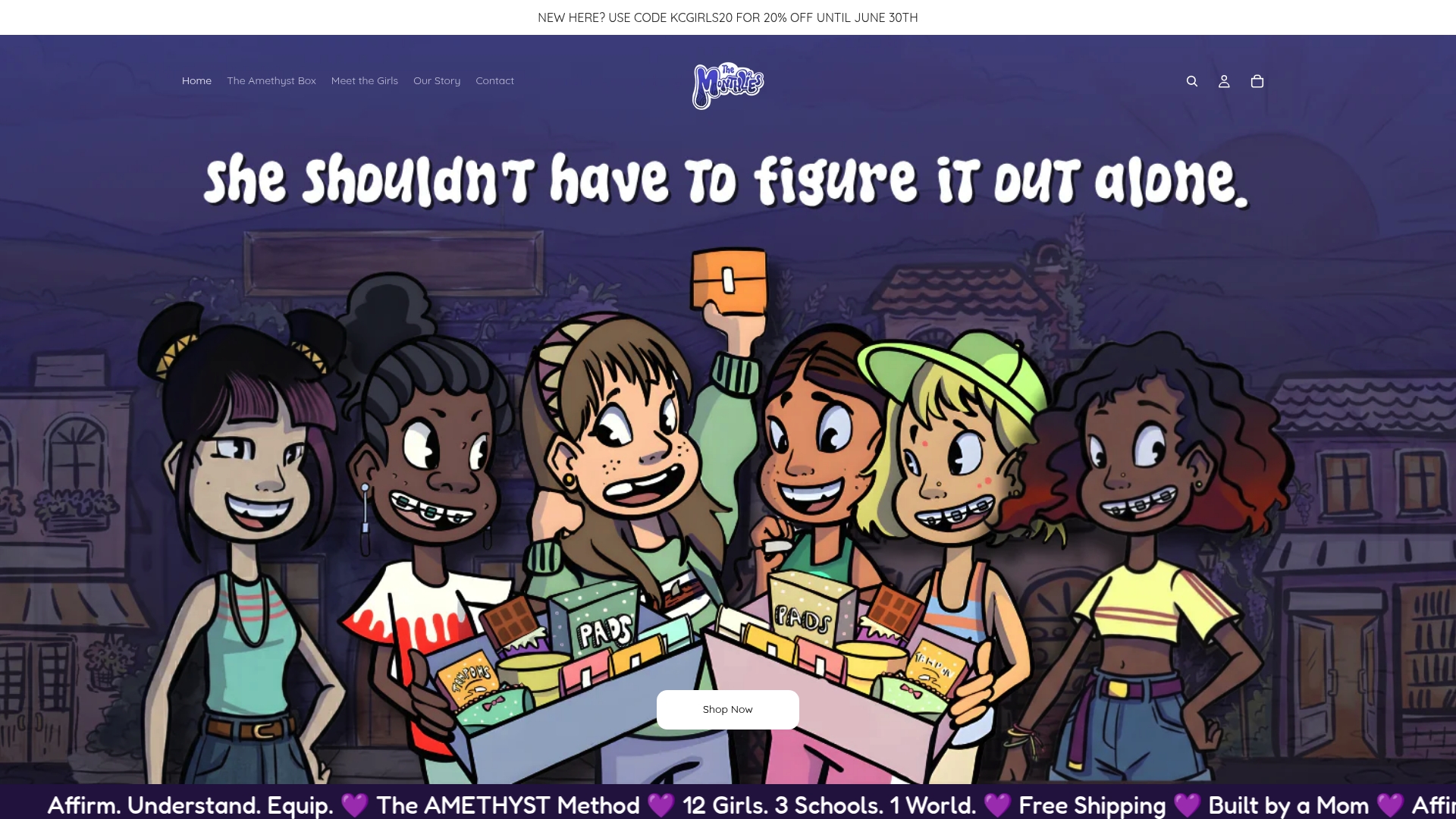
The Amethyst Box from Themonthliesbox was designed for exactly this moment: a tween who might get her first period at school and a caregiver who wants her to feel ready, not rattled. It combines tween-sized period supplies, affirmation cards, educational materials, and comfort items in one discreet, ready-to-go package built around the Amethyst Method.
The On-The-Go Kit is the school-bag solution: compact, portable, and stocked with everything she needs for a school-day emergency. For caregivers who want a fuller self-care bundle, the LavenHaven Care Package adds comfort and emotional support items that go beyond just period supplies.
These kits suit busy parents, gift-givers, and anyone who wants a done-for-you option that covers supplies, education, and emotional support in one place. If you’d rather build your own kit, everything in this guide gives you the list. But if you want it handled, Themonthliesbox has you covered. Visit themonthliesbox.com to find the right kit for your daughter.
Useful sources for U.S. parents
If you need to escalate with your school, state education department toolkits like the Oregon DOE Menstrual Dignity Toolkit carry the most weight in conversations with administrators.
- Nemours KidsHealth: Getting Your Period at School — Practical, kid-friendly steps for handling a first period at school; useful to share directly with your child.
- NHS: Starting Your Periods — Clear clinical guidance on what to expect, when to talk, and how to use anatomical language with confidence.
- Oregon Department of Education Menstrual Dignity Toolkit — The most thorough U.S. school policy framework for inclusive, dignity-first menstrual support; cite this when advocating with school administrators.
- Edutopia: How to Build a Menstruation Station at Your School — Teacher-written guide on making period products a standard school supply; useful for PTA conversations.
- Cyclical School: Teacher Guide to Supporting Menstruating Students — Covers staff training, bathroom access, and how teacher attitudes shape student dignity.
- Clue/HelloClue: Getting Your Period at School — Practical tips on stain removal, go-bag strategy, and reusable product care for school days.
- Patient.info: How to Manage Your Period in School — Age-of-onset context and general management tips; good background reading for caregivers.
- Self-Care Categories Students Need for Real Balance — Broader student self-care framework that puts period prep in context alongside mental and physical wellness.
This article is general information for caregivers and is not a substitute for medical advice. For symptoms that concern you, confirm current guidance with your child’s pediatrician or a qualified health professional.
0 comments