

Tracking your menstrual cycle after your first period means recording the start dates and flow details of each period to understand your body’s unique pattern and predict future periods. This practice, formally called menstrual cycle tracking, gives you real information about your health instead of guesses. The first period cycle can feel confusing, but knowing what to watch for makes it far less stressful. Girls typically get their first period between ages 9 and 15, with the average around age 12, and cycles take 1–2 years to settle into a regular pattern.
How to track your cycle after your first period: what you need to know first
The menstrual cycle is counted from the first day of actual bleeding to the first day of the next period. That count is your cycle length. For adults, a normal cycle runs 21–35 days. For young girls just after their first period, normal range widens to 21–45 days. That wider range is not a sign that something is wrong.
The reason cycles vary so much early on comes down to biology. The hypothalamic-pituitary-ovarian (HPO) axis, the hormonal system that controls your cycle, is still maturing in the first year or two after menarche. The Merck Manual confirms that this irregularity is a normal developmental phase, not a health problem. Bleeding itself typically lasts 2–7 days per cycle.
Here is what a normal early cycle looks like:
- Cycle length: 21–45 days between periods
- Bleeding duration: 2–7 days per period
- Flow: can range from light to moderate to heavy across different cycles
- Symptoms: cramping, bloating, mood shifts, and fatigue are all common
- Variation: two cycles in a row may feel completely different from each other
Knowing this upfront removes a lot of worry. Irregular cycles in the first two years are expected, not alarming.
What tools and basics do you need to start tracking?
Starting menstrual cycle tracking does not require any special technology. A simple calendar or notebook works just as well as an app. The goal is consistency, not complexity.

Tracking multiple cycles accurately requires recording at least 3 consecutive cycles, and ideally 6, before drawing conclusions about your pattern. One cycle tells you very little. Six cycles tell you a lot.
Here is what to record every cycle:
- Day 1: the first day of actual bleeding (not spotting)
- Flow duration: how many days bleeding lasts
- Flow intensity: light, moderate, or heavy for each day
- Symptoms: cramps, headaches, mood changes, fatigue, or bloating
- Any unusual changes: very heavy bleeding, pain that stops daily activities, or cycles shorter than 21 days
| Method | Benefits | Considerations |
|---|---|---|
| Paper calendar | No phone needed, private, simple | Easy to lose, harder to calculate averages |
| Notebook journal | Space for notes and symptoms | Requires manual math for cycle length |
| Period tracking app | Automatic calculations, reminders | Requires a device, some apps ask for personal data |
Pro Tip: Mark Day 1 with a circle or star on your calendar the moment bleeding starts. Do not wait until the end of the day. Accurate Day 1 marking is the foundation of all cycle math.
Tracking is more than counting days. Body literacy means connecting physical and emotional changes to hormonal phases across the full cycle, not just the bleeding days. Girls who track symptoms alongside dates build a much clearer picture of their health over time.
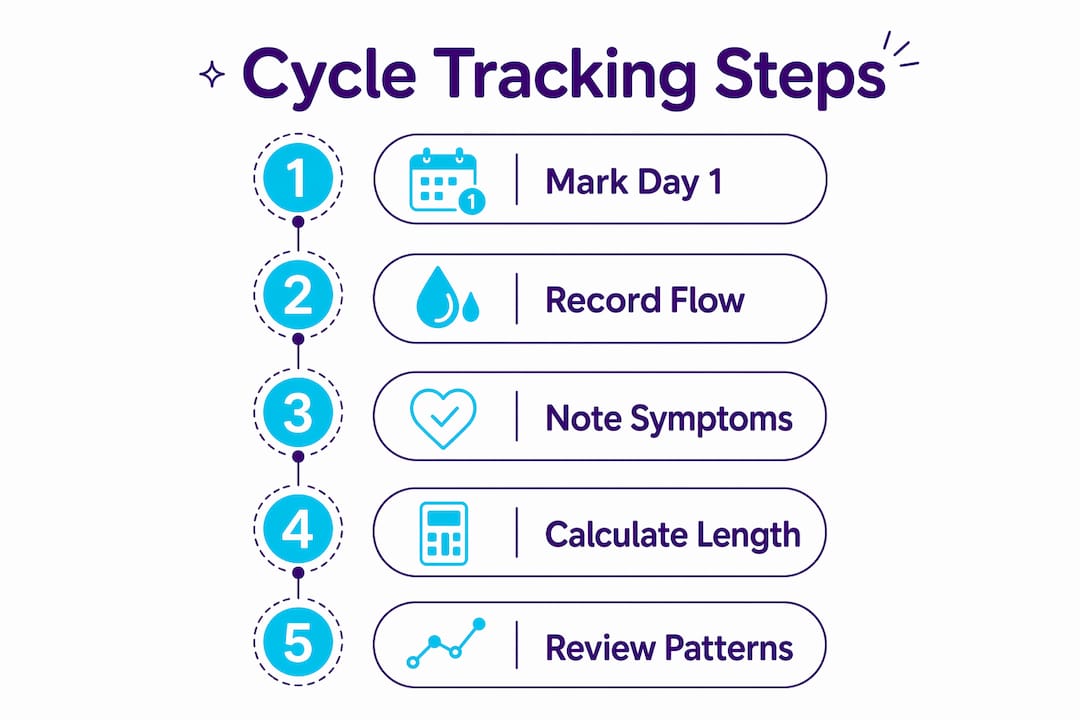
Step-by-step guide to calculating your cycle length
Calculating cycle length is straightforward once you know the method. Follow these steps consistently for accurate results.
- Mark Day 1. The first day of actual bleeding is Day 1 of your cycle. Spotting does not count. Accurate Day 1 marking is the single most important habit in cycle tracking.
- Wait for your next period. When bleeding starts again, mark that date as the new Day 1.
- Count the days between. Count from the first Day 1 up to but not including the second Day 1. That number is your cycle length.
- Example: If your period starts on march 1 and your next period starts on march 29, your cycle length is 28 days.
- Repeat for 3–6 cycles. Add up all your cycle lengths and divide by the number of cycles tracked. That gives your average cycle length.
- Predict your next period. Add your average cycle length to your most recent Day 1. If your average is 30 days and your last period started on april 5, your next period is predicted around may 5.
- Estimate ovulation. The luteal phase is consistently about 14 days long, meaning ovulation happens roughly 14 days before your next period, not 14 days after your last one. For a 30-day cycle, ovulation falls around Day 16.
Pro Tip: Track at least 3 cycles before trying to predict anything. One or two cycles give you data points, not a pattern.
A few things to avoid:
- Do not count spotting as Day 1. Spotting is light pinkish or brownish discharge before actual bleeding begins.
- Do not skip recording a cycle because it felt “normal.” Every data point matters.
- Do not compare your cycle length to a friend’s. Normal varies widely from person to person.
What changes are normal in the first years after your period starts?
Cycle irregularity in the first 1–2 years after menarche is expected. The HPO axis takes time to establish a consistent hormonal rhythm. Cycle lengths ranging from 21 to 45 days during this period reflect development, not disorder.
Common changes you may notice include:
- Cycles that are longer one month and shorter the next
- A period that seems to skip a month entirely
- Flow that is heavier or lighter than previous cycles
- New or changing symptoms like stronger cramps or mood swings
Most of these changes fall within the normal range. Skipped periods in the first two years are common and usually tied to the HPO axis still maturing. Stress, significant weight changes, and intense exercise can also delay a period temporarily.
Tracking helps you tell the difference between a variation that is normal for you and a change that deserves medical attention. A single unusual cycle is rarely a concern. A pattern of unusual cycles is worth discussing with a doctor.
Certain signs do warrant a conversation with a healthcare provider. Bleeding lasting longer than 7 days, very heavy flow that soaks through a pad or tampon every hour, cycles consistently shorter than 21 days, or severe pain that disrupts daily life all deserve professional attention. Tracking gives you the specific details a doctor needs to help you effectively.
Parents play an important role here. Reviewing tracked data together with your daughter, without pressure or alarm, builds trust and keeps communication open. The goal is awareness, not anxiety.
Key takeaways
Tracking your menstrual cycle after your first period requires marking Day 1 accurately, recording flow and symptoms consistently, and tracking at least 3–6 cycles before drawing conclusions about your pattern.
| Point | Details |
|---|---|
| Normal cycle range post-menarche | Cycles of 21–45 days are normal in the first 1–2 years after the first period. |
| Day 1 accuracy matters | Mark the first day of actual bleeding, never spotting, as Day 1 for reliable tracking. |
| Track multiple cycles | Record at least 3 cycles, ideally 6, to find your average length and predict future periods. |
| Ovulation timing | Ovulation occurs roughly 14 days before your next period, not 14 days after your last one. |
| When to seek help | Bleeding over 7 days, very heavy flow, or cycles under 21 days consistently warrant a doctor visit. |
What I have learned from watching girls start their tracking practice
The most common mistake I see is expecting a brand-new cycle to behave like a textbook example. It almost never does. The first period is a beginning, not a finished system. Cycles in the early years are supposed to be irregular. That is the body doing exactly what it should.
What tracking actually gives a young girl is not a perfect prediction. It gives her a relationship with her own body. She starts to notice that she feels tired a few days before her period, or that her mood shifts mid-cycle. That awareness is worth more than any app notification.
For parents, the most supportive thing you can do is track alongside your daughter without making it feel like homework. Look at the calendar together. Ask how she felt this cycle. Keep the tone curious, not clinical. The first period tracking conversation does not need to be perfect. It just needs to happen.
Patience is the real skill here. Give the body 12–18 months before expecting any consistency. In the meantime, every cycle recorded is a data point that builds understanding. That understanding builds confidence. And confidence is what carries a girl through puberty with her head up.
— The
Themonthliesbox is here for every step of this
Starting periods and learning to track them is a lot to take in at once. Themonthliesbox created the Amethyst Box specifically for this moment: a curated first period kit built around affirmations, educational materials, and practical supplies that make the experience feel supported rather than scary.

The Amethyst Box follows the Amethyst Method, covering the affirm, understand, and equip phases so girls feel emotionally ready and practically prepared. Every item inside is chosen to build comfort and confidence, not just manage a period. For girls who want ongoing support, the Bestie Bundle offers two boxes at a savings, making it easy to share the experience with a friend. Visit Themonthliesbox to find the right fit for your daughter’s needs.
FAQ
How do I find my cycle length after my first period?
Count from the first day of bleeding in one cycle to the first day of bleeding in the next. That number is your cycle length.
Is it normal for cycles to be irregular after the first period?
Yes. Cycles ranging from 21 to 45 days are normal in the first 1–2 years after menarche as the hormonal system matures.
How many cycles should I track before predicting my next period?
Track at least 3 consecutive cycles, and ideally 6, to calculate a reliable average cycle length for prediction.
When should a parent take their daughter to a doctor about her period?
Seek medical advice if bleeding lasts longer than 7 days, flow is extremely heavy, or cycles are consistently shorter than 21 days.
Can I track my cycle without an app?
A paper calendar or notebook works well. Mark Day 1 each cycle, record flow duration and symptoms, and calculate cycle length by counting days between start dates.
0 comments