

The fastest way to prepare your daughter for her first period is a short, parent-led menstrual health curriculum: three to five calm, focused sessions paired with a practice-ready period kit. You do not need a classroom or a script from a school nurse. You need a plan, a few honest conversations, and the right supplies within reach.
Every solid at-home menstrual health education plan rests on three things:
- Age-appropriate facts delivered in plain, correct language (think “uterus” and “vagina,” not vague euphemisms)
- Short practice activities so your daughter handles products before she needs them
- An on-the-go kit she has already packed herself, sitting in her backpack
The Monthlies Box’s Amethyst Box is built around exactly this sequence. Its Amethyst Method moves through three phases: Affirm, Understand, and Equip, which maps cleanly onto the sessions below. Keep that in mind as you read through the plan.
Pro Tip: You do not have to finish all five sessions in one week. One honest conversation a month, started early, does more good than a single marathon talk the week before her period arrives.
Key Takeaways
Starting a short, structured at-home menstrual health curriculum by age 8, paired with a practice-ready period kit, is the most effective way to prepare your daughter for her first period with confidence.
| Point | Details |
|---|---|
| Start by age 8 | Pediatricians recommend specific puberty talks around age 8; some girls start periods as early as that age. |
| Three curriculum must-haves | Age-appropriate facts, hands-on product practice, and a packed on-the-go pouch cover the core needs. |
| Red flags to know | Heavy bleeding soaking a pad in under 2 hours, or no period by age 15, warrants a pediatrician call. |
| Small talks beat one big talk | Ongoing micro-conversations are more effective than a single formal “period talk,” per Nemours KidsHealth. |
| Themonthliesbox Amethyst Box | Maps to each curriculum session with tween-sized supplies, affirmation cards, educational materials, and an on-the-go pouch. |
Table of Contents
- When should you start talking about periods with your daughter?
- How to open the period conversation: scripts and language that actually work
- A short at-home menstrual health curriculum you can teach in 3–5 sessions
- What to pack: a practical period-prep kit and an on-the-go pouch checklist
- Practice activities and resources that make these talks easier
- When to call the pediatrician: warning signs that need attention
- Simple ways to normalize ongoing period talks and track early cycles
- Why small, early talks beat one big “period talk”
- The Amethyst Box supports every session in this curriculum
- Sources
When should you start talking about periods with your daughter?
Pediatricians recommend starting general body-basics conversations between ages 5 and 10, and moving into more specific puberty and period talks by around age 8. The average age for a first period is around 12, but some girls may start as early as age 8, which means the window for preparation is shorter than most parents expect.
Watch for these early physical signs, which often precede a first period by 1.5 to 3 years:
- Breast budding or tenderness
- Pubic or underarm hair
- Increased body odor
- A small amount of clear or white vaginal discharge
When any of these appear, move the more specific period conversations up on your calendar. Waiting until she asks is a gamble you do not want to take. For more on why early education matters, why girls need period education is a helpful starting point.
How to open the period conversation: scripts and language that actually work
Experts consistently recommend using clear anatomical words and framing menstruation as a normal developmental milestone. Correct language reduces shame. Vague language creates it.
For younger tweens (ages 7–9): “Your body is going to go through some changes over the next few years. One of them is called a period. It means your uterus is healthy and working the way it’s supposed to. I want to tell you about it so it’s never a surprise.”
For older preteens (ages 10–12): “You may have already heard things about periods from friends or at school. I want to make sure you have the real facts, and I want you to know you can always ask me anything.”
A few dos and don’ts to keep in mind:
- Do use the words “vagina,” “uterus,” and “menstruation” from the start
- Do invite questions by pausing and asking, “What have you heard about this?”
- Don’t dramatize or use language that frames periods as painful or scary by default
- Don’t treat the conversation as a one-time event
Pro Tip: A book, short video, or even a product ad can lower the awkwardness instantly. Let a third-party resource open the door, then follow up with your own words. Talking to your daughter about periods has additional conversation starters you can borrow.
A short at-home menstrual health curriculum you can teach in 3–5 sessions
Each session runs about 25–30 minutes: 10–15 minutes of core teaching, 10 minutes of activity, and 5 minutes for questions or a small homework task.
-
Session 1: Bodies and basics. Cover what a period is, why it happens, and what to expect (flow lasts 3–7 days; early cycles are often irregular). Activity: Draw a simple diagram of the uterus together. Homework: Write down one question to bring back next session.
-
Session 2: Products and practice. Lay out pads, period underwear, and (for older tweens) tampons. Let her open packaging, feel the materials, and ask questions. Letting tweens handle and choose products builds confidence and reduces fear at first use. Activity: Practice applying a pad to a pair of underwear. Homework: Pick a favorite product and put it in her kit. See how to introduce menstrual products for a step-by-step guide.
-
Session 3: Pain management and coping. Explain cramps and PMS symptoms, and walk through practical options: a heating pad on the lower abdomen, gentle movement, staying hydrated, and age-appropriate NSAIDs like ibuprofen when needed. Activity: Set up the heating pad together and practice using it. Homework: Note where the ibuprofen is kept at home.
-
Session 4: Social and emotional topics. Talk about mood changes, what to say to friends, and how to ask a trusted adult for help at school. Role-play: “What would you do if your period started during gym class?” Activity: Practice the exact words she’d use to ask a teacher for a pad.
-
Session 5: Review and kit practice. Pack the on-the-go pouch together, review everything covered, and answer any remaining questions. This is also the right time to involve other caregivers so your daughter hears a consistent message from everyone she trusts.
Pro Tip: If your family includes nonbinary or trans kids, use body-neutral language like “people who menstruate” alongside daughter-specific language where appropriate, and follow your child’s lead on what feels comfortable.
What to pack: a practical period-prep kit and an on-the-go pouch checklist
A well-stocked kit means a first period never becomes a crisis. Clinicians recommend both an at-home supply and a compact pouch for school or activities.
At-home kit:
- Pads in various absorbencies including light, regular, and overnight
- Period underwear as a backup option
- Unscented wipes
- A small zip bag for soiled items
- A heating pad
- Ibuprofen or naproxen (with dosage guidance reviewed together)
- Comfort items: a cozy blanket, her favorite snack, a small journal
On-the-go pouch (backpack or locker):
- 1–2 pads (regular absorbency)
- One pair of spare underwear in a small bag
- A travel-size pack of unscented wipes
- A small zip bag for disposal
- A short handwritten note with quick instructions, in her own words
Pro Tip: Pack the pouch together during a calm, unhurried moment. When she assembles it herself, she remembers what’s in it and feels ready rather than anxious.
Practice activities and resources that make these talks easier
Third-party resources reduce awkwardness by giving both of you something neutral to react to instead of each other. Use these six activities across your sessions:
- Product touch-and-feel: Open packages, compare sizes, and let her ask anything without pressure.
- “What if” scenarios: “What would you do if your period started at a sleepover?” Walk through it together.
- Guided reading: Read a chapter of an illustrated puberty book side by side, then discuss one thing that surprised her.
- Short video + discussion: Watch a short educational video, pause it, and ask what questions it raised.
- Packing relay: Time how fast she can pack her on-the-go pouch from memory. Make it low-stakes and even fun.
- Call-and-response Q&A: You ask a question, she answers; then she asks one back. Keeps it a conversation, not a lecture.
For role-play scripts and common worries, first period worries addressed covers the questions tweens most often ask but feel too embarrassed to say out loud.
When to call the pediatrician: warning signs that need attention
Most period symptoms are normal. A few are not. Contact your daughter’s pediatrician if you notice any of the following:
- No period by age 15, even with other pubertal signs present
- Very heavy bleeding: soaking a pad or tampon in under 2 hours, or passing large clots
- Severe cramps that stop her from attending school or normal activities, and do not respond to ibuprofen
- A gap of more than 3–6 months between periods after cycles have already established
- Fever, unusual discharge, or pelvic pain outside of her period
When you call, bring a short log: how many days her period lasted, how many products she used per day, and how many school days she missed. That information helps the pediatrician assess whether a referral to a gynecologist or further testing is needed.
Simple ways to normalize ongoing period talks and track early cycles
Tracking does not have to be complicated. A paper calendar with a small dot on period-start days is enough for the first year. Teen-friendly apps like Clue or Flo work well for older tweens who prefer a phone. The goal is a record she can share with her doctor, not a perfect data set.
A simple check-in rhythm for the first few cycles:
- Week 1 of each new cycle: Ask how she felt, what helped, and what she’d change about her kit.
- After cycle 3: Review the pattern together. Is it roughly regular? Are cramps manageable?
- Ongoing: Monthly or as-needed check-ins, keeping the door open without making it a formal event.
For school preparedness, cover these three things before the school year starts:
- Where her supplies are stored (locker, backpack, nurse’s office)
- Which trusted adult she’d go to if she needed help
- A private signal she can use with you if she needs supplies sent to school quickly
Why small, early talks beat one big “period talk”
The single biggest mistake parents make is saving everything for one formal conversation. Nemours KidsHealth notes that small, ongoing conversations triggered by everyday moments, like a shopping trip or a TV show, are far more effective than a single sit-down talk. Your daughter absorbs information better when it arrives in pieces she can process, and she learns that periods are something she can talk to you about anytime, not a topic that gets one awkward evening and then disappears.

Involving other caregivers matters too. When a grandmother, aunt, or co-parent uses the same language and the same calm tone, your daughter gets a consistent message: this is normal, you are supported, and you are not alone. That consistency is what builds real confidence, not any single conversation.
The Amethyst Box supports every session in this curriculum
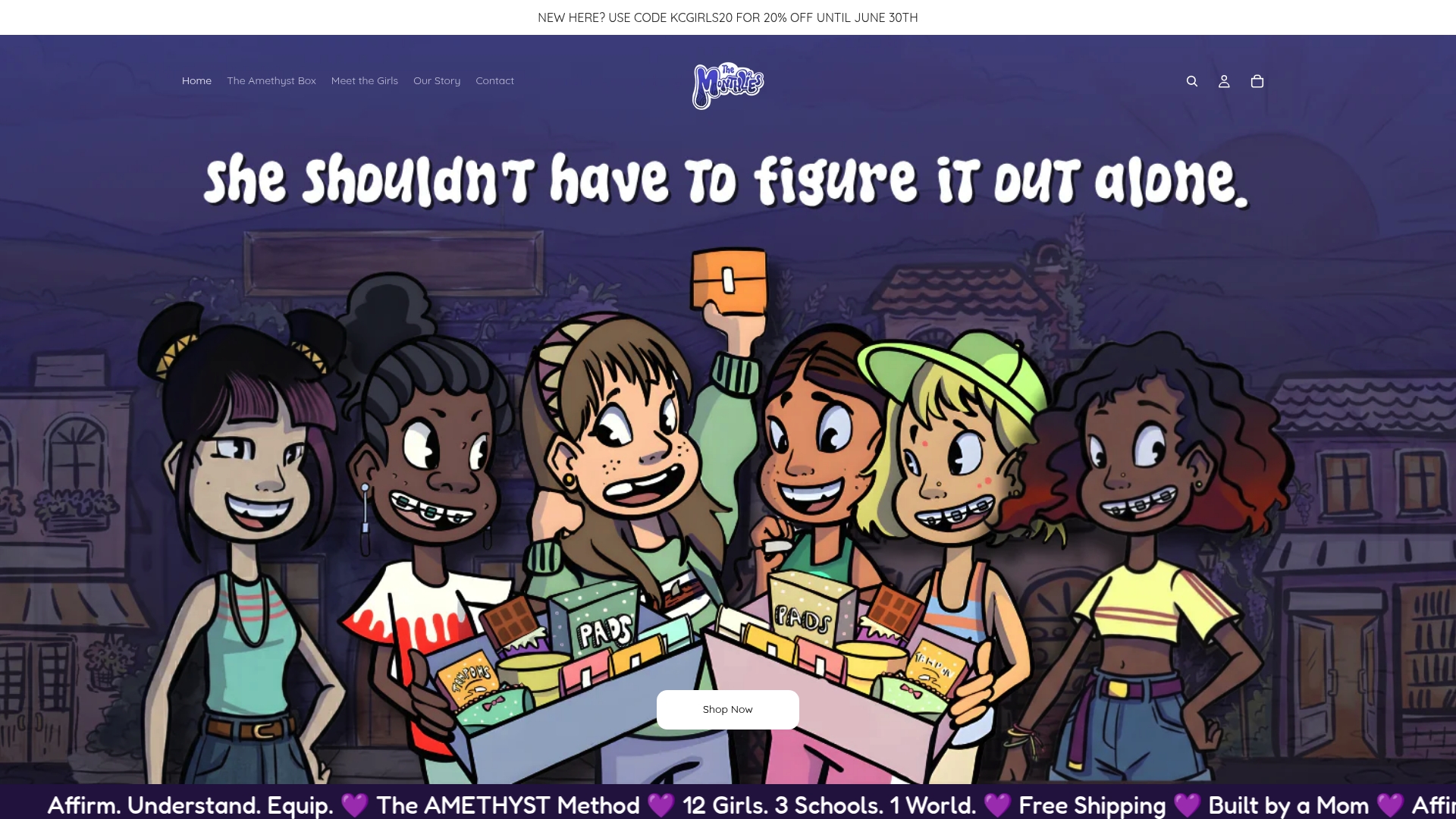
The Amethyst Box by Themonthliesbox is built to map directly onto the at-home curriculum above. It includes tween-sized period supplies for Session 2’s product practice, affirmation cards that support the emotional and social conversations in Session 4, educational materials that reinforce the body-basics content from Session 1, and a ready-made on-the-go pouch for Session 5’s kit practice. Everything arrives curated and sized for a tween, so you are not hunting down five separate items from five different stores.
Parents who want a fuller self-care experience can also explore The Monthlies On-The-Go Kit for a compact, backpack-ready option. Preview the Amethyst Box and see exactly what’s inside before you order.
Sources
- Talking to Your Child About Periods | Nemours KidsHealth
- How to prepare your daughter for her first period | Marshfield Clinic Health System Shine365
- How to discuss puberty with your child | Children’s Health
- Signs Your Child Is About To Start Her First Period | Mayo Clinic Press
- Navigating Periods: Advice For Parents | The Well by Northwell
This article is general information, not a substitute for advice from a qualified doctor. Consult a qualified healthcare professional about your own circumstances before acting on anything here.
0 comments