

Start early, use concrete language, and pair sensory-friendly adaptations with predictable routines. Puberty typically begins between ages 8 and 13 in girls, so age-appropriate conversations should start around 6 to 8. Add social stories, sensory-tested period products, a simple hygiene practice plan, and clear consent teaching, and puberty stops feeling like a surprise and starts feeling like something your child can handle.
TL;DR:
- Starting puberty conversations early, around age 6 to 8, helps neurodivergent children process information gradually and reduces stress.
- Sensory-friendly period products like underwear and soft pads are preferred by autistic youth, with internal products saved for later guidance.
- Building independence requires breaking hygiene routines into small, rehearsed steps and using visual or reminder tools for continuity.
- Managing big emotions involves sensory tools, scheduled breaks, and predictable routines, with early mental health support if distress persists.
- Tailoring communication methods to each child’s neurotype—visual supports, short bursts, or literal language—improves understanding and comfort.
Table of Contents
- When and How to Start Puberty Conversations With Your Child
- Choosing Sensory-Friendly Period Products That Actually Get Used
- Building Hygiene Independence Through Routines and Practice
- Helping Your Child Manage Big Emotions During Puberty
- Teaching Consent, Boundaries, and Body Safety
- What the Research Says About Puberty and Neurodivergent Kids
- Why Sleep Changes During Puberty Affect Mood More Than Parents Expect
- Supporting Friendships and Social Challenges During Adolescence
- Recognizing Signs of Puberty-Related Mental Health Distress
- How Puberty Uniquely Affects Neurodivergent Children
- Adjusting How You Talk About Puberty for Different Neurotypes
- Finding Support Networks for Parents of Neurodivergent Teens
- A Small Win That Changed How One Family Approached This
- A Ready-Made Way to Practice Sensory-Friendly Period Care at Home
- Sources
- FAQ
When and How to Start Puberty Conversations With Your Child
Waiting for “the right moment” almost never works, especially for a neurodivergent kid who does best with predictability. Starting conversations by age 6 to 8 gives your child time to process information in small doses instead of getting hit with everything at once during a stressful moment in a school bathroom.
Concrete beats abstract every time. Skip euphemisms like “becoming a woman” or “down there” and use the actual words: vulva, vagina, period, pubic hair. A neurodivergent brain that struggles with inference needs literal language, not metaphor.
Try scripts like these as a starting point:
- “Your body is going to change over the next few years. That’s called puberty, and it happens to everyone.”
- “One day blood will come out of your vagina. That’s called a period, and it means your body is healthy.”
- “You might feel more emotions than usual. That’s normal, and we can figure out what helps.”
Social stories work especially well here because they turn an unpredictable event into a repeatable sequence. A short, illustrated story titled “What Happens When I Get My Period” that walks through noticing, telling an adult, and changing a pad gives your child a script to follow instead of a mystery to solve. Match the vocabulary your child’s school uses in health class, so the words don’t feel like two different topics.
Check understanding by asking your child to explain the idea back in their own words, then add detail gradually over weeks, not in one sitting. A short script for ages 8 to 11 can give you a starting template if you’re unsure how to open the topic.
Pro Tip: Read the same social story three or four times across different weeks before introducing anything new. Repetition builds comfort faster than adding more information.
Choosing Sensory-Friendly Period Products That Actually Get Used
Texture, smell, dampness, and the crinkle of packaging are not minor annoyances for a sensory-sensitive kid. They’re often the actual reason a product gets refused, not the period itself. Sensory features like texture and smell are consistently the biggest drivers of product preference among autistic youth, more than absorbency or brand claims.
A practical product path looks like this:
- Start with period underwear, since it skips insertion, eliminates wrapper noise, and can be changed with no unwrapping step at all.
- Move to soft, fragrance-free, seamless pads if more absorbency is needed, and unwrap several at home before period day so the sound and texture are familiar.
- Only consider internal products later, and only with direct guidance, since insertion adds a sensory and motor step many kids aren’t ready for.
A study of 99 autistic youth found a clear preference for period underwear and external pads over internal products, with sensory impact cited as the leading reason. Build a quiet carrying case with pre-opened supplies and a spare pair of underwear, and track any unusually heavy bleeding or fatigue for a pediatrician, since iron status can affect concentration and energy during growth spurts.
Building Hygiene Independence Through Routines and Practice
Independence rarely comes from a single conversation. It comes from breaking one big, vague task (“take care of your period”) into three to six small, literal steps your child can rehearse until they’re automatic.
A basic changing routine might look like:
- Wash hands
- Remove old product and wrap it
- Put on new product
- Wash hands again
- Adjust clothing
- Throw away the wrapped product
Picture cards taped inside a bathroom cabinet turn this into a checklist instead of a memory test. For cycle tracking, match the tool to your child’s executive function: a paper calendar with stickers works for some kids, a simple phone reminder app works for others, and a parent-set alarm works when neither sticks. Practice runs matter more than lectures here. Breaking tasks into three to five concrete steps reliably improves independence for teens with executive-function differences, and role-playing the whole sequence at home, including packing a self-care practice routine for school, builds real confidence before day one at school arrives. Praise each small milestone, then step back supervision gradually as each step becomes reliable on its own.
Helping Your Child Manage Big Emotions During Puberty
Hormonal shifts land on top of a brain that’s already doing extra work to regulate sensory input and impulses. Adolescent brain changes affect emotional regulation and impulse control in every teenager, and that effect often intensifies for a neurodivergent kid managing sensory load at the same time. More meltdowns, more shutdowns, and more anxiety during this window aren’t a sign something has gone wrong. They’re a predictable result of two systems under strain at once.
Co-regulation tools that help in the moment:
- A calm box with weighted items, fidgets, or noise-canceling headphones
- Scheduled sensory breaks built into the school day, not just offered as a last resort
- Visual timers before transitions, so change feels announced instead of sudden
- Predictable downtime after school, before homework or chores begin
If school is a major trigger point, request specific language in an IEP or 504 plan, such as access to a quiet space during transitions or advance notice before schedule changes. A parent’s guide to managing period anxiety offers more detail on pairing these tools with period-specific stress.
Pro Tip: Watch for withdrawal that lasts more than two weeks, sudden changes in sleep or appetite, or talk of self-harm. Those are signs to loop in a pediatrician or therapist, not something to wait out.
Teaching Consent, Boundaries, and Body Safety
Concrete, repeated rules work far better than a single vague talk about “good touch and bad touch.” Clinical guidance points to explicit, literal teaching about private versus public body behavior as the most effective approach for autistic youth specifically, more effective than assuming a child will infer social rules from context.
- State the rule plainly: “Your private parts are covered by underwear. No one touches them except a doctor with a parent present, or you when you’re changing or bathing.”
- Practice saying “no” out loud through role-play, then practice a backup phrase like “I need to tell an adult” for moments when saying no alone doesn’t feel like enough.
- Build a short list of three trusted adults your child can name from memory, and agree on a simple safety signal they can use if something feels wrong.
Clear, concrete consent teaching with visual supports reduces social misunderstanding and increases reporting of unsafe touch. If you ever suspect abuse or unsafe contact, contact a pediatrician or child-protection professional immediately rather than handling it solely at home.
What the Research Says About Puberty and Neurodivergent Kids
The research on this topic is more actionable than most parents expect. NICHD’s puberty factsheet confirms typical onset ranges, which helps you time conversations before, not after, changes start. Studies on sensory preference consistently point toward period underwear and soft pads as the better starting products for sensory-sensitive kids.
For deeper reading and printable tools:
- PubMed’s sensory factors research on product comfort and design
- Children’s National’s puberty guidance for autism-specific scripts
- PMC’s adolescent health resource compilation for social-story templates
A packaged option can help shortcut the trial-and-error phase for families who want tested supplies and visual aids in one place.
Why Sleep Changes During Puberty Affect Mood More Than Parents Expect
Puberty resets the body’s internal clock, pushing many kids toward later natural sleep and wake times just as school and activity schedules demand more of them, not less. For a neurodivergent child who may already run on a fragile sleep schedule, this shift tends to hit harder and show up faster as irritability, meltdowns, or a sudden drop in tolerance for sensory input.
Watch for the pattern before assuming it’s purely behavioral. A child who was managing sensory overwhelm reasonably well at age 10 may start melting down over the same noises at age 12, not because the noises changed, but because four hours of lost sleep changed their capacity to cope with them. Mood swings that seem to appear out of nowhere often trace back to a sleep debt that’s been building for weeks.
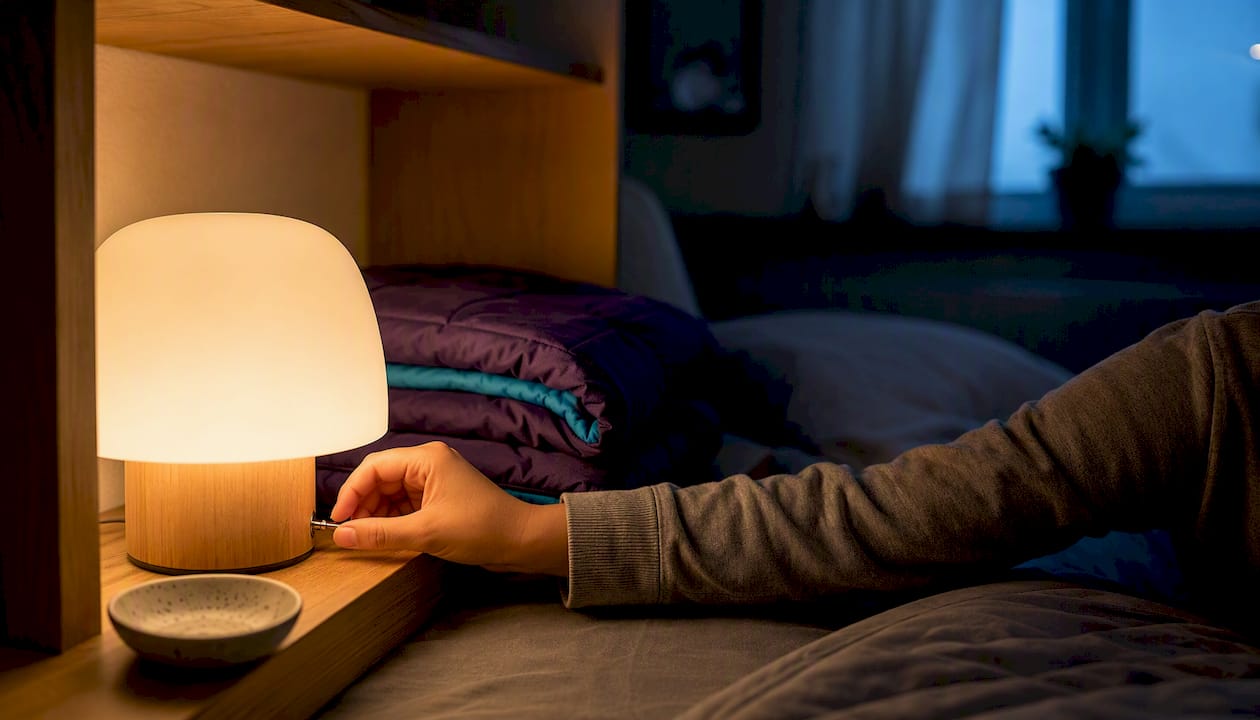
Practical adjustments help more than strict enforcement. A consistent wind-down routine, dimmed lighting an hour before bed, and removing screens earlier than feels necessary all support the natural shift happening in your child’s body. Weighted blankets or specific sensory input at bedtime work well for some kids and not others, so treat sleep tools the same way you’d treat period products: test, observe, adjust.
If sleep problems persist for more than a few weeks despite consistent routines, or if your child shows signs of a sleep disorder like frequent waking or extreme difficulty falling asleep, that’s worth raising with a pediatrician. Sleep issues and puberty-related mood changes feed each other, and breaking that cycle often improves far more than sleep alone.
Supporting Friendships and Social Challenges During Adolescence
Peer relationships get more complicated during puberty for every kid, but the shift is often sharper for neurodivergent teens. Social rules that used to be simple, like taking turns or sharing interests, get replaced with a faster, less literal social world built on subtext, group dynamics, and shifting expectations that can be exhausting to track in real time.
Some neurodivergent teens pull back from friendships around this age, not because they’ve lost interest in connection, but because the effort required to keep up with fast-changing social norms starts to outweigh the reward. Others push forward but misread cues, which can lead to friction or exclusion that’s confusing for both the teen and the parent watching it happen.
Structured social settings tend to work better than unstructured ones during this stretch. A shared-interest club, a smaller friend group, or an activity with clear rules gives a neurodivergent teen a script to follow instead of open-ended social improvisation. Practicing specific scenarios at home, like what to say if a friend cancels plans or how to respond to being left out of a group chat, gives your child concrete language to use instead of leaving them to figure it out live.
Don’t assume isolation and awkwardness are permanent traits rather than a mismatch between your child’s communication style and their current social environment. Many neurodivergent teens build strong, lasting friendships once they find peers who share their interests or communication style, and that’s often less about changing the teen and more about finding the right social fit.
Recognizing Signs of Puberty-Related Mental Health Distress
Puberty is stressful for every teen, but for a neurodivergent child already managing sensory sensitivity and executive-function demands, the added hormonal and social pressure can tip into genuine mental health concern rather than typical moodiness.
Some distress is expected: more irritability, occasional withdrawal, or new anxiety about body changes. What deserves closer attention is a pattern that lasts, rather than a bad week. Watch for persistent sadness or anxiety lasting more than two weeks, a sharp drop in interest in activities your child used to enjoy, significant changes in eating or sleeping beyond typical puberty shifts, or any mention of self-harm or hopelessness.
Meltdowns and shutdowns that increase in frequency or intensity can also signal that your child’s coping capacity is maxed out, not that behavior has simply gotten “worse.” The teen brain’s regulation systems are still developing throughout adolescence, and that developmental gap combined with sensory and social stress can push a neurodivergent teen toward anxiety or depression more easily than it does for neurotypical peers.
Trust your instincts here. If something feels different, not just difficult, a conversation with a pediatrician or a therapist familiar with neurodivergent adolescents is worth having sooner rather than later. Early support during puberty tends to prevent smaller struggles from becoming larger mental health concerns down the road.
How Puberty Uniquely Affects Neurodivergent Children
Puberty asks a lot of anybody, but it asks something different of a neurodivergent one. Sensory sensitivities that were manageable in childhood, to certain fabrics, smells, or sounds, often intensify during puberty as hormonal changes heighten sensory processing overall. A child who tolerated scratchy tags at age 7 might find them unbearable at age 12, right when new clothing needs (bras, period products) are being introduced.
Executive functioning takes a hit too. Planning, organizing, and remembering multistep routines, already a challenge for many neurodivergent kids, gets harder during puberty as the brain undergoes major structural changes. This is exactly why breaking hygiene tasks into micro-steps matters more now than it did a few years ago, not less.
Interoception, the ability to notice internal body signals like hunger, needing the bathroom, or an oncoming period, is often less reliable in neurodivergent kids to begin with. Puberty adds new signals to track (cramps, breast tenderness, mood shifts) on top of ones your child may already struggle to interpret. This is part of why a predictable tracking system, rather than relying on your child to simply “notice” their period is coming, matters so much.
None of this means puberty has to be harder overall. It means the standard advice given to neurodivergent-blind parenting resources often misses the specific mechanisms at play, and adjusting expectations around sensory load and executive function from the start prevents a lot of avoidable frustration for both of you.
Adjusting How You Talk About Puberty for Different Neurotypes
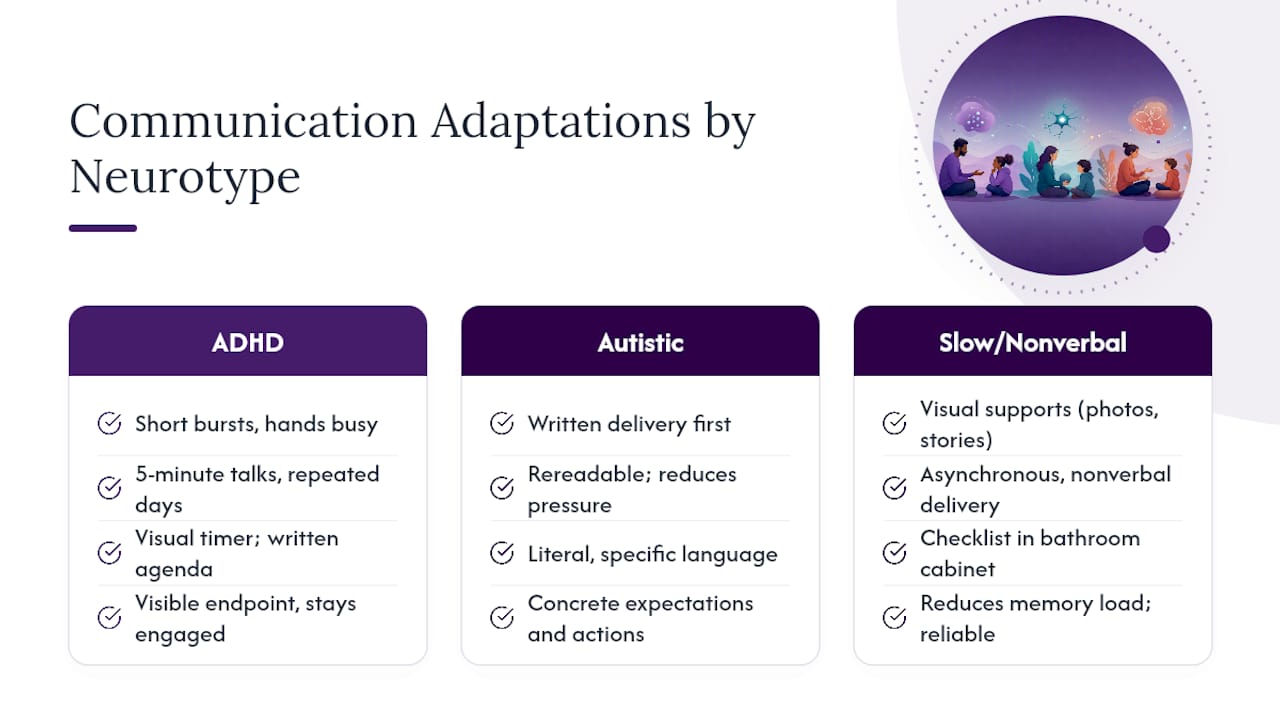
There’s no single communication style that works for every neurodivergent kid, which is part of why generic puberty scripts fall flat so often. A child with ADHD may need information delivered in short bursts with something to do with their hands, while an autistic child may need the exact same information delivered in writing first, so they can reread it without the pressure of a live conversation.
For kids with ADHD, timing matters as much as content. Long talks lose them fast, so five-minute conversations repeated across several days tend to land better than one comprehensive sit-down. Visual timers or a written agenda for the conversation (“first we’ll talk about periods, then you can ask questions, then we’re done”) can help a distractible kid stay engaged because the endpoint is visible.
For autistic kids, literal, specific language beats warmth-focused framing almost every time. “Your period might be uncomfortable” is vague enough to cause anxiety about the unknown. “Your period might cause cramping in your lower belly, and a heating pad or ibuprofen usually helps” gives your child something concrete to expect and something concrete to do about it.
For kids who process language slowly or who have limited verbal communication, visual supports carry more weight than spoken words. Photo sequences, drawn social stories, or even a simple written checklist taped inside a bathroom cabinet communicate more reliably than a conversation your child has to hold in memory. Matching your communication style to how your specific child actually processes information, rather than how puberty conversations are “supposed” to go, is often the single biggest factor in whether the information actually sticks.
Finding Support Networks for Parents of Neurodivergent Teens
You don’t have to build this knowledge alone, and most parents underestimate how much a good support network changes the day-to-day experience of this stage. Local and online parent groups focused specifically on neurodivergent adolescence, rather than general parenting forums, tend to offer more relevant, specific advice because the members are solving the exact same problems you are.
School-based resources matter too. A special education coordinator, school psychologist, or occupational therapist familiar with your child can often help translate general puberty advice into accommodations that work inside your school’s specific structure, particularly around bathroom access, changing supplies at school, or sensory breaks during health class.
Clinical resources fill in the gaps that peer support can’t. A written guide on discussing menstrual health as a family or a structured approach to introducing a menstrual health curriculum at home gives you a framework instead of starting from a blank page. Occupational therapists who specialize in sensory processing can also help troubleshoot specific product or clothing sensitivities that go beyond what trial and error at home can solve.
Give yourself permission to ask for help before you’re overwhelmed, not after. Parents who connect with other neurodivergent-specific communities early tend to report feeling more confident navigating each new stage, because they’re not reinventing every solution from scratch.
A Small Win That Changed How One Family Approached This
A mother once told me she practiced changing a pad with her daughter using an old pair of underwear and a practice pad, weeks before her daughter’s first period ever arrived. When the real day came, her daughter didn’t panic. She just said, “I know what to do.” That’s the whole goal here: not a perfect conversation, but enough small, repeated practice that puberty feels familiar instead of frightening. If you’re tired or unsure whether you’re doing enough, you almost certainly are doing enough.
— The
A Ready-Made Way to Practice Sensory-Friendly Period Care at Home
Themonthliesbox exists for exactly the moment described above: the practice run that makes the real day feel ordinary instead of scary. Building your own sensory-safe kit from scratch means testing multiple pad brands, sourcing affirmation materials, and writing your own social stories, which takes real time most parents don’t have during an already full schedule.
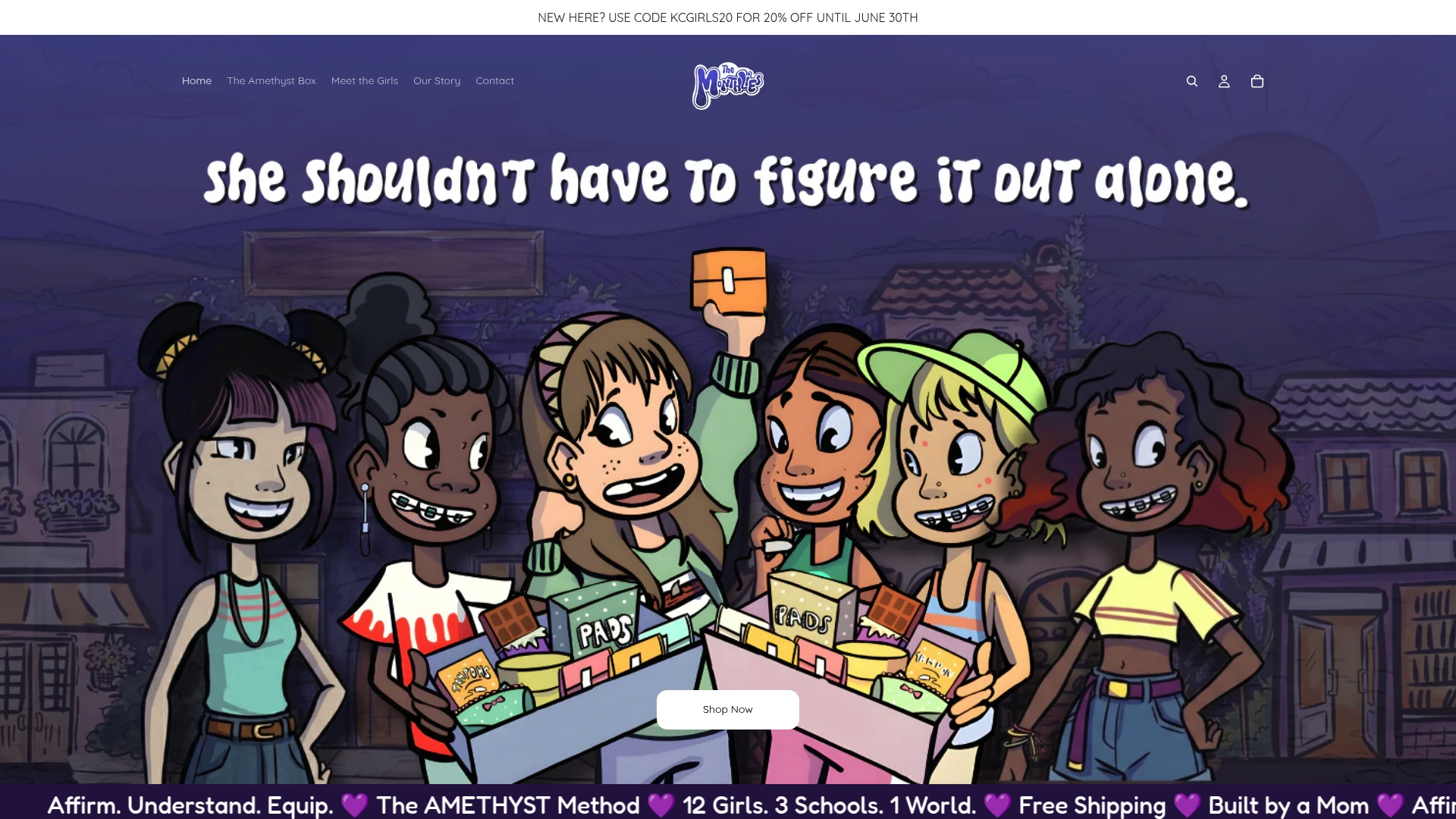
The Amethyst Box is built around the Amethyst Method’s three phases (affirm, understand, and equip) and includes practical supplies sized for tweens, educational materials, and affirmation cards designed to build confidence rather than just deliver information. Use it as your practice kit for the changing routine described earlier, your quiet kit for school days, or your first real period kit when the day arrives. For families who also want broader self-care support, the LavenHaven Care Package and The Monthlies Deluxe Box round out the sensory-comfort and self-care side of this stage. If you’re ready to stop assembling pieces yourself, consider choosing a box that matches where your child is right now from available options online.
This article is general information, not a substitute for advice from a qualified doctor. Consult a qualified healthcare professional about your own circumstances before acting on anything here.
Sources
- PubMed article on sensory factors and menstrual product comfort
- SPARK for Autism: What Menstrual Products Do Autistic Youth Prefer?
- NICHD: Puberty factsheet
- NIMH: The teen brain — 7 things to know
- NIH ODS: Iron — Health Professional Fact Sheet
FAQ
Are Neurodivergent Kids Often Socially Awkward During Puberty?
Not inherently. Social friction usually comes from a mismatch between fast-changing peer norms and a communication style that needs more explicit, literal cues, not from a lack of interest in connection.
How Do You Handle Autistic Puberty at Home?
Start conversations early with concrete language and social stories, trial sensory-friendly products like period underwear, break hygiene tasks into small practiced steps, and build in predictable co-regulation tools for emotional overwhelm.
What Are Some Practical Tips for Parenting a Neurodivergent Child Through This Stage?
Use literal language over euphemism, practice routines before they’re needed, match communication style to your child’s specific neurotype, and lean on curated resources like a pre-teen self-care practice routine or a packaged kit to save prep time.
Why Do Neurodivergent Kids Often Struggle With Change?
Many neurodivergent brains rely heavily on predictability to manage sensory and cognitive load, so unpredictable changes, like a first period or a sudden mood shift, feel more destabilizing than they would to a peer who adapts to novelty more easily.
Does Themonthliesbox Offer a Kit Specifically for First Periods?
Yes. The Amethyst Box is priced at $85 and includes practical period supplies, affirmation cards, and educational materials designed around the Amethyst Method’s affirm, understand, and equip phases.
0 comments