

Period flow typically falls into three categories: light, normal, or heavy. Color and texture add useful clues about what’s happening inside your body. Most variations are completely normal, but a few patterns are worth a call to your clinician.
Here’s what to watch for at a glance:
- Volume cue: Soaking a pad or tampon every 1–2 hours signals heavier flow that may need evaluation.
- Color cue: Bright red means fresh, active flow; dark brown usually means older blood moving slowly.
- Red-flag cue: Bleeding that lasts longer than 8 days, causes dizziness, or passes large clots deserves prompt medical attention.
Most color and volume changes across a cycle are normal, especially near the beginning and end of a period. Persistent or severe changes, though, are worth tracking and sharing with a clinician.
Key Takeaways
Understanding period flow types gives you the tools to recognize what’s normal for your body and when to ask for help.
| Point | Details |
|---|---|
| Three volume categories | Light, normal, and heavy flow are defined by daily product use and the extent to which bleeding disrupts daily life, rather than specific measured volumes. |
| Average loss is modest | Typical menstrual blood loss averages about 33.2 mL per cycle; over 80 mL defines heavy in research. |
| Color reflects oxidation | Bright red means fresh flow; dark brown means older, slower blood. Color alone is rarely an emergency. |
| Key red flags | Soaking a pad every 1–2 hours, clots over 25 mm, bleeding beyond 8 days, or dizziness warrant prompt care. |
| Themonthliesbox | The Amethyst Box prepares tweens with tween-sized supplies, flow education, and affirmation cards. |
Table of Contents
- What do the different period flow types mean for you?
- What does period blood color and texture tell you?
- How do timing and cycle patterns affect what’s normal?
- What causes abnormal bleeding patterns?
- When should you see a doctor about your period?
- How to track your flow and report it to a clinician
- How to talk to tweens about flow types and build a first-period kit
- What tracking flow really teaches us
- Prepared from day one with Themonthliesbox
- Sources
What do the different period flow types mean for you?
Understanding menstrual flow starts with three volume categories: light, normal, and heavy. Clinicians use these labels, but the definitions are more nuanced than they first appear.
Light flow means you’re using fewer products per day, often just one or two pads or liners. The total blood loss is low, and the period may feel almost like spotting on some days.
Normal flow sits in the middle. Research estimates that a typical period involves about 5–80 mL of menstrual fluid across the whole cycle, with the heaviest days usually near the start.
Heavy flow is where clinical definitions get specific. For research purposes, heavy menstrual bleeding is defined as loss exceeding 80 mL per cycle. In practice, though, almost nobody measures milliliters at home. That’s why clinicians rely on quality-of-life cues instead.
Statistic to know: Average menstrual blood loss is about 33.2 mL per cycle — roughly two tablespoons. Anything up to 80 mL falls within the range most clinicians consider manageable.
Practical home heuristics are far more useful than measuring:
- Changing a fully soaked pad or tampon every 1–2 hours suggests heavy flow.
- Using more than 6–7 fully soaked products per day is worth noting.
- Passing clots larger than about 25 mm (roughly the size of a quarter) is a clinical concern.
- Flow that feels “heavy” but doesn’t disrupt daily life is often within normal range.
Two people can lose the same amount of blood and experience it very differently. That’s why clinicians ask about daily disruption, not just product count. For parents wondering about a daughter’s first cycle, our guide on why first periods vary in flow explains what’s typical at menarche.
Pro Tip: Track your two or three heaviest days each cycle. Knowing your personal “peak” pattern makes it much easier to spot a real change later.
What does period blood color and texture tell you?
Color is one of the most misunderstood parts of understanding menstrual flow. The good news: most color changes reflect simple biology, not a health crisis.
Color primarily reflects how quickly blood moves through the uterus and how long it’s been exposed to oxygen. Bright red blood is fresh and moving steadily. Dark red or brown blood has taken longer to exit, giving it time to oxidize. Black blood at the very start or end of a period is usually just the oldest, slowest-moving flow.
Here’s a quick guide to common colors:
- Bright red: Active, steady flow, most common on peak days.
- Dark red or brown: Slower or older blood, typical at the start or end of a period.
- Pink: Lighter flow mixed with cervical fluid, common at the beginning of a period or mid-cycle spotting.
- Orange or gray: These shades can sometimes indicate infection, especially when paired with an unusual odor.
- Watery or thin texture: Often seen with lighter flow or hormonal shifts.
- Thick or clumpy texture: Normal during heavier days; small clots are common.
Northwestern Medicine notes that clinicians focus on persistent patterns rather than single one-off changes. A day of brown spotting at the end of your period is not a reason to worry. A sudden shift to consistently gray or orange discharge with odor is.
Clots deserve a special mention. Small clots, especially on heavy days, are a normal part of the body’s natural clotting process. For a deeper look at what clot size means, our post on first period clots explained walks through what’s typical and what’s not.
How do timing and cycle patterns affect what’s normal?
Timing is the third dimension of understanding menstrual flow, alongside volume and color. A period that looks “normal” in isolation can still signal a problem if the timing is off.
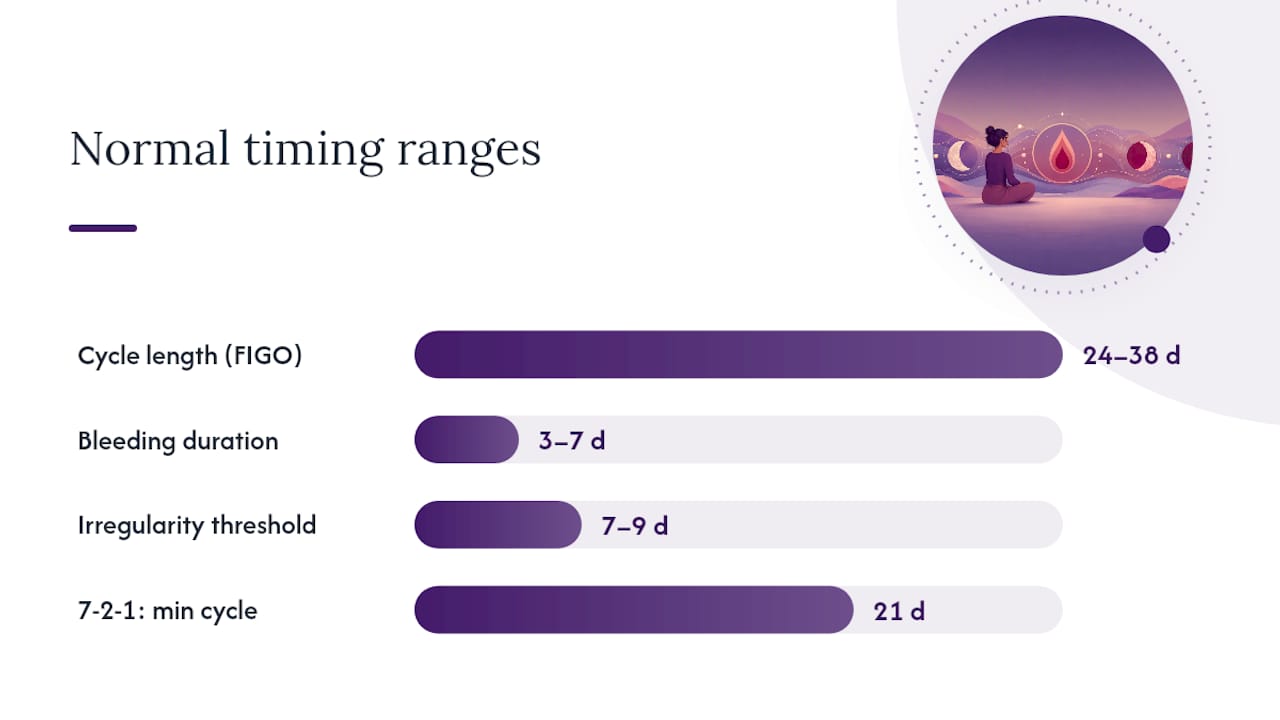
According to Mayo Clinic, a typical menstrual cycle occurs every 24–38 days, and bleeding usually lasts up to 8 days. These ranges come from FIGO (the International Federation of Gynecology and Obstetrics) and are widely used in clinical practice.
Key timing concepts to know:
- Cycle length: The number of days from the first day of one period to the first day of the next. Anything outside 24–38 days consistently is worth tracking.
- Duration: Most periods last 3–7 days, though up to 8 days is still within normal range.
- Regularity: Cycles that vary by more than 7–9 days from month to month may indicate hormonal irregularity.
- Spotting vs. intermenstrual bleeding: Light spotting around ovulation is common. Heavier bleeding between periods is not typical and should be evaluated.
A simple way to remember normal ranges is the 7-2-1 approach: bleeding lasting up to 7 days, a cycle no shorter than 21 days, and no more than 1 pad or tampon soaked per hour at peak. This isn’t a clinical standard, but it’s a practical memory tool for spotting when something feels off.
Near menarche and perimenopause, cycle length and flow volume tend to be more variable and often normalize over time. Age context matters when deciding whether an irregular cycle needs evaluation.
What causes abnormal bleeding patterns?
When flow changes significantly, there’s usually a reason. Knowing the common causes helps you give your clinician useful information faster.
| Cause | Typical pattern change | Key clue |
|---|---|---|
| Anovulation / PCOS | Irregular cycles, missed periods, then heavy flow | Cycles outside 24–38 days, no predictable pattern |
| Fibroids or polyps | Heavier or prolonged bleeding, sometimes mid-cycle spotting | Pelvic pressure, clots, consistent heaviness |
| Infection (e.g., STI, PID) | Unusual discharge, pelvic pain, irregular spotting | Odor, pain with intercourse, fever |
| Pregnancy-related causes | Missed period, then heavy or unusual bleeding | Positive pregnancy test, one-sided pain |
| Bleeding disorders | Heavy flow since first period, easy bruising | Family history, heavy flow at menarche |
| Medications / hormonal IUD | Lighter periods, spotting, or temporary irregularity | Recent contraceptive change |
Persistent heavy periods can lead to iron-deficiency anemia, which causes fatigue, dizziness, and shortness of breath. If heavy flow has been going on for several cycles, ask your clinician about checking iron levels.
Pro Tip: Before your appointment, jot down: when the change started, how many products you’re using per day, any associated pain, and your current contraception. That four-item note cuts triage time significantly.
When should you see a doctor about your period?
Some changes are worth a routine appointment. Others need same-day or urgent care. Here’s how to tell the difference.
Seek urgent or emergency care if you experience:
- Soaking a pad or tampon every 1–2 hours for two or more consecutive hours (CDC guidance)
- Dizziness, fainting, or shortness of breath during your period
- Clots larger than a quarter (about 25 mm) passing frequently
- Bleeding that has lasted more than 8 days
- Sudden, severe pelvic pain alongside heavy bleeding
Schedule a routine gynecology or primary care visit if:
- Your cycle is consistently shorter than 24 days or longer than 38 days
- Bleeding between periods has happened more than once
- Your flow has become noticeably heavier or lighter over several cycles
- You suspect a hormonal or structural cause (like fibroids)
- You’re experiencing fatigue or other anemia symptoms alongside heavy flow
Telehealth is a practical option for non-urgent concerns, especially for initial triage or follow-up after labs. Many gynecologic concerns can be assessed remotely before deciding whether an in-person exam is needed.
How to track your flow and report it to a clinician
Good tracking turns vague descriptions into useful clinical data. You don’t need an app to do it well, though apps like Clue, Flo, or Apple Health make it easier.
Record these items each cycle day:
- Start date of your period
- Flow amount (number of pads or tampons used, and whether they were fully soaked)
- Color (bright red, dark brown, pink, other)
- Clots (yes/no, and approximate size)
- Pain score (1–10 scale)
- Associated symptoms (bloating, fatigue, dizziness, unusual discharge)
- Contraception currently in use
Mayo Clinic recommends tracking these items consistently for at least two to three cycles before a visit, so your clinician can see a pattern rather than a single data point.
Sample clinic note you can copy: “My period started [date]. Flow was heaviest on days 1–2, soaking 4–5 pads per day. I passed two clots about the size of a nickel. Pain was 6/10. No unusual odor or discharge. I am currently using [contraception].”
Pro Tip: For parents helping a tween track her first few cycles, a simple paper calendar with color-coded stickers works beautifully. One color for flow days, one for spotting, one for pain. It’s visual, low-pressure, and easy to bring to a pediatrician visit.
How to talk to tweens about flow types and build a first-period kit
Preparing a young girl for her first period means giving her the words to describe what she’s experiencing, not just the supplies to manage it.
Simple scripts for parents:
- “Your period might be light at first, which means just a little blood on your pad. That’s completely normal.”
- “Some days the flow will be heavier, and that’s okay too. We’ll make sure you have what you need.”
- “Blood can look dark brown or bright red depending on the day. Both are normal.”
First-period kit checklist:
- Pads in a range of sizes (including thinner ones sized for tweens)
- A small zip pouch for her school bag
- Comfortable underwear she doesn’t mind staining
- Pain relief (ibuprofen or acetaminophen, age-appropriate)
- A simple one-page guide explaining what colors and amounts are normal
- Affirmation cards or a note from you
For product guidance, our post on menstrual products for parents covers sizing and options for tweens specifically.
Reassure her that her first few cycles may be irregular in timing and flow. That’s typical near menarche. Call her clinician if bleeding lasts more than 8 days, she’s soaking products every hour, or she seems unusually fatigued.
Pro Tip: Normalize color changes out loud. Say something like, “You might notice the blood looks darker at the end of your period. That’s just older blood, and it’s totally fine.” Hearing it before it happens removes the fear entirely.
What tracking flow really teaches us
Most period education focuses on what’s “normal” as a fixed target. But the more useful frame is personal baseline. Two people can have very different cycles and both be completely healthy. What matters is whether your pattern is consistent for you, and whether changes are gradual or sudden.
The clinical evidence backs this up. Northwestern Medicine emphasizes that tracking cycles over several months is the best way to distinguish a one-off variation from a pattern worth evaluating. A single brown day or one lighter cycle is almost never the signal. A persistent shift over three or more cycles usually is.
For parents, the most powerful thing you can do is make tracking feel normal and non-alarming from the very first period. When a girl grows up knowing what her own flow looks like, she’s far better equipped to notice a real change and advocate for herself with a clinician. That confidence is worth more than any single piece of medical advice.
Prepared from day one with Themonthliesbox
When your daughter’s first period arrives, having the right supplies already packed makes all the difference between panic and confidence. Themonthliesbox builds that readiness into a single, thoughtfully curated kit.

The Amethyst Box is designed specifically for first periods, with supplies sized for tweens, educational materials that explain flow types in age-appropriate language, and affirmation cards that make the whole experience feel supported rather than scary. For families who want a more complete self-care experience, the Monthlies On-The-Go Kit fits neatly into a school bag so she’s always prepared. Browse the full collection and find the kit that fits your daughter’s needs at Themonthliesbox.
Sources
These are the trusted sources behind the guidance in this article. Each one is worth bookmarking for ongoing reference.
- Physiology, Menstrual Cycle - StatPearls - NCBI Bookshelf
- Determinants and Assessment of Menstrual Blood Flow - PMC
- Menstrual cycle: What’s normal, what’s not - Mayo Clinic
- What Your Period Says About Your Health | Northwestern Medicine
- How much period blood is normal? - Clue
- Period Blood: What Color Is Normal? | Healthline
- About Heavy Menstrual Bleeding - CDC
This article is for general informational purposes only and is not a substitute for professional medical advice. Always consult a qualified healthcare provider about your specific situation.
0 comments