

When you’re choosing period products for your daughter, five signals cut through the noise: OEKO‑TEX Standard 100, GOTS (Global Organic Textile Standard), EU Ecolabel or Nordic Swan, GRS (Global Recycled Standard), and an independent PFAS lab report. For anything used internally, add one more check: FDA product classification and ISO 10993 biocompatibility testing. Together, these cover the most important safety and sustainability questions you’ll face at the shelf or on a product page.
Here’s what each one primarily verifies:
- OEKO‑TEX Standard 100 — finished textile tested against a list of harmful substances
- GOTS — organic fiber content plus processing and social criteria throughout the supply chain
- EU Ecolabel / Nordic Swan — lifecycle environmental performance and restricted-substance lists for the whole product
- GRS — recycled content verified with chain-of-custody documentation
- PFAS lab report — third-party confirmation that per- and polyfluoroalkyl substances are absent
- FDA classification + ISO 10993 — U.S. regulatory baseline and biocompatibility testing for internal-use or mucous-membrane-contact products
Shopping tip: On any packaging or product page, look for a certificate number, the certifying body’s name, a scope statement, and a date. A logo alone, with no number and no date, is not enough. For certified menstrual products, these details should be easy to find.
Table of Contents
- How U.S. regulation and voluntary certifications work together
- Certifications that matter most for disposable pads and tampons
- Certification and safety signals for reusable period products
- What company-level and broad ecolabels actually tell you
- Key Takeaways
- Why this matters to us at Themonthliesbox
- Where to verify certificates and lab reports
How U.S. regulation and voluntary certifications work together
The FDA is the baseline for period products sold in the United States. Tampons and pads are regulated as Class II medical devices under FDA 510(k) guidance, which means manufacturers must submit premarket notifications covering absorbency testing, labeling requirements, chemical residue assurances, and biocompatibility expectations aligned with ISO 10993. Period underwear, by contrast, is generally classified as Class I (product code NUQ) and is often exempt from 510(k) review, unless the brand makes medical claims that shift its regulatory status.
ISO 10993 is the international standard for evaluating the biocompatibility of materials that contact the body. For menstrual cups and other reusable devices that touch mucous membranes, a biocompatibility report aligned with ISO 10993 is the most meaningful safety document a brand can share. Peer-reviewed research on menstrual product safety reinforces why this matters: internal-use products warrant a higher level of biological-endpoint testing than external textiles.

Voluntary certifications like OEKO‑TEX or GOTS sit on top of this regulatory floor. They are not required by U.S. law, but they verify things the FDA does not specifically mandate, such as restricted-substance lists, organic fiber sourcing, or recycled-content traceability. Think of FDA oversight as the minimum and voluntary certifications as the extra layer of confidence.
What to ask any brand: request the FDA product code (for tampons and pads), a biocompatibility summary or ISO 10993 reference (for cups and reusables), and downloadable lab reports. If a brand can’t share those, that’s worth noting.
Certifications that matter most for disposable pads and tampons
Disposable products involve multiple materials: cotton or synthetic absorbent layers, pulp or fluff, a leak-proof backing, and packaging. No single certification covers all of them, so you’ll often see more than one label on a well-verified product.
The most useful certifications for disposables are:
- EU Ecolabel — covers restricted chemicals, lifecycle criteria, and biodegradability requirements for absorbent hygiene products; EU Ecolabel criteria were updated in 2023 for feminine hygiene products
- Nordic Swan Ecolabel — requires minimum certified raw-material thresholds, chain-of-custody documentation, and strict forbidden-substance lists for pulp and paper components
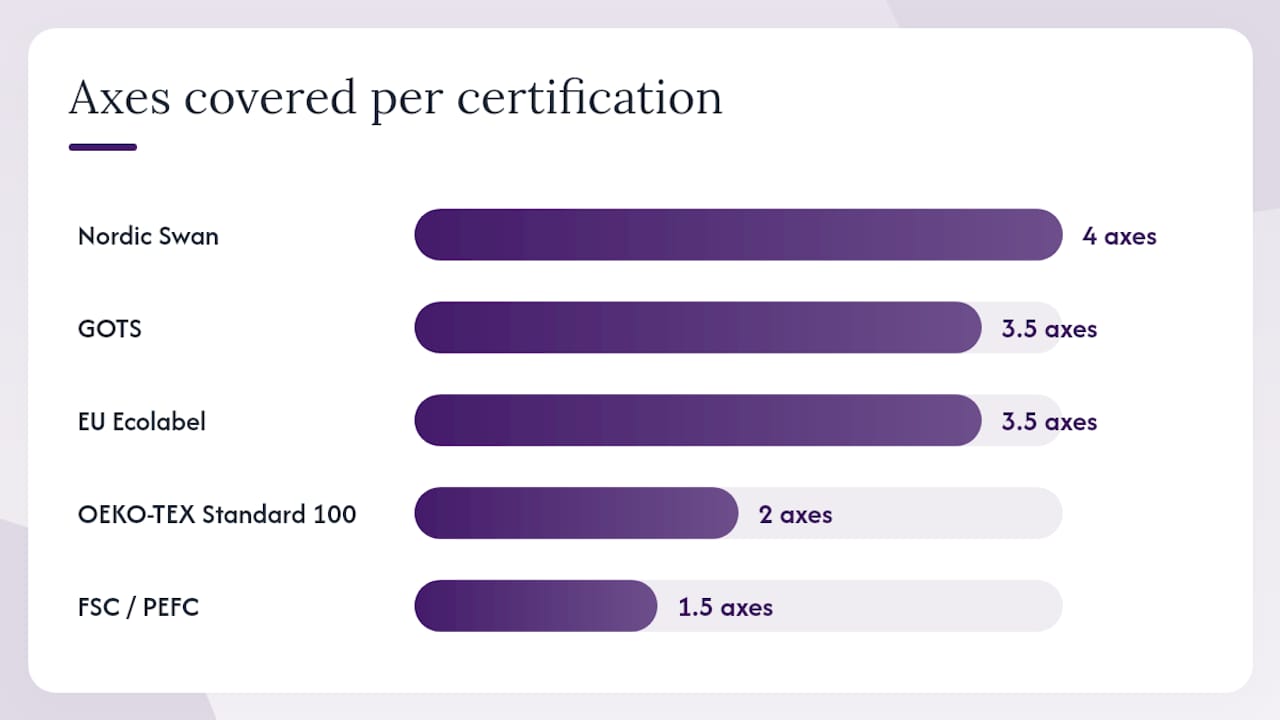
The comparison below shows which axis each certification covers for disposables.
| Certification | Finished-product safety | Raw-material traceability | Restricted chemicals | Lifecycle impact | Social criteria |
|---|---|---|---|---|---|
| OEKO‑TEX Standard 100 | ✓ | — | ✓ | — | — |
| GOTS | Partial | ✓ | ✓ | — | ✓ |
| EU Ecolabel | ✓ | Partial | ✓ | ✓ | — |
| Nordic Swan | ✓ | ✓ | ✓ | ✓ | — |
| FSC / PEFC | — | ✓ | — | Partial | — |
| USDA Organic | — | ✓ | — | — | — |
Red flags on disposable packaging: “natural” or “eco” with no certificate number, expired certificates (check the date), or a GOTS logo without a scope statement confirming which components are certified.
Certification and safety signals for reusable period products
Reusables, including period underwear, cloth pads, and menstrual cups, each carry different risks and therefore need different verification. The priority shifts from raw-material sourcing to finished-product chemical safety and, for internal devices, biocompatibility.
For period underwear and cloth pads, the key documents are:
- OEKO‑TEX Standard 100 Class II certificate — Class II applies to products with prolonged skin contact and carries tighter limits on formaldehyde and other harmful substances than Class I; request the scope statement to confirm it covers the gusset and waterproof layer, not just the outer fabric
- Third-party PFAS lab report — water-resistant and stain-resistant finishes have historically used PFAS chemistry; a credible PFAS-free claim requires a panel test from an ISO/IEC 17025 accredited lab using EPA Method 1633A, the reference method finalized in December 2024; some U.S. states now require written certificates of compliance for PFAS absence in textiles
- GOTS or GRS scope — if the brand claims organic cotton or recycled materials, GOTS verifies organic fiber and processing criteria; GRS verifies recycled content with chain-of-custody documentation
- Material scope details — confirm the certificate covers every layer: gusset, elastic, waterproof shell, and any colored panels (dyes can introduce substances not covered by a scope limited to the base fabric)
For menstrual cups and other internal reusables, the priority document is a biocompatibility report referencing ISO 10993. This is the same framework the FDA expects for Class II devices. A cup made from medical-grade silicone should have documented testing for cytotoxicity, sensitization, and irritation at minimum.
Pro Tip: When a brand claims “PFAS-free,” ask specifically for the lab report, the testing method, and the lab’s accreditation number. A general statement on a website without a downloadable report is a marketing claim, not verified evidence.
What company-level and broad ecolabels actually tell you
B Corp, Cradle to Cradle, Nordic Swan, and EU Ecolabel are often grouped together in marketing copy, but they operate at very different levels.
- B Corp — a company-level certification assessing social and environmental performance, governance, and transparency across the whole business; it says nothing specific about whether a single product has been tested for harmful substances
The practical distinction: a brand with B Corp status has made verifiable commitments to transparency and supply-chain responsibility. That is genuinely useful when you’re evaluating whether a company is likely to be honest about its sourcing. But it does not replace a finished-product chemical test or a PFAS lab report. You can trust a B Corp brand more readily, and still ask for the product-level documentation.
For sustainable period care, the most protective combination is a company-level badge (B Corp or equivalent) paired with a product-level finished-product safety certificate (OEKO‑TEX Standard 100 or EU Ecolabel).
Key Takeaways
Finished-product certifications like OEKO‑TEX Standard 100 Class II, paired with a third-party PFAS lab report, are the most practical safety signals for parents choosing period products for tweens.
| Point | Details |
|---|---|
| OEKO‑TEX Class II for textiles | Covers prolonged skin contact; tighter substance limits than Class I; verify the scope includes all layers. |
| PFAS lab report for reusables | Request the method (EPA Method 1633A) and lab accreditation; a website claim alone is not enough. |
| GOTS scope for organic cotton | Confirm the scope covers the absorbent component, not just the outer fabric. |
| EU Ecolabel or Nordic Swan for disposables | Both cover restricted substances and lifecycle criteria; the most thorough product-level labels for single-use products. |
| FDA classification + ISO 10993 for internal use | Tampons and pads are Class II devices; cups need biocompatibility documentation referencing ISO 10993. |
Why this matters to us at Themonthliesbox
At Themonthliesbox, we believe that preparing a girl for her first period means more than handing her a product. It means giving her and her parent the confidence that what she’s using has been thought through carefully. That’s why we take certification questions seriously when we curate what goes into the Amethyst Box. We look for products with verifiable finished-product safety documentation, and we share that information openly because parents deserve to know, not just trust.
The certification landscape is genuinely complicated, and we know that. Our goal is to do the research so you don’t have to start from scratch. Whether you’re building a first-period kit or looking for something your daughter can carry to school, we want every item in her hands to be something you feel good about.

The Monthlies On-The-Go Kit is a practical starting point for parents who want a curated, ready-to-go option with products selected for comfort and safety. And if you’re looking for a fuller first-period experience, the Amethyst Box brings together supplies, affirmations, and education in one thoughtful package.
Where to verify certificates and lab reports
These are the authoritative sources to check any certification claim before you buy.
- OEKO‑TEX label check — oeko-tex.com/en/label-check; enter the certificate number to confirm scope, products covered, and expiry date
- GOTS database — global-standard.org; search by company or certificate number to verify organic textile claims
- FSC certificate database — info.fsc.org; confirms forest certification and chain-of-custody scope for pulp and packaging
- PEFC certificate database — pefc.org/find-a-certificate; similar lookup for PEFC-certified pulp suppliers
- EU Ecolabel portal — ecolabel.eu; search licensed products and verify current status
- Nordic Swan portal — svanen.se; search licensed products by category
- FDA guidance for tampons and pads — the 510(k) guidance document explains classification, testing expectations, and biocompatibility requirements
What a legitimate lab report looks like: it names the testing laboratory, includes the lab’s ISO/IEC 17025 accreditation number, states the testing method (e.g., EPA Method 1633A for PFAS), lists the limits of detection for each substance tested, and shows the actual results. A one-page PDF with a brand logo and the words “PFAS-free” is a declaration, not a lab report.
For a broader look at clean period products and what safety standards mean in practice, the Themonthliesbox blog has parent-focused guides that translate the technical details into plain language.
0 comments