

Period stigma is the social and cultural shame that restricts people who menstruate, and it measurably harms education, health, and dignity. A majority of teens say the negative associations around periods affect them personally, and many hide products on the way to the bathroom, according to the 2025 State of the Period Study. The rest of this piece breaks down where that shame comes from, how it plays out in classrooms and clinics, and what actually reduces it.
TL;DR:
- Over 77% of teens report hiding menstrual products or avoiding asking for help, highlighting how stigma continues to influence daily behaviors.
- Cultural and religious beliefs historically framed menstruation as impure or dangerous, shaping social norms that still reinforce shame today.
- Marginalized groups such as lower-income, Black, transgender, and refugee populations face higher stigma and worse access to respectful facilities and products.
- Effective stigma reduction relies on agency-focused education, policy changes ensuring free and accessible supplies, and consistent, neutral language use.
- Practical tools like the Amethyst Box, which combines affirmation, education, and supplies, help foster confidence and normalize conversations around menstruation.
Table of Contents
- What Period Stigma Means and How Language Keeps It Hidden
- Where Period Stigma Comes From: Religion, History, and Power
- Everyday Places Period Stigma Shows Up
- The Evidence: What Recent Studies and Surveys Actually Found
- Who Stigma Hits Hardest
- The Real Cost: Education, Health, and Human Rights
- What Actually Reduces Period Stigma
- A Working Checklist for Educators and Advocates
- Putting the Evidence Into Practice: The Amethyst Method
- An Editorial Take on Why This Work Can’t Wait
- A Practical Starting Point for Parents and Educators
- Sources
- FAQ
What Period Stigma Means and How Language Keeps It Hidden
Stigma, in the sociological sense, is a mark that a group or society attaches to a trait, turning something ordinary into something shameful. Applied to menstruation, that mark shows up as silence, euphemism, and avoidance. Someone hides a pad in a sleeve. A classroom skips the topic entirely. A doctor’s appointment gets postponed because naming the symptom out loud feels harder than living with it.
Qualitative research on young people’s menstrual experiences describes this pattern precisely: stigma operates through concealment strategies and coded language, and it teaches menstruators to manage their bodies quietly rather than understand them fully. The study on menstrual stigma and norms found that programs focused only on hiding blood or masking odor, without building real body literacy, can end up reinforcing the very shame they’re trying to work around.
Euphemisms are the clearest fingerprint of stigma in everyday speech. They let people reference menstruation without naming it, which sounds harmless until you notice what the habit actually does: it keeps the subject just out of reach of normal conversation. Common patterns include:
- Code words like “that time of the month,” “Aunt Flo,” or “on the rag”
- Vague medical deflection, such as calling it “women’s issues” or “female problems” in professional settings
- Silence by omission, where periods go unmentioned in health class, sports team announcements, or workplace policies
- Physical concealment behaviors, like carrying products in makeup bags or asking to be excused without explanation
Researchers analyzing this kind of language treat the ratio of neutral terms to euphemisms as a measurable signal of how much stigma persists in a given community, which makes it a useful benchmark for anyone running an awareness campaign.
It helps to separate period stigma from period poverty, even though the two feed each other constantly. Stigma is the shame and silence. Period poverty is the lack of affordable products, sanitation, and facilities, often called WASH (water, sanitation, and hygiene) access in global health literature. A psychosocial review on menstrual justice frames the two as structurally linked: stigma makes it harder to advocate for product access, and lack of access deepens the shame of not being able to manage a normal bodily function with dignity.
Where Period Stigma Comes From: Religion, History, and Power
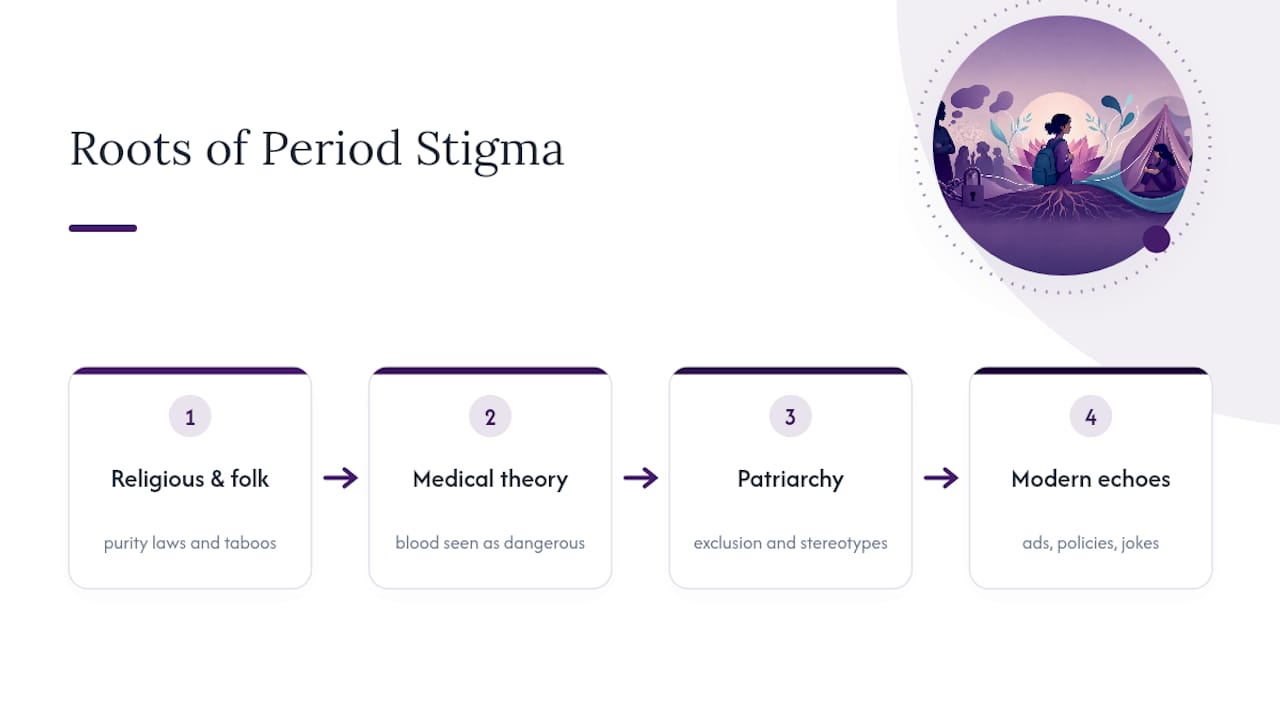
Menstrual taboos are old, geographically widespread, and remarkably consistent in one respect: nearly every documented culture developed some rule restricting menstruating people from specific spaces, activities, or contact. Anthropological scholarship on menstrual taboos and stigma traces this back through religious texts, folk belief systems, and early medical theory that treated blood, in general, as spiritually and physically dangerous. Menstrual blood, unlike blood from an injury, came with no visible wound to explain it. That mystery, paired with existing anxieties about women’s bodies, hardened into rules.
Several religious traditions historically framed menstruation as a state of ritual impurity requiring separation. Leviticus describes menstruating women as unclean for seven days. Some interpretations of purity law in Hinduism have restricted menstruating women from temples, kitchens, or touching certain foods. Orthodox Jewish practice includes niddah, a period of separation during and after menstruation, followed by ritual purification. These aren’t fringe practices; they shaped daily life for enormous populations over centuries, and echoes of the underlying logic, menstruation as something requiring containment and apology, still surface in modern advertising that shows blue liquid instead of red, or in school policies that send a student to the nurse’s office rather than letting her manage a leak in class.
The anthropological research on menstrual taboos also shows real variation worth noting, because it undercuts the idea that shame is a biological inevitability rather than a social choice. Some cultures historically treated menstruation with reverence rather than disgust, marking menarche with celebration rather than restriction. The Apache Sunrise Ceremony and certain Aboriginal Australian traditions frame a girl’s first period as a moment of empowerment and community welcome. That contrast matters for advocacy work: if some societies built rituals of celebration instead of concealment, the shame model isn’t fixed. It’s a choice culture makes and can unmake.
Patriarchy did most of the work of sustaining stigma once religious frameworks laid the groundwork. Menstruation became evidence for the argument that women’s bodies were inherently unstable, less rational, and less suited for public life, an argument used for centuries to justify excluding women from politics, education, and leadership. Modern gender norms carry the residue. A workplace joke about someone being “hormonal” during a disagreement, a locker room where boys learn periods are disgusting before they ever learn what one is, a textbook that covers male puberty in a paragraph and menstruation in a footnote. None of it requires religious language anymore. The pattern has outlived its original justification and now runs on habit, embarrassment, and a lack of anyone willing to say the word out loud first.
Everyday Places Period Stigma Shows Up
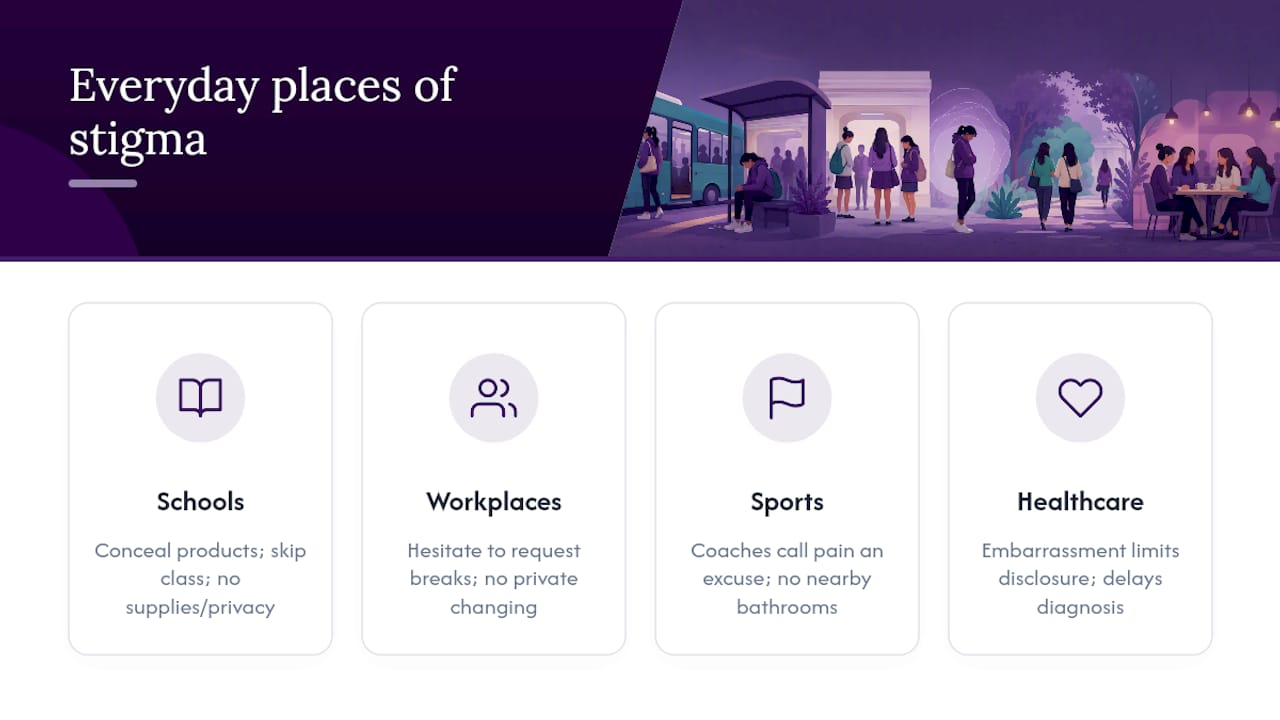
Stigma rarely announces itself directly. It shows up as small, repeated behaviors that add up to real disadvantage across school, work, sports, and healthcare.
In schools, the pattern is remarkably consistent: students conceal products, avoid asking teachers for help, and sometimes skip class entirely rather than risk visible evidence of menstruating. Teacher responses can make this worse when they treat a leak or a supply request as a discipline issue or an emergency rather than a routine part of the school day. A student who has to ask a male teacher, in front of the class, to go to the nurse learns fast that the safer move next time is silence, even at the cost of missing instruction.
In workplaces, stigma surfaces as stereotype and practical friction at once. Someone experiencing severe cramps may hesitate to request a break, worried it reads as low stamina or reduced competence. Some cultures still carry the older idea that a menstruating woman is somehow less capable of clear judgment, a belief with zero physiological basis but real career consequences when it shapes who gets handed a high-pressure project.
In sports and extracurriculars, the pressure runs toward toughing it out. Coaches sometimes discourage athletes from mentioning period-related pain, framing it as an excuse rather than a legitimate physical experience, which can push young athletes to hide symptoms that would otherwise prompt a coach to adjust training intensity.
In healthcare, embarrassment has a direct, measurable cost. Surveys on menstrual health communication find a substantial share of women feel uncomfortable discussing period symptoms with their own doctors, according to HealthyWomen’s reporting on period embarrassment. That discomfort delays diagnosis of conditions like endometriosis, fibroids, and abnormal bleeding, sometimes for years, because patients minimize symptoms rather than describe them plainly.
The 2025 State of the Period Study highlights concealment habits common among many teens, including hiding menstrual products when walking to a bathroom, a behavior observed across school hallways, office corridors, and locker rooms alike.
All four settings connect back to a structural issue: limited access to products and adequate facilities. A student without a pad in her backpack, a worker without a private place to change a tampon, an athlete without a bathroom near the field, each of these access gaps forces the exact concealment behavior that keeps stigma alive, because managing a period discreetly becomes a logistical problem before it’s ever a shame problem.
The Evidence: What Recent Studies and Surveys Actually Found
Period stigma isn’t just a well-worn observation anymore; it has been measured, and the numbers are getting worse, not better. The 2025 State of the Period Study found that stigma indicators increased since the organization’s 2023 survey, with a substantial portion of teens saying they feel personally affected by negative associations around menstruation. Hiding behavior was also higher than in earlier survey waves.
Qualitative research adds texture the survey numbers can’t capture on their own. The study on menstrual stigma and norms followed young people’s own accounts of navigating menstruation and found a consistent theme: education that teaches only concealment tactics, how to hide a pad, how to mask odor, without teaching bodily literacy, tends to reinforce shame rather than dismantle it. The researchers argue for curricula that build agency, meaning students learn to recognize normal versus concerning symptoms and to seek help confidently, not just to manage appearances.
A broader psychosocial review on gender equity and menstrual justice reached a similar structural conclusion from a different angle, synthesizing findings across public health and sociology. Stigma, the review concludes, isn’t an isolated attitude problem; it’s woven into policy gaps, economic exclusion, and healthcare access all at once, which means no single classroom lesson or single policy fixes it alone.
A methodological note matters here: large surveys like this one rely on self-reported behavior, which can undercount concealment habits people don’t consciously register as concealment. Qualitative interviews, by contrast, involve smaller samples but capture the reasoning behind the behavior, why a student chooses silence over asking for help. Reading the two study types together gives a fuller picture than either alone: the survey shows scale, the interviews show mechanism.
Who Stigma Hits Hardest
Period stigma doesn’t distribute its harm evenly. The 2025 State of the Period Study documents higher rates of hiding behavior among Black students and lower-income students compared to their peers, a gap that reflects both cultural pressure and unequal access to private facilities and reliable product supply. A student who can’t count on having a pad at home carries a double burden: the shame of the topic itself, plus the practical fear of an unmanaged leak at school.
Income shapes the calculation directly. A family stretched thin on grocery money often treats period products as a discretionary purchase rather than a necessity, which means a student either goes without or asks a friend, teacher, or school nurse—each option carrying its own layer of embarrassment on top of the underlying stigma.
Transgender and nonbinary people who menstruate face a version of stigma that layers on top of the general shame most menstruators encounter. Bathroom access alone can be fraught, since a trans man or nonbinary student who menstruates may not feel safe using either a men’s or women’s restroom to manage a period, and school or workplace policies rarely account for that reality. Health forms and product marketing that assume every menstruator is a woman add another layer of erasure, making it harder for trans and nonbinary people to find relevant health information or feel comfortable asking questions at all.
Certain environments concentrate vulnerability further. Refugee camps and displacement settings often lack reliable product supply or private sanitation, forcing people to use unsafe substitutes like rags or newspaper. Incarcerated and detained populations report similar shortages, with limited control over when or how often they can access products. Under-resourced schools, particularly in rural districts or areas with aging infrastructure, may lack functioning bathroom doors, running water, or private stalls, turning a routine biological process into a daily logistical crisis. A UNFPA briefing on menstruation and human rights frames all three settings as clear violations of dignity, not just inconvenience, tying period stigma directly into international human-rights frameworks rather than treating it as a purely cultural quirk.
The Real Cost: Education, Health, and Human Rights
The consequences of period stigma are concrete, not abstract, and they show up first in attendance records. Students who hide products, fear leaks, or lack access to supplies are more likely to skip school on heavy-flow days, and repeated absences compound into real learning gaps over a school year. The connection between managing periods discreetly and staying in class runs directly through resources like reliable period poverty support at school, which is exactly why product access and stigma reduction have to move together rather than as separate initiatives.
Mental health absorbs a quieter cost. Kids who learn early that periods are something to hide often internalize that shame as a broader message about their bodies, one that can surface later as anxiety around normal bodily changes or reluctance to seek medical help for anything reproductive-related. Learned silence around period pain specifically is worth flagging: a teen taught that cramps are just something to endure quietly may not recognize when pain crosses into something that warrants a doctor’s visit, whether that’s endometriosis, a hormonal imbalance, or another treatable condition. Watching for red flags that need medical attention becomes much harder when the cultural default is to stay quiet about symptoms altogether.
The human-rights framing gives this all a sharper edge than “it’s uncomfortable to talk about.” The UNFPA’s analysis states plainly that menstrual taboos, combined with inadequate WASH access, function as barriers to health, education, and dignity, the same language used for other recognized rights violations. A structural review of menstrual stigma reinforces this by linking stigma to reduced labor-force participation for women in some contexts, tying a cultural taboo directly to economic outcomes. Once stigma gets framed this way, it stops being a matter of etiquette and becomes a policy problem with measurable stakes.
What Actually Reduces Period Stigma
Not every awareness campaign or classroom lesson moves the needle equally. The strongest evidence points toward a specific combination of approaches, and skipping any one of them tends to leave the others underperforming.
- Agency-based education over concealment-based education. Programs that teach body literacy, symptom recognition, and when to seek care outperform programs that only teach hiding techniques. Research on agency-focused menstrual education found that students taught to understand their cycles, rather than just manage appearances, showed better health-seeking behavior later.
- Policy that removes cost as a barrier. Free product provision in schools, workplace accommodation policies that don’t require disclosure of symptoms to get a break, and eliminating sales tax on menstrual products all reduce the practical friction that turns a private need into a public struggle.
- WASH infrastructure as a non-negotiable baseline. Clean, private, well-stocked bathrooms with functioning locks and running water aren’t a bonus; they’re the physical precondition for reducing stigma. A review on menstrual poverty as a structural issue makes clear that stigma and access failures reinforce each other in a loop that education alone can’t break.
- Language change through consistent, neutral naming. Public campaigns that consistently use the words “period” and “menstruation,” rather than euphemisms, in advertising, classrooms, and workplace policy documents, slowly shift what counts as sayable in public. Tracking euphemism use versus neutral terminology, an approach drawn from sociolinguistic analysis of stigma in discourse, gives advocates an actual metric for whether a campaign is working.
- Trusted messengers, not just materials. Teens overwhelmingly name healthcare providers and parents as their most trusted sources for period information, at 92% and 70% respectively, per the 2025 State of the Period Study. A well-designed pamphlet matters less than whether the adults around a teen are actually willing to talk about periods without flinching.
Pro Tip: Run a simple before-and-after language audit in your own classroom or organization. Count how many times “period” or “menstruation” gets used versus a euphemism over one week, then repeat the count eight weeks after introducing neutral language on purpose. The shift is usually visible fast.
Parents looking for a starting script rather than a theory can find one in guidance on discussing menstrual health with family, which translates the agency-based approach into an actual conversation rather than a lecture.
A Working Checklist for Educators and Advocates
Turning evidence into practice doesn’t require a grant or a task force. Most of the highest-leverage moves cost nothing but attention and a willingness to go first with plain language.
Immediate classroom actions:
- Use “period” and “menstruation” by name in lessons, announcements, and casual conversation, and drop euphemisms deliberately.
- Keep a visible, unlocked supply of pads and tampons in every restroom, not just the nurse’s office.
- Give teachers a two-sentence script for handling a supply request or a visible leak calmly, without turning it into a spectacle.
- Cover male puberty and menstruation with equal depth and equal classroom time, not a footnote for one and a full unit for the other.
Institutional policies worth pursuing:
- Free product provision built into the school or workplace budget, not dependent on donation drives
- Accommodation language in employee handbooks that doesn’t require disclosing symptoms to request a break
- Bathroom infrastructure audits that check for functioning locks, running water, and disposal bins, not just presence of a toilet
Metrics and research tools:
- Track self-reported hiding behavior through anonymous surveys, using the 77% concealment figure from the 2025 State of the Period Study as a benchmark to measure against.
- Monitor euphemism-to-neutral-term ratios in your own materials and public communications over time.
- Log absenteeism patterns around menstrual cycles as a proxy for both stigma and product access gaps.
Realistic timelines matter here. Language shifts inside a single classroom can show up within a school term. Policy changes at the district or company level typically take a full budget cycle. Measuring actual stigma reduction, rather than just program participation, usually needs at least a year of consistent data collection to separate real change from seasonal noise. Support for building out a full curriculum, rather than a one-off lesson, is covered in more depth in guidance on introducing a menstrual health curriculum.
Putting the Evidence Into Practice: The Amethyst Method
Everything the research points toward, agency over concealment, plain language over euphemism, confidence over quiet endurance, is easier to describe than to hand a nine-year-old on the actual day she needs it. That gap is exactly what Themonthliesbox built the Amethyst Box to close.
The box follows a three-phase structure: affirm, understand, equip. The affirm phase uses character-led affirmation cards to counter the shame message before it takes root, telling a girl her body is normal before anyone else gets the chance to tell her it’s embarrassing. The understand phase includes educational materials written at a tween reading level, covering what’s actually happening in the body rather than just how to hide it. The equip phase provides practical, right-sized supplies, including a transportable on-the-go kit, so a first period at school doesn’t turn into a logistical crisis on top of an emotional one.
Parents and educators can fold the kit into an existing conversation rather than treating it as a standalone gift. Handing over the box alongside an open talk about what to expect turns a single dreaded conversation into an ongoing, comfortable one, which is the same agency-first approach the research keeps pointing back to.
An Editorial Take on Why This Work Can’t Wait
The data on this topic tends to get read as background noise, a statistic to cite once and move past. It shouldn’t be.
What gets underestimated most is how little it actually takes to shift the number. Not a curriculum overhaul, not a budget line. One adult willing to say “period” out loud without flinching changes what a kid believes is sayable. Pick one item from the checklist above and run it for a full semester. Track the euphemism ratio, the absenteeism pattern, whatever metric fits your setting. Then compare notes with other educators and advocates doing the same. The research is solid; what’s missing is enough people actually testing it in real classrooms and workplaces at once.
— The
A Practical Starting Point for Parents and Educators
There are other ways to approach this work: standalone curricula, DIY conversation guides, one-off school assemblies. Each has a place, but most parents don’t have the bandwidth to build an agency-first, shame-reducing program from scratch on a Tuesday night before their daughter’s first period arrives.

The Amethyst Box uses an affirm, understand, equip approach that combines affirmation-based confidence building with plain-language education and practical supplies in one package, designed for kids encountering menstruation for the first time. If you’re already planning to introduce a first-period conversation soon, or you’re an educator looking for a classroom-ready starter kit, visit Themonthliesbox to see the Amethyst Box and get a head start before the conversation becomes urgent.
Sources
The 2025 State of the Period Study provides the most current large-scale survey data on teen stigma and hiding behavior cited throughout this piece. The qualitative study on menstrual stigma and norms offers firsthand accounts of how young people experience and navigate shame. The psychosocial review on menstrual justice connects stigma to structural policy failures. The UNFPA FAQ on menstruation and human rights frames the issue within international rights law. For sustainable product options that support broader access solutions, see SweeTee Beauty’s guide to sustainable menstrual products.
- 2025 State of the Period Study
- Navigating menstrual stigma and norms: a qualitative study on young people’s menstrual experiences and strategies for improving menstrual health
- Gender equity and menstrual justice: a psychosocial review on stigma and discrimination in access to reproductive health
- Menstruation and human rights - Frequently asked questions | United Nations Population Fund
FAQ
Why is menstruation so stigmatized?
Menstrual stigma traces back to historical religious and cultural narratives that framed menstrual blood as impure or dangerous, and those narratives got reinforced over centuries by patriarchal norms that used menstruation to justify excluding women from public life.
What causes dark or unusual-colored blood during a period?
Darker blood, often appearing brown or nearly black, usually means the blood is older and took longer to leave the uterus, which is common at the start or end of a period; it’s rarely a sign of a problem on its own, but persistent unusual color paired with pain or odor is worth mentioning to a doctor.
Why do some people feel anxious around their period?
Cycle-related mood shifts have a hormonal component, but learned shame plays a real role too. Someone taught for years that periods must be hidden often carries low-level anxiety about visibility, leaks, or being “found out,” on top of any hormonal fluctuation.
What is menstrual stigma, exactly?
Menstrual stigma is the social and cultural shame attached to a normal biological process, expressed through euphemism, concealment, exclusion, and silence, and it’s linked to real harms in education, healthcare access, and mental health, as documented in the 2025 State of the Period Study and related research.
How can parents help end period shame at home?
Using plain, neutral language early, keeping supplies visible and accessible rather than hidden, and normalizing questions about the body before the first period arrives all reduce learned shame, an approach the Amethyst Box builds around directly through its affirm, understand, equip structure.
0 comments