

Puberty mood swings are almost always a normal, temporary part of adolescent development, not a sign something has gone wrong. When your child snaps at breakfast and cries by lunch, the right first moves are simple: stay calm, name the feeling out loud, and check what sleep and stress have looked like that week. Track how long the shift lasts, how intense it gets, and whether it’s disrupting school or friendships. If it stretches past two weeks, feels extreme, or stops your child from functioning, call your pediatrician.
TL;DR:
- Mood swings lasting longer than two weeks or causing significant functioning issues warrant a pediatric evaluation, especially with physical signs of early puberty.
- Applying consistent sleep, nutrition, and movement routines can significantly reduce the severity and duration of emotional outbursts in adolescents.
- Tracking mood episodes’ dates, triggers, and impact helps clinicians distinguish typical puberty-related moodiness from depression needing treatment.
- Parents should use calm, validating responses and prepare scripts for difficult conversations to prevent escalation during emotional episodes.
- Early-onset puberty before age 8 in girls or age 9 in boys increases risks of anxiety and depression, making early assessment and support important.
Table of Contents
- What Causes Mood Swings During Puberty?
- Practical Strategies Parents Can Use Right Away
- Mood Swings vs. Depression: What to Watch For
- Age, Timing, and the Risks of Early Puberty
- Starting the Conversation: Scripts and Role-Play Prompts
- How Puberty Mood Swings Differ Between Boys and Girls
- Nutrition and Movement’s Role in Mood Regulation
- Common Myths About Puberty Mood Swings
- How Themonthliesbox Thinks About Emotional Readiness
- A Companion for the Conversations You’re Already Having
- Sources
What Causes Mood Swings During Puberty?
Hormones are the obvious answer, but they’re only half the story. Rising estrogen and testosterone reshape activity in the limbic system, the brain region that governs emotional intensity, which is why a comment that used to roll off your child’s back now triggers tears or fury. Puberty typically starts between ages 8 and 13 in girls and 9 and 14 in boys, and that hormonal shift arrives well before the brain’s control center is ready to handle it.
That timing gap is the part most parents never hear explained. The emotional centers of the brain mature years before the prefrontal cortex, the part responsible for impulse control and weighing consequences. Your child isn’t choosing to overreact. Their brain is running on a system that generates big feelings without yet having the wiring to hit the brakes.
Several everyday factors pile on top of that biological reality:
- Shifted sleep cycles that push natural bedtime later, leaving less total rest
- School pressure and shifting academic demands
- Peer dynamics, including exclusion or shifting friend groups
- Social media exposure and constant social comparison
- Emerging body-image concerns tied to visible physical changes
Statistic Callout: Puberty that begins before age 8 in girls or before age 9 in boys is classified as early-onset, and it’s linked to higher rates of depression and anxiety than on-time puberty. If your child is showing physical signs of puberty well ahead of these ages, a pediatric evaluation is worth scheduling. Learn more about early signs your daughter is approaching puberty to know what to watch for.
Practical Strategies Parents Can Use Right Away
You don’t need a psychology degree to help your child through a rough emotional stretch. You need a few reliable tools you can reach for in the moment, before things escalate.
- Acknowledge the feeling before you address the behavior. Try: “That sounds really frustrating” or “I can see you’re upset, and that’s okay.” Naming the emotion, without judgment, calms the nervous system faster than logic ever will.
- Ask open questions instead of interrogating. “What’s the hardest part of today?” invites more than “What’s wrong with you?”
- Protect sleep like it’s medicine, because it basically is. A consistent bedtime and screens off an hour before lights out make a measurable difference in next-day mood.
- Keep meals and movement steady. Regular food timing and some daily physical activity stabilize energy and reduce irritability spikes.
- Build a self-soothe box together. Fill it with things like a stress ball, a favorite playlist, a journal, or scented lotion, so your child has a physical go-to when words fail.
- Set boundaries before the storm, not during it. Consequences work best when they’re calm and predictable, decided in advance rather than issued mid-meltdown.
Outbursts and withdrawal need different responses. A child who’s yelling needs space and a lower voice from you, not a matching volume. A child who’s gone quiet and shut the door needs you to check in briefly, then back off and try again later. Pushing either one to “talk now” usually backfires.
Pro Tip: Keep a five-minute “cool down first” rule for both of you. Nothing productive gets said in the first five minutes of a big feeling, so wait it out before discussing consequences or solutions.
For more scripts and situational tips, this guide on emotional responses to first periods covers a related emotional flashpoint many families hit around the same age.
Mood Swings vs. Depression: What to Watch For
Clinicians lean on three practical dimensions to sort typical puberty moodiness from something that needs treatment: duration, severity, and impact.
Duration means how long the shift lasts. A bad week is common. A low mood that persists for more than two weeks straight is not typical teenage moodiness, it’s a signal. Severity asks how intense the reaction is relative to the trigger, whether your child seems disproportionately hopeless, angry, or numb. Impact looks at whether daily functioning is breaking down: school, friendships, sleep, appetite, hygiene.
Red flags that warrant same-week attention include:
- Any mention of self-harm or not wanting to be alive
- Sudden, dramatic changes in appetite or sleep
- Withdrawing from activities they used to love, not just one bad day
- A sharp, unexplained drop in grades or school engagement
Depressive symptoms in teenage girls often show up as irritability and withdrawal rather than obvious sadness, which is exactly why parents can miss them, mistaking depression for “just being a teenager.”
| What to track | Why it helps |
|---|---|
| Dates and duration of mood episodes | Shows whether it’s passing or persistent |
| Specific triggers noticed | Helps pediatricians spot patterns |
| Sleep and appetite changes | Flags physical signs tied to mood |
| Impact on school or friendships | Measures real-world severity |
Bring that log to your pediatrician. Tracking mood with dates and triggers gives clinicians usable data instead of a vague “she’s been off lately,” and it speeds up getting the right referral if one is needed.
Age, Timing, and the Risks of Early Puberty
Most girls start puberty between ages 8 and 13, and most boys between 9 and 14, with physical stages often described using Tanner staging as a general reference point. Falling inside that window is developmentally normal, even though the exact month feels anything but normal to the kid experiencing it.
Statistic Callout: Early-onset puberty, defined as starting before age 8 in girls or before age 9 in boys, carries meaningfully higher rates of anxiety and depression than on-time development. If your child fits that window, pediatric evaluation is worth prioritizing, not because something is necessarily wrong, but because early support changes outcomes.
Part of the risk isn’t hormonal at all. It’s social. A girl who develops years before her classmates often stands out in ways she didn’t choose and can’t control, and that visibility alone raises stress and self-consciousness. Being out of step with peers, in either direction, adds an emotional load on top of the biological one.
Starting the Conversation: Scripts and Role-Play Prompts
Having a few lines ready before the next hard moment makes an enormous difference. Practice these out loud, even if it feels awkward at first.
- “I’m not trying to fix this right now, I just want to understand.”
- “You don’t have to talk about it yet, but I’m here when you do.”
- “It’s okay to be mad. It’s not okay to slam doors. Let’s figure out what you need instead.”
Follow-up questions that invite sharing without pressure:
- “What part of today felt hardest?”
- “Is there anything I did that made this worse?”
- “Do you want space, or do you want company right now?”
Role-play these with a partner, a co-parent, or a friend before you need them for real. Rehearsing the calm version of yourself makes it far easier to access in the actual moment. If a coach, teacher, or school counselor sees your child regularly, loop them in briefly. A consistent adult noticing the same pattern you’re seeing at home is often the fastest way to confirm whether it’s typical or something more.
How Puberty Mood Swings Differ Between Boys and Girls
Emotional volatility during puberty isn’t gender-exclusive, but it tends to show up differently. Girls more often report internalized symptoms: sadness, anxiety, self-criticism, and withdrawal. Boys more commonly externalize, showing irritability as anger, restlessness, or risk-taking rather than tears.
That difference matters for spotting depression specifically. A withdrawn, weepy girl gets noticed. A short-tempered, restless boy often gets labeled “difficult” instead of screened for a mood issue, even though irritability is one of the most common depressive symptoms in male teens.
Timing plays a role too. Girls typically enter puberty about a year or two before boys, which means the emotional volatility phase often starts earlier for girls and can catch parents off guard if they’re expecting it later. Hormonal patterns also differ: girls experience monthly cyclical shifts on top of the broader puberty surge, while boys’ testosterone rise tends to run more continuously.
None of this means one gender’s mood swings deserve more concern than the other’s. It means the same three-part check, duration, severity, and impact, needs to be applied consistently, regardless of whether the mood shows up as tears or as slammed doors.
Nutrition and Movement’s Role in Mood Regulation
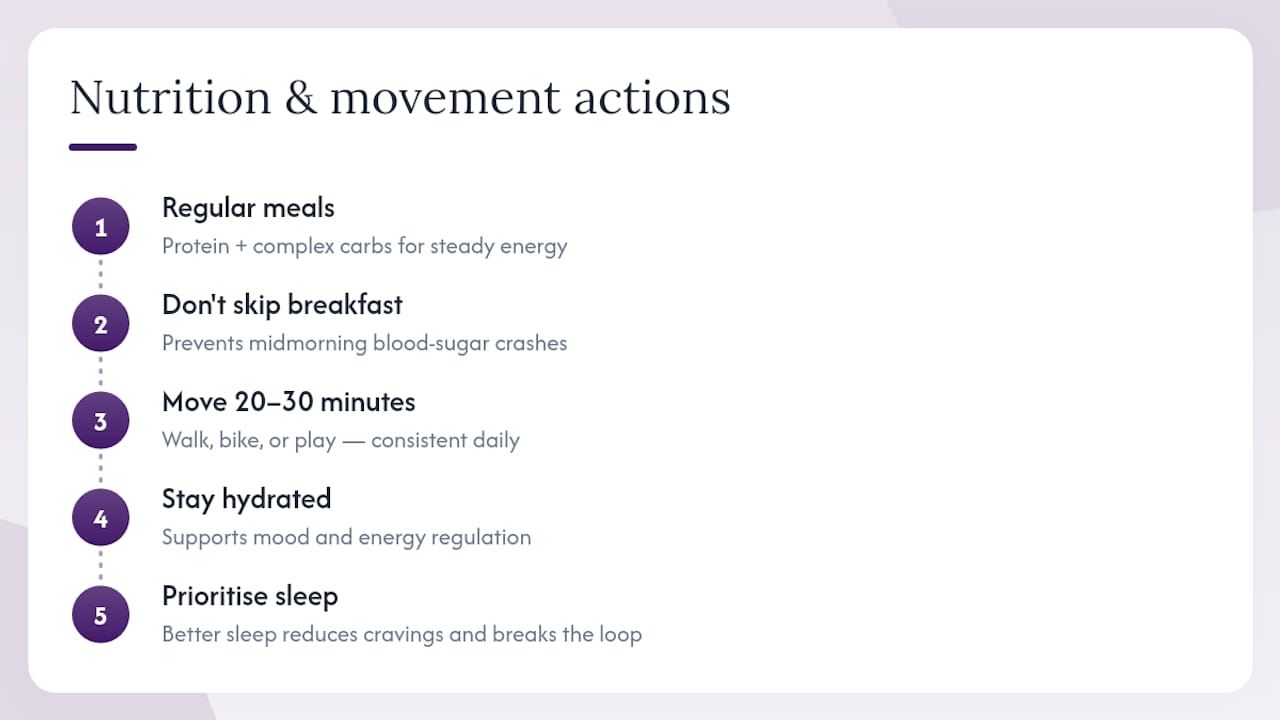
What your child eats and how much they move genuinely shapes how steady their mood stays, and it’s one of the most fixable pieces of this whole picture. Blood sugar crashes from skipped meals or high-sugar snacking amplify irritability, because a hungry adolescent brain has even less capacity for emotional control than a fed one.
Regular meals with protein and complex carbohydrates keep energy and mood steadier through the day. Skipping breakfast before school is a common, avoidable trigger for midmorning meltdowns.
Physical activity works almost like a release valve for the intensity puberty hormones create. Even twenty to thirty minutes of movement, a walk, a bike ride, a pickup game, burns off some of that hormonal charge and tends to leave kids calmer afterward rather than more wound up. It doesn’t need to be organized sports. It needs to be consistent.
Hydration and sleep round out the basics, and they interact with each other more than most parents realize: poor sleep increases cravings for sugary, low-nutrient food the next day, which then makes mood regulation harder that evening, which makes falling asleep harder again. Breaking that loop anywhere, better sleep, a solid breakfast, an afternoon walk, tends to improve the whole cycle rather than just one piece of it.
Common Myths About Puberty Mood Swings
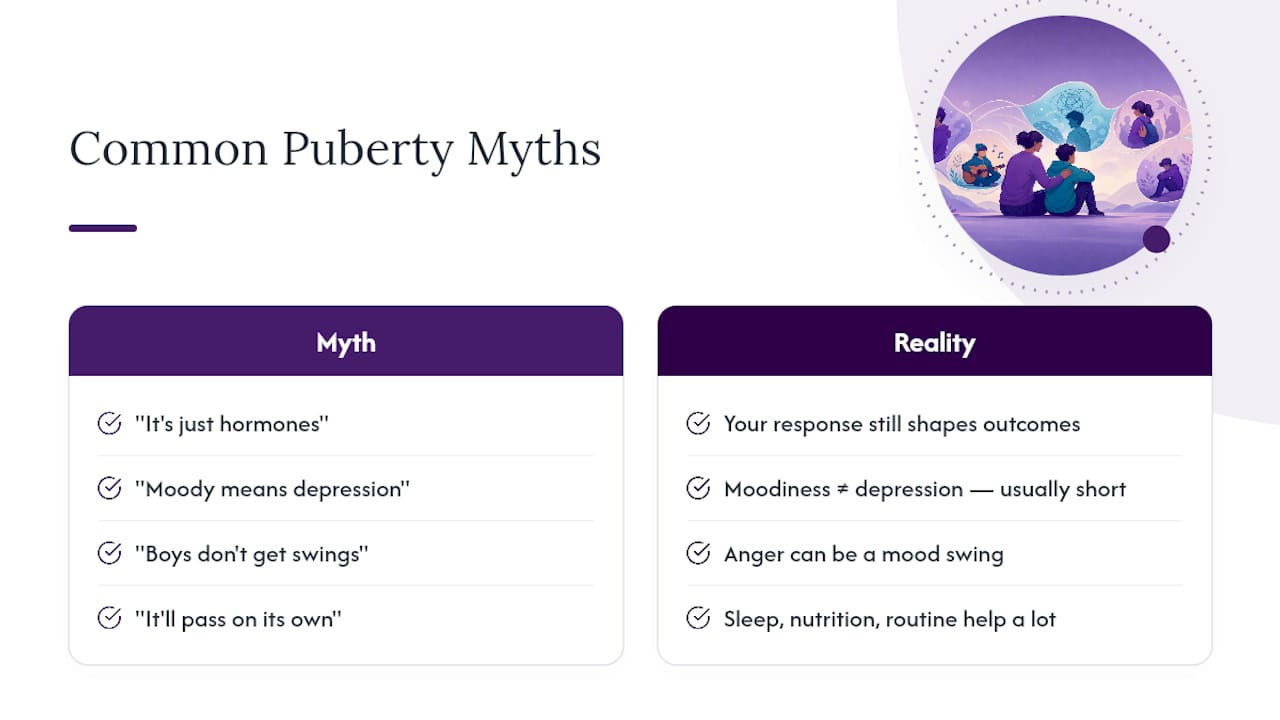
“It’s just hormones, nothing you do matters.” Hormones set the stage, but your response still shapes the outcome. A calm, validating reaction genuinely reduces how long and how intense an episode runs, even though it can’t prevent the hormonal shift itself.
“If she’s moody, she must be depressed.” Moodiness and depression are not the same thing. Most mood swings are short, situational, and resolve within days. Depression is defined by duration, severity, and functional impact, not by a single bad week.
“Boys don’t really get mood swings, they just get angry.” Anger is often a mood swing wearing a different costume. Dismissing male irritability as “just how boys are” is one of the most common reasons depressive symptoms in teenage boys go unnoticed.
“This will pass on its own, there’s nothing to actively do.” Some of it will pass with time, but sleep, nutrition, communication, and routine all measurably affect how rough that passage feels. Waiting it out passively is a choice, and usually not the most helpful one.
“Talking to your child about their feelings will make things worse.” The opposite tends to be true. Kids who feel dismissed escalate faster than kids who feel heard, even when the conversation itself is brief and imperfect.
How Themonthliesbox Thinks About Emotional Readiness
Every strategy in this article works better when a child already has language for what’s happening to their body and brain. That’s the gap Themonthliesbox built the Amethyst Method to close, moving kids through affirming, understanding, and equipping phases before the hard moments hit.
A simple example: pulling out an affirmation card during a rough evening check-in, something like “my feelings are big but they don’t define me”, gives a child a script for the moment instead of just a parent’s script. Paired with a self-soothe kit already stocked and ready, it turns an abstract conversation about puberty into something tangible a child can actually reach for.
— The
A Companion for the Conversations You’re Already Having
You’ve got the scripts, the sleep fixes, and the red flags to watch for. What often makes the difference is having something tangible to put in your child’s hands while you’re using them. The Amethyst Box was built for exactly that gap, pairing affirmation cards and educational materials with the practical supplies a girl needs when her body starts changing, so the emotional conversation and the physical preparation happen together instead of as two separate, awkward talks.

Inside, the Amethyst Method walks a girl through three phases, affirm, understand, and equip, giving her language for big feelings and comfort items for hard days, not just period supplies for the day it starts. If your daughter is approaching puberty and you want a head start on both the practical and emotional side, explore the Amethyst Box and see whether it fits where she is right now.
This article is general information, not a substitute for advice from a qualified doctor. Consult a qualified healthcare professional about your own circumstances before acting on anything here.
Sources
- Puberty and adolescent development — NCBI Bookshelf
- Navigating puberty — NIH News in Health
- The risks of earlier puberty — Contemporary Pediatrics
- Puberty — MedlinePlus
0 comments