

Most girls start puberty between about 8 and 13 years old. The first change parents usually notice is breast budding, not a period. Menstruation typically follows about two to three years later, averaging around age 12. If you notice breast development, pubic hair, or a growth spurt before age 8, or nothing at all by 13, it’s worth a call to the pediatrician.
TL;DR:
- Girls can begin puberty as early as age 8 and typically experience breast budding around ages 8 to 10, with menarche usually occurring two to three years later.
- The duration of puberty varies from 2 to 5 years, with some girls progressing faster or slower without indicating abnormal development.
- Developmental stages follow the Tanner scale, but variations such as pubic hair appearing before breast changes are normal and should not cause concern.
- Early or delayed puberty signs should prompt consultation if progression is rapid, order is unusual, or no signs are present by age 13.
- Supporting her emotionally involves normalizing feelings, respecting privacy, and preparing practical tools like period packs to boost confidence for her first period.
Table of Contents
- What Does the Puberty Timeline for Girls Look Like by Age?
- What Are the Tanner Stages and What Do They Mean?
- Do All Girls Go Through Puberty in the Same Order?
- When Should You Worry About Puberty Timing?
- How Should You Support Her Through the Emotional Changes?
- What Should You Pack for Her First Period?
- How Does a Curated Puberty-Prep Box Support Readiness?
- How Do Nutrition and Health Affect Puberty Timing?
- What Puberty Myths Do Parents Need to Unlearn?
- What Hormones Drive Puberty, and Why Do They Affect Mood Too?
- How Should You Handle Puberty-Related Skin Changes Like Acne?
- Why Does Puberty Take Longer for Some Girls Than Others?
- A Note From One Parent-Educator to Another
- A Ready-Made Way to Prepare Her for This
- Sources
What Does the Puberty Timeline for Girls Look Like by Age?
Every girl’s body runs on its own clock, but pediatric growth charts show a fairly consistent pattern once puberty gets going. Think of these age bands as a map, not a schedule. Your daughter doesn’t have to hit every marker exactly on time to be developing normally.
Before any visible changes start, a girl is in what doctors call the prepubertal baseline, sometimes labeled Tanner stage 1. Hormone levels are still low and there’s nothing to see yet, even though the pituitary gland is quietly starting to wake up the ovaries behind the scenes.
Between roughly ages 8 and 10, most girls show the earliest outward signs: a small, sometimes tender bump under one or both nipples (breast budding), a bit of light vaginal discharge, and the first wisps of pubic hair. Parents often mistake the discharge for something’s wrong, but a thin, clear-to-whitish discharge is one of the body’s normal ways of preparing for menstruation down the road.
From about 9 to 13, things pick up speed. This is usually when the growth spurt kicks in, body hair (including underarm hair) increases, and skin changes like acne start showing up thanks to rising oil production.
By 10 to 15 and sometimes a bit later, breast development continues toward its adult shape, and menarche typically arrives about two to three years after that first breast budding, which lines up with the Cleveland Clinic’s average age of 12 for a first period in the U.S. Growth slows noticeably after that first period, though it doesn’t stop overnight.
| Age Range | What’s Typically Happening |
|---|---|
| Before age 8 | Prepubertal baseline; no visible changes yet |
| 8 to 10 | Breast budding, light discharge, early pubic hair |
| 9 to 13 | Growth spurt, more body hair, acne begins |
| 10 to 15+ | Breast development continues, menarche usually occurs, growth slows |
None of these windows are hard deadlines. A girl who starts at 9 and one who starts at 12 are both well within the typical range, just moving at their own pace.
What Are the Tanner Stages and What Do They Mean?
Pediatricians describe puberty using five Tanner stages, a clinical framework that tracks breast and pubic hair development step by step. Knowing these stages helps you understand not just what is changing but roughly when to expect the next shift.
For breast development:
- Stage 1: Flat, prepubertal, no glandular tissue.
- Stage 2: Breast budding begins, often around age 8 to 10, sometimes tender to the touch.
- Stage 3: Breast tissue and areola continue to enlarge, commonly between 10 and 12.
- Stage 4: The areola and nipple form a separate contour from the breast, typically 11 to 13.
- Stage 5: Adult breast shape and size, usually reached by mid to late teens.
For pubic hair, the stages run in parallel: sparse, downy hair (Stage 2, often 8 to 10), coarser and darker hair spreading (Stage 3 to 4, roughly 10 to 13), and a full adult pattern (Stage 5, usually by 13 to 15).
The Cleveland Clinic notes the whole process generally spans 2 to 5 years from start to Tanner stage 5, which is why two girls who started at similar ages can still finish at noticeably different times. Tanner staging matters because it gives you and your pediatrician a shared, observable way to check whether growth is tracking as expected, rather than guessing off age alone.
Do All Girls Go Through Puberty in the Same Order?
The most common sequence runs breast budding, then pubic and underarm hair, then a growth spurt, then vaginal discharge, then menarche. But “most common” isn’t “only.” Bodies don’t always read the script in order.
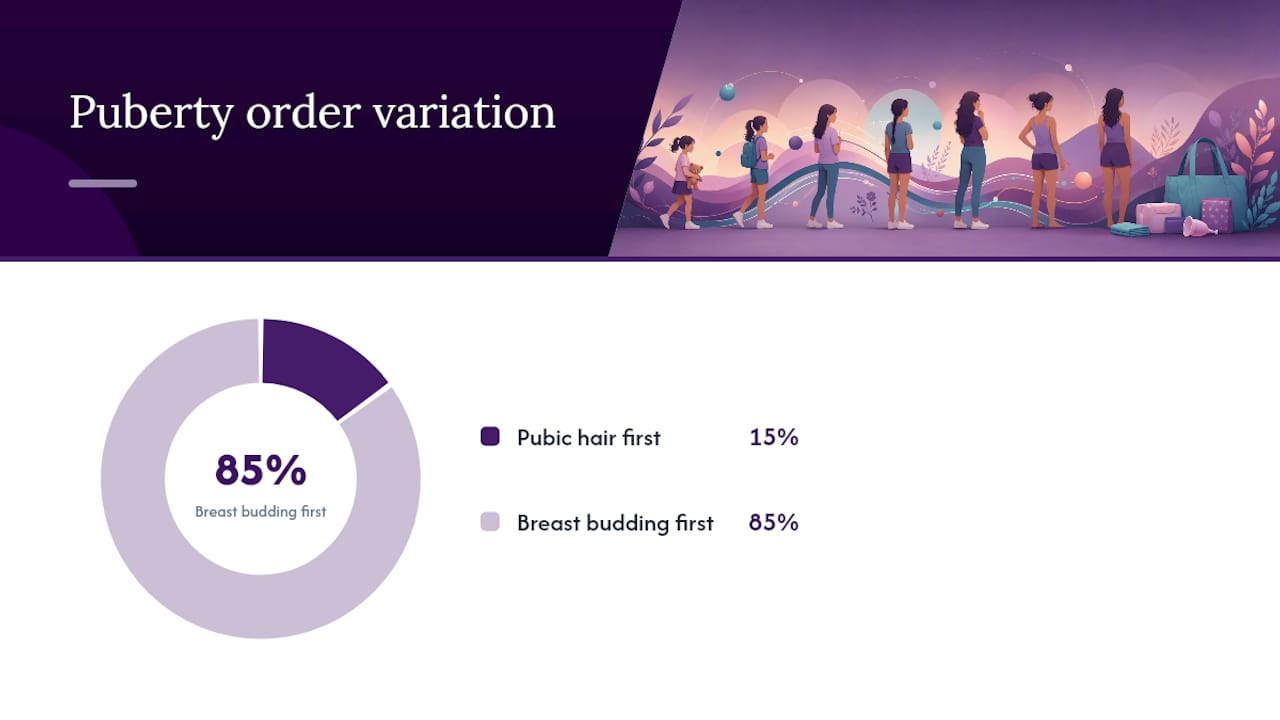
Pro Tip: If your daughter grows pubic hair before any breast changes, don’t panic and don’t assume something’s off. It’s simply one of the recognized normal variations, not a red flag on its own.
About 15% of girls develop pubic hair before breast budding, a pattern sometimes called adrenarche-first presentation. It’s still within normal limits, according to the American Academy of Pediatrics.
Timing relationships matter too:
- The growth spurt typically peaks before the first period, not after.
- Most girls gain another 1 to 2 inches after menarche, even though the fastest growth has already happened.
- A girl who suddenly shoots up several inches in one school year, then gets her period a few months later, is following a very typical pattern, not an early-warning sign.
When Should You Worry About Puberty Timing?
Two terms come up in pediatric offices: precocious puberty (signs starting before age 8) and delayed puberty (no signs at all by age 13). Both deserve a conversation with your pediatrician, though neither automatically means something is seriously wrong.
- Watch for rapid progression. A girl who goes from Tanner stage 2 to stage 4 in just a few months, rather than over a year or two, is worth flagging.
- Note the order of bleeding. Vaginal bleeding that shows up before any breast development at all is unusual and should be checked.
- Track flow and pain. Very heavy bleeding (soaking through protection hourly) or pain severe enough to disrupt school or sleep warrants a visit.
- Ask about no changes by 13. Johns Hopkins Medicine recommends evaluation if breast budding hasn’t started by that age.
A typical evaluation includes a growth chart review, sometimes a bone age X-ray, and occasionally hormone testing. In many cases, pediatricians recommend watchful waiting rather than immediate intervention, especially for minor timing shifts that fall just outside the average window.
How Should You Support Her Through the Emotional Changes?
Puberty rearranges more than her body. Rising and falling hormone levels genuinely affect mood, and researchers link these shifts to real changes in emotional regulation, not just teenage drama. Add in body-image worries and constant peer comparison, and you’ve got a lot happening beneath the surface.
A few things help:
- Normalize feelings out loud: “It’s completely normal to feel extra emotional right now, your body is doing a lot.”
- Ask open questions instead of yes/no ones: “What’s that been like for you?” invites more than “Are you okay?”
- Respect her privacy. Not every change needs to be a family discussion.
- Watch for warning signs that go beyond typical moodiness, like persistent sadness, severe anxiety, or pulling away from friends for weeks at a time. That’s when a pediatrician or counselor should get involved.
Pro Tip: If teasing at school or online is the issue, resist jumping straight to solutions. Say “That sounds rough, tell me more” before offering advice. Kids share more when they don’t feel rushed toward a fix.
What Should You Pack for Her First Period?
First periods rarely look like the neat, predictable cycles shown in health class diagrams. MedlinePlus notes that typical first periods last 2 to 7 days, and cycles can stay irregular for the first year or two while hormones settle into a rhythm.
A simple home and school kit removes a lot of first-day panic:
- A few pads sized for smaller frames, since adult-sized products can feel bulky and uncomfortable.
- A spare pair of underwear, tucked discreetly into a zip pouch.
- A small, unmarked bag she can keep in her backpack without drawing attention.
- A wet wipe or two for quick cleanup.
Practice matters more than lectures. Let her unwrap and handle a pad at home before she ever needs one at school, so the first real use isn’t also her first time figuring out the packaging.
| Situation | What To Do |
|---|---|
| Light, irregular flow in year one | Normal; track it loosely, no action needed |
| Heavy bleeding (soaking hourly) | Contact the pediatrician |
| Severe cramping disrupting daily life | Contact the pediatrician |
| No period by 13 with other signs present | Mention it at the next checkup |
How Does a Curated Puberty-Prep Box Support Readiness?
Preparation works best when it covers more than supplies. Themonthliesbox built the Amethyst Method around three phases: affirm her worth and normalcy during this transition, understand what’s actually happening in her body, and equip her with the practical tools to handle it confidently.
A box built on that method typically pairs period supplies sized for tweens with affirmation cards, plain-language educational materials, and a compact on-the-go pouch for school. It’s a different starting point than grabbing adult products off a store shelf and hoping the conversation happens on its own.
Some parents want to assemble everything themselves, and that’s a fine route too. Others prefer a ready-made option that opens the conversation for them, especially when the first-period talk feels harder to start than the shopping list.
How Do Nutrition and Health Affect Puberty Timing?
Body weight, general health, and nutrition all influence when puberty begins, sometimes more than genetics alone. The Merck Manual notes that improvements in nutrition and overall health have pushed the average age of puberty onset earlier than it was a century ago, across many populations.
Body fat plays a specific role here because fat tissue produces hormones, including leptin, that help signal the brain when the body has enough energy reserves to support reproduction. Girls with higher body weight for their age sometimes start puberty earlier, while girls dealing with chronic illness, significant undernutrition, or very intense athletic training can see puberty delayed.
This doesn’t mean parents should try to manage a daughter’s weight specifically to control puberty timing. That’s neither realistic nor healthy, and it risks turning a normal biological process into a source of shame. What matters more is steady access to balanced meals, enough sleep, and a level of physical activity that supports rather than depletes her energy. Chronic conditions like poorly managed diabetes or significant gastrointestinal issues can also shift timing, which is one more reason ongoing pediatric checkups matter, not just for growth tracking but for catching health issues that might be quietly influencing development.
What Puberty Myths Do Parents Need to Unlearn?
A surprising number of widely repeated puberty “facts” don’t hold up.
One common myth: getting a period means growth is basically over. In reality, most girls still gain another 1 to 2 inches after menarche, even though the fastest growth has already passed.
Another myth: puberty follows the exact same order for every girl. As covered earlier, roughly 15% of girls develop pubic hair before any breast budding at all, which is a normal variation, not a red flag.
A third misconception: irregular periods in the first year or two signal a problem. Cycle irregularity right after menarche is expected while hormone patterns settle, not evidence that something’s wrong.
And one more worth retiring: that discussing puberty early will somehow rush it along or make a girl grow up “too fast.” Puberty’s timing is driven by genetics, body composition, and health, not by how much a parent has explained beforehand. If anything, girls who understand what’s coming tend to handle the actual changes with less fear, not more.
What Hormones Drive Puberty, and Why Do They Affect Mood Too?
Puberty starts in the brain, not the body. The hypothalamus begins releasing a hormone that signals the pituitary gland, which in turn tells the ovaries to ramp up estrogen production. That single hormonal cascade is behind nearly every physical change on this timeline, from breast development to the growth spurt to eventual menstruation.
Estrogen doesn’t stay confined to reproductive development, though. It also interacts with brain chemistry, including areas tied to mood regulation, which helps explain why hormonal shifts and emotional ups and downs tend to arrive together rather than as separate events. That’s part of why hormonal changes are linked to genuine emotional shifts, not just typical adolescent moodiness dismissed as “hormones” in the eye-rolling sense.
Understanding this connection helps reframe how parents respond in the moment. A tearful reaction to something small isn’t necessarily about that specific thing. It’s often the hormonal weather underneath making everything feel bigger. That doesn’t mean every emotional moment gets a free pass, but it does mean patience serves everyone better than frustration when the mood swings show up right alongside the physical changes.
How Should You Handle Puberty-Related Skin Changes Like Acne?
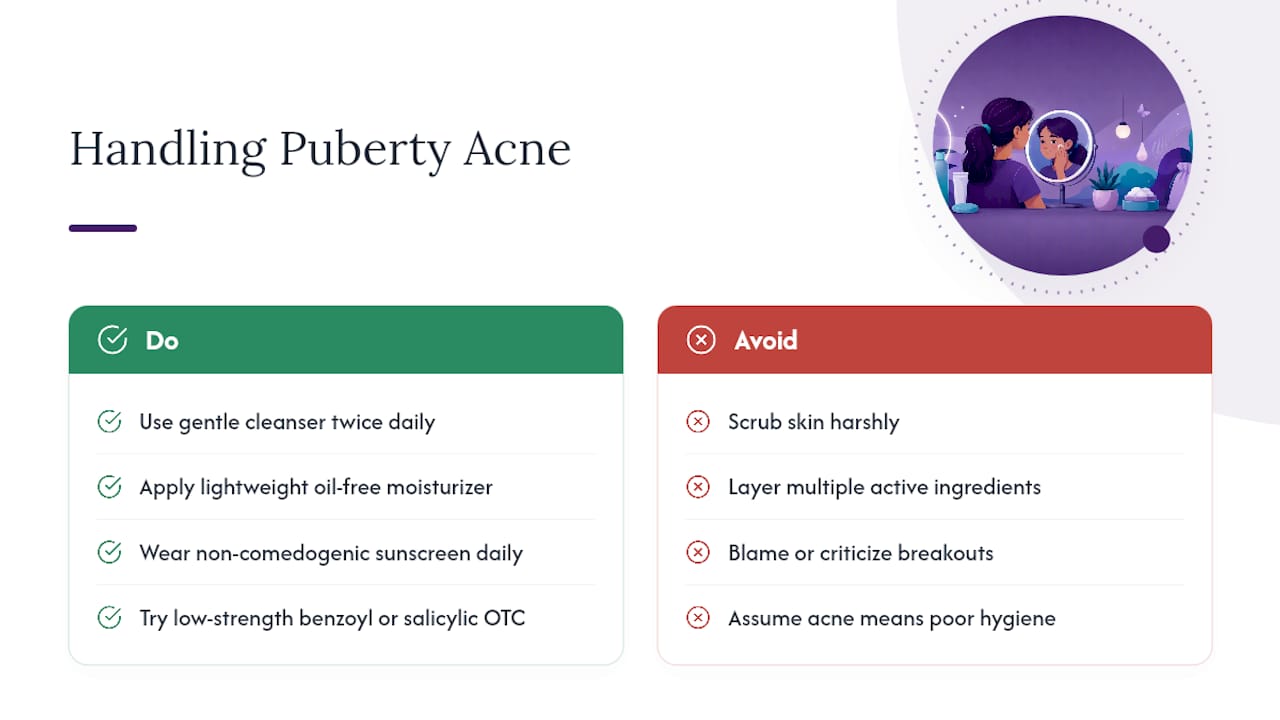
Rising hormone levels increase oil (sebum) production in the skin, and that’s the direct cause behind most puberty-related acne. It’s not caused by poor hygiene, and it’s not something a girl is doing wrong.
A simple, consistent routine works better than an aggressive one. A gentle cleanser used twice daily, a lightweight oil-free moisturizer, and a non-comedogenic sunscreen cover most needs without irritating still-adjusting skin. Harsh scrubbing or multiple active ingredients layered together often makes breakouts worse, not better, especially on skin that’s already more reactive during this stage.
For mild, occasional breakouts, over-the-counter options with benzoyl peroxide or salicylic acid in low concentrations are usually enough. If acne is widespread, painful, or leaving marks, that’s worth a conversation with a pediatrician or dermatologist rather than trial-and-error with drugstore products. Persistent cystic acne sometimes responds better to prescription treatment than anything available without one.
Beyond the physical side, how you talk about her skin matters. Offhand comments about breakouts, even well-meaning ones, can land harder than expected during a stage when body image is already sensitive. Treating acne as a normal, temporary part of puberty, rather than a problem to fix urgently, tends to reduce the stress around it.
Why Does Puberty Take Longer for Some Girls Than Others?
The full puberty process generally spans 2 to 5 years from first signs to Tanner stage 5, but where a girl falls in that range depends on a mix of genetics, body composition, and overall health. A girl whose mother started her period at 11 is statistically more likely to start around a similar age, though genetics is a tendency, not a guarantee.
Some girls move through the stages quickly, hitting menarche within 18 months of breast budding. Others take the full 3 years or slightly longer, and both patterns are considered normal. What matters more than speed is whether the sequence and pace stay reasonably consistent, without sudden jumps or long stalls that don’t fit her overall pattern.
Family history offers a useful, if imperfect, guide. If you started earlier or later than average yourself, it’s worth mentioning that to her pediatrician, since it provides helpful context for interpreting where she falls on the timeline. It’s not a reason to worry if her pattern looks different from yours, though. Siblings raised in the same household with similar nutrition and health can still start puberty a full two years apart from each other, and both siblings can be entirely within normal range.
A Note From One Parent-Educator to Another
I still remember fumbling through my first “your body is changing” conversation, overexplaining out of nervousness. What worked better, eventually, was short and calm: “Your body’s getting ready to grow up, and that’s a good thing, even when it feels weird.” When in doubt, lean on your pediatrician rather than guessing. That’s what they’re there for.
— The
A Ready-Made Way to Prepare Her for This
Themonthliesbox gives you a shortcut past the awkward blank page of “where do I even start” that most first-period conversations begin with. The Amethyst Box pairs tween-sized period supplies with affirmation cards and plain-language educational materials, built specifically for parents who want the conversation started for them, not just the products handed over.

It works well alongside the talks you’re already having, giving her something tangible to hold onto between conversations, and it fits neatly into a backpack for school-day peace of mind. For families preparing more than one daughter, or buying for a niece or goddaughter, the Bestie Bundle covers two girls at once for less than buying separately. If she’s already had her first period and just needs something compact for her bag, the On-The-Go Kit covers those daily essentials. Order the Amethyst Box now and have it ready before she needs it, not after.
This article is general information, not a substitute for advice from a qualified doctor. Consult a qualified healthcare professional about your own circumstances before acting on anything here.
Sources
- Puberty: Tanner stages for boys and girls — Cleveland Clinic
- Healthychildren
- The stages of puberty for girls — Johns Hopkins Medicine
- Puberty patient information — MedlinePlus
0 comments