

The best self care kit ideas for puberty prep come down to one clear plan: build a two-tier kit, one comprehensive Home Kit and one compact On-the-Go Kit, and introduce it before the first period arrives. Research published in the Journal of Adolescence found that adolescents who feel prepared to manage puberty report fewer symptoms of depression and anxiety. That is not a small thing. Preparedness is protective, and a well-packed kit is one of the most practical ways to build it.
Breast development and vaginal discharge often appear months to a couple of years before that. That window is your best opportunity to get a kit ready, have the first conversations, and let your daughter practice with supplies before she actually needs them.
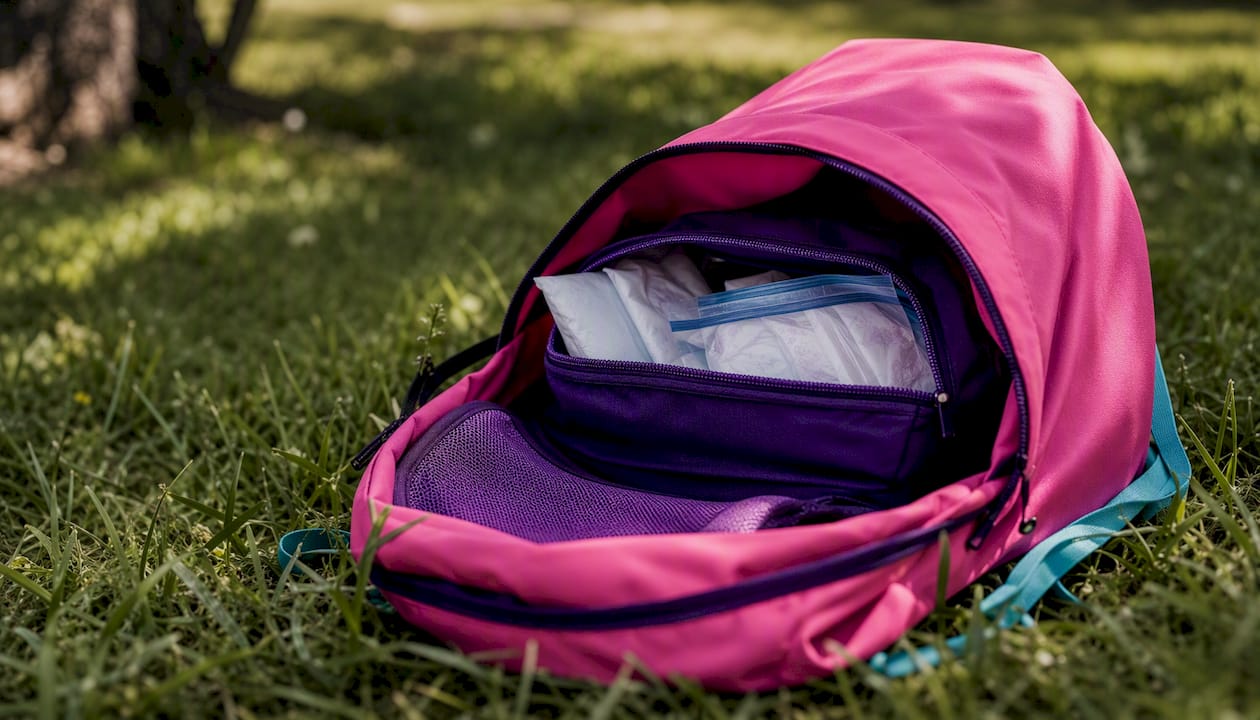
Pro Tip: If you only have time for one thing today, pack the On-the-Go pouch described in Section 3 and put it in her backpack. That single step covers the most common scenario: a period that starts at school.
Key Takeaways
A two-tier puberty-prep kit, one comprehensive Home Kit and one compact On-the-Go Kit, is the most practical and confidence-building approach for tween and teen girls preparing for their first period.
| Point | Details |
|---|---|
| Build two tiers | Assemble a full Home Kit for learning and a compact On-the-Go pouch for school and activities. |
| Pack the pouch first | Include 2–3 pads, panty liners, spare underwear, unscented wipes, and a resealable bag. |
| Practice before the first period | Walk through pad use, changing frequency, and the school scenario before she needs it. |
| Know the red flags | See a pediatrician if no period by 15, severe unrelieved pain, or very heavy bleeding occurs. |
| Themonthliesbox ready-made option | The Amethyst Box and On-The-Go Kit cover both tiers with Amethyst Method-aligned supplies and affirmations. |
Table of Contents
- Why does a two-tier kit work so well for tweens?
- What goes in the On-the-Go kit?
- What goes in the full Home Kit?
- How do you teach pads, tampons, and period underwear before the first period?
- What’s normal, and when should you call the pediatrician?
- How do you build confidence and start the conversation?
- How do you pack for school, sleepovers, and sports?
- Reusable vs. disposable: which is right for your tween?
- What parents often get wrong about puberty prep
- The Monthlies Amethyst Box and On-The-Go Kit
- Sources
Why does a two-tier kit work so well for tweens?
A two-tier kit matches how real life actually works. Your daughter spends most of her day away from home, so a single large box on her bathroom shelf does not cover her at school, at a friend’s house, or at practice.
The Home Kit is the full starter box: multiple product types, educational materials, comfort items, and confidence-building tools. The On-the-Go Kit is a small, discreet pouch that lives in her backpack or locker and covers the unexpected.
The split matters developmentally, too. Research on pubertal self-efficacy shows that feeling capable of managing puberty is directly tied to lower anxiety. A girl who knows she has supplies with her, and knows how to use them, carries that confidence into every school day.
Cycles are often irregular for 2–3 years after menarche, per Cleveland Clinic guidance, which means unpredictability is normal. The On-the-Go Kit is her safety net during that whole window.
What goes in the On-the-Go kit?
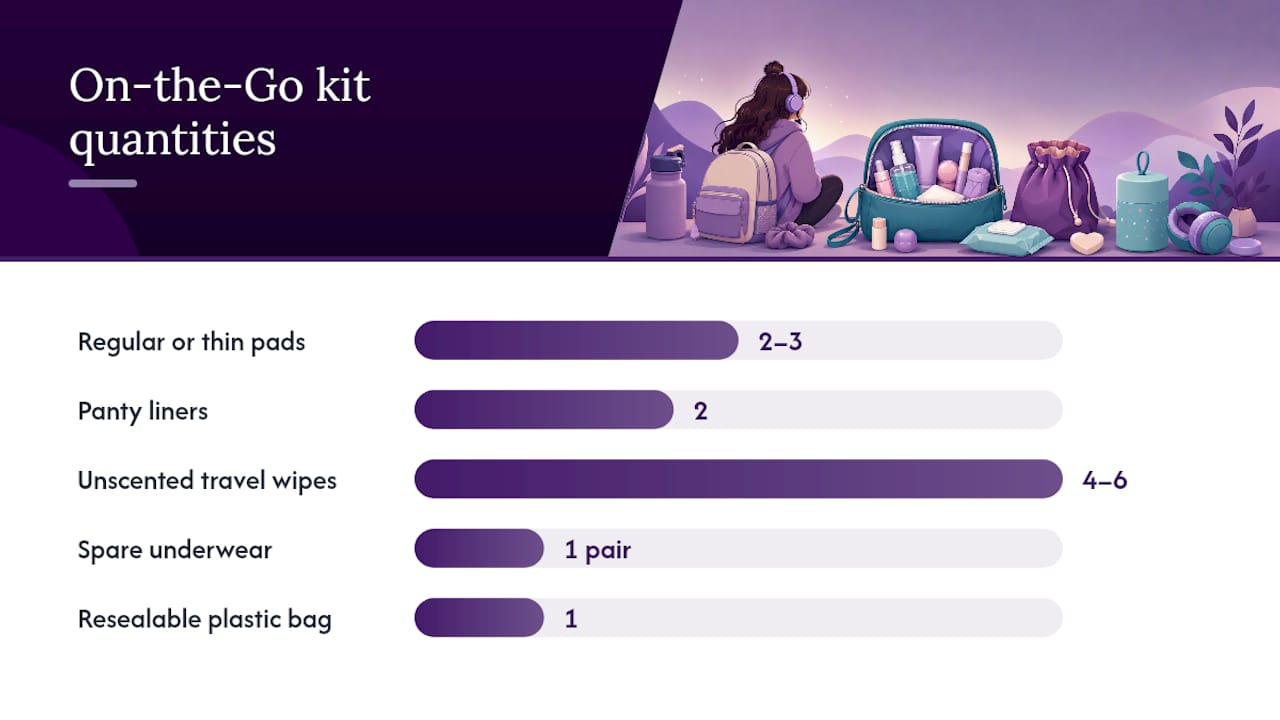
WebMD recommends packing a small period kit for school with pads, panty liners, a spare pair of underwear, wipes, and a resealable bag. Here is the full checklist, sized for a tween’s backpack.
| Item | Quantity | Notes |
|---|---|---|
| Regular or thin pads | 2–3 | Individually wrapped for discretion |
| Panty liners | 2 | For lighter days or discharge |
| Spare underwear | 1 pair | Dark-colored, rolled tight |
| Unscented travel wipes | 4–6 | Fragrance-free only |
| Resealable plastic bag | 1 | For soiled items |
| Small OTC pain reliever | 1 dose | Only if school policy allows |
| Waterproof zip pouch | 1 | Discreet, solid color or subtle print |
For the pouch itself, look for something roughly pencil-case sized with a waterproof lining and a secure zipper. A solid color or subtle print keeps it discreet. Tuck a small affirmation card inside so the first time she opens it feels supported, not scary.
Pro Tip: Rotate disposable supplies every 6–12 months so nothing expires in the bottom of her bag. A quick swap at the start of each school year takes two minutes.
For a detailed period bag must-haves list, Themonthliesbox has a parent-friendly guide that maps directly to this checklist.
What goes in the full Home Kit?
The Home Kit is where you build real skills and comfort. Think of it as a starter box that grows with her. A solid first period kit covers three categories: supplies, education, and confidence.
Core supplies:
- Pads in multiple absorbencies (light, regular, overnight)
- Panty liners
- Period underwear (one or two pairs as a backup option)
- Sample tampons, only if she is curious and you have walked through how to use them
- A heating pad or disposable heat patches for cramps
- Stain remover stick
- A small supply organizer or drawer caddy
Education and confidence items:
- A simple, age-appropriate how-to guide
- Practice pads for demonstration before the real thing
- Affirmation cards (the Amethyst Method uses these to build confidence alongside practical prep)
- A journal or sticker activity sheet
- Age-appropriate reading material about puberty
Assembling this yourself typically runs $40–$80 depending on brand choices. Choosing fragrance-free, hypoallergenic products across the board reduces the risk of irritation, which is especially worth noting for tweens whose skin is more sensitive during hormonal changes.
Pro Tip: Skip scented pads, sprays, and anything marketed as “freshening.” Unscented is always the safer choice for young skin.
How do you teach pads, tampons, and period underwear before the first period?
Practice before the first period is one of the most effective things you can do. Planned Parenthood advises using practical demos and micro-conversations rather than saving everything for one big talk.
- Start with pads. Show her how to peel the backing, place it in underwear, and wrap it for disposal. Use a clean pad and a spare pair of underwear so she can try it herself.
- Explain changing frequency. Pads should be changed every 4–6 hours, or sooner if needed. Overnight pads can last through sleep.
- Introduce tampons only when she is ready. If she expresses interest, walk through the steps together using the instruction insert. Cover TSS basics: use the lowest absorbency that works, change every 4–8 hours, and never leave one in overnight.
- Try period underwear as a low-pressure option. Many tweens find these easier to start with. They wash like regular underwear and can be worn as a backup with a pad.
- Practice the school scenario. Role-play what she would do if her period started in class: go to the restroom, use her On-the-Go pouch, and if needed, ask the school nurse.
Pro Tip: Keep a practice period self-care routine light and low-stakes. Frame it as learning a new skill, not preparing for something scary.
Menstrual cups are worth mentioning for older teens who are comfortable with their bodies, but most tweens do better starting with pads or period underwear. Introduce cups only after she has used tampons confidently.
What’s normal, and when should you call the pediatrician?
Most girls get their first period between ages 10 and 15, with the Cleveland Clinic citing about 12 as the average. Breast development and vaginal discharge typically appear months to a few years before menarche. Early cycles are often irregular, and that is completely normal for the first 2–3 years.
Irregular cycles in the first two to three years after menarche are expected. The body is still calibrating its hormonal rhythm.
Call the pediatrician if you notice any of these:
- No period by age 15
- No period within 3 years of breast development starting
- Severe cramps that do not respond to OTC NSAIDs like ibuprofen
- Bleeding that soaks through a pad or tampon in under an hour for several hours in a row
- Periods that were regular and then stopped for 3 or more months
These are the red flags that warrant a conversation with an adolescent medicine specialist, not a reason to panic, but not something to wait on either.
How do you build confidence and start the conversation?
The research is clear: pubertal self-efficacy is something parents can actively build. You do not need a perfect script. You need small, repeated moments.
Conversation starters that work:
- While shopping: “Let’s pick out some supplies together so you have them ready.”
- After a TV moment: “Did you notice that character mentioned her period? What do you already know about that?”
- Casually: “I got my first period at school and I wasn’t ready. I want you to feel totally prepared.”
Activities that build self-efficacy:
- Role-play the school scenario once, lightly and without pressure
- Try a “change the channel” routine: when cramps or mood dips hit, she picks a song, does three deep breaths, or takes a short walk
- Journaling prompts: “What would make me feel more ready?” or “What questions do I still have?”
Building self-care practices that support mental health does not require big gestures. Consistent small habits, practiced before they are needed, are what actually stick.
How do you pack for school, sleepovers, and sports?
Each scenario has slightly different needs, but the On-the-Go pouch is the foundation for all of them.
School: Keep the pouch in the main compartment of her backpack, not buried at the bottom. Teach her the school nurse’s name and location. If OTC pain relief is in the kit, check the school’s medication policy first and include a signed parent note if required. For more on handling a period at school, Themonthliesbox has a practical parent guide.
Sleepovers and camp: Pack two extra pairs of underwear, a few additional pads, disposable heat patches, and a small zip bag for privacy. If OTC medication is going with her, include a written caregiver note.
Sports and travel: A waterproof pouch is non-negotiable for pool days or high-activity events. Period underwear worn under athletic shorts works as a backup layer. On heavy flow days, doubling up with a pad and period underwear gives extra confidence.
Pro Tip: Label the pouch with her name on the inside only, not the outside. Privacy matters, and a discreet pouch she feels good carrying is one she will actually use.
Reusable vs. disposable: which is right for your tween?
Both have a place in a well-built kit. The right choice depends on age, comfort level, and school logistics.
- Disposable pads and liners: Simplest to start with, no cleaning required, easy to carry and discard at school. Lower upfront cost, though ongoing expense adds up.
- Period underwear: Eco-friendly, comfortable, and great as a backup layer. Requires rinsing and washing, which can feel awkward at school. Best introduced at home first.
- Menstrual cups: Lowest long-term cost and waste, but require comfort with insertion and thorough cleaning. Most appropriate for older teens who have already used tampons.
For tweens just starting out, disposable pads and panty liners are the most practical first choice. Introduce reusables gradually as she gets comfortable.
Safety notes that apply to every product:
- Always choose unscented, fragrance-free options
- Avoid douches and scented sprays entirely
- Look for “dermatologically tested” or “hypoallergenic” on the label
- Tampons should always be the lowest absorbency that works for the flow
What parents often get wrong about puberty prep
Most parents wait too long, and then try to cover everything in one conversation. That approach puts pressure on both of you and rarely lands the way you hope.
The more useful frame is this: puberty prep is not a single event. It is a series of small, low-stakes moments that add up to a girl who feels genuinely ready. A kit is a physical anchor for those conversations. It says, “We thought about this together, and you are supported.”
The Amethyst Method, which Themonthliesbox built its entire product line around, reflects exactly this. Affirm first, then help her understand what is happening, then equip her with the practical tools. That sequence matters. Confidence comes before the supplies, not after.
The Monthlies Amethyst Box and On-The-Go Kit
If building a kit from scratch feels like a lot to coordinate, Themonthliesbox has done the work for you.
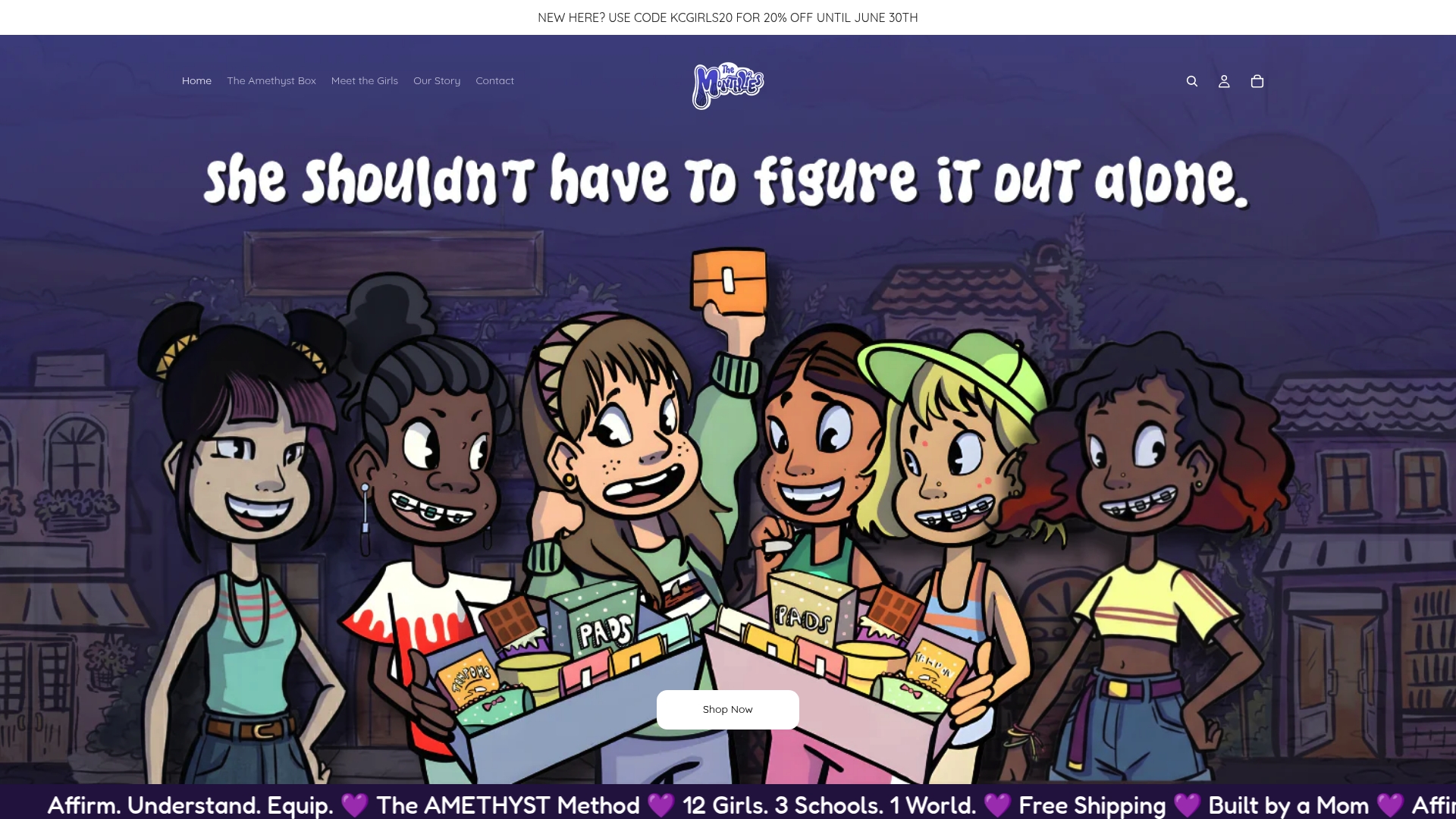
The Amethyst Box is a ready-made Home Kit built around the Amethyst Method. It includes tween-sized period supplies, affirmation cards, an educational insert, and comfort items, all curated to affirm, educate, and equip in one box. The On-The-Go Kit is the compact, backpack-ready companion that maps directly to the checklist in Section 3.
Buying both together as the Bestie Bundle saves $40 and covers both tiers at once. It is also a thoughtful gift option for caregivers or mentors who want to give something genuinely useful. Visit Themonthliesbox to see the full range and find the right fit for your daughter.
Sources
- Pubertal self-efficacy research - Journal of Adolescence (Cornell) - PubMed
- What should I teach my middle-schooler about their body? - Planned Parenthood
- All about menstruation - WebMD
This article is general information, not a substitute for advice from a qualified doctor. Consult a qualified healthcare professional about your own circumstances before acting on anything here.
0 comments