

Be present, talk early and often instead of saving it for one big conversation, and put together a simple first-period pouch now. Layered, low-pressure conversations reduce stigma and keep the door open for questions, according to the Mott Poll on children’s health. A brand offering curated puberty-first period kits can help you handle the practical side while you focus on staying close.
TL;DR:
- Building a small, discreet first-period pouch with beginner-sized supplies and practicing quick, clear instructions can reduce panic when her period begins unexpectedly.
- Engaging in frequent, short conversations about puberty, adjusted to her age, fosters trust, questions, and emotional regulation without the pressure of one big talk.
- Establishing a support network with a trusted female relative and the school nurse, along with a prepared response plan, ensures backup without increasing anxiety.
- Maintaining steady, low-pressure presence through shared activities helps her feel supported and understood while she navigates hormonal mood swings and body changes.
- Using simple, factual language about hygiene and body autonomy, along with regular reinforcement, promotes healthy self-care and respectful boundaries over time.
Table of Contents
- Single Father Puberty Guide: Your First 30 Days
- How to Talk About Puberty Without the One Big Talk
- Building a Period Kit Without Making It Weird
- Staying Close While She Pulls Away a Little
- Puberty Timeline: What’s Normal and When to Call the Doctor
- Finding Backup: Mentors, School Staff, and Other Resources
- What the Research Actually Backs Up
- What Sons Experience Differently During Puberty
- Where Single Fathers Get Stuck (and How to Get Unstuck)
- Helping Her Feel Good in a Body That’s Changing Fast
- Hygiene and Self-Care Conversations That Don’t Feel Like a Lecture
- Talking About Consent and Relationships as She Gets Older
- A Single Dad’s Short Vignette: What Worked for Us
- Making the First Kit Simple: The Amethyst Box
- Sources
Single Father Puberty Guide: Your First 30 Days
You don’t need to become an expert overnight. You need a plan you can actually follow, starting this week.
Days 1 to 7: Get grounded.
- Read one short, practical resource on talking to your daughter about periods, like The Monthlies’ guide on starting the conversation, so you’re not improvising from scratch.
- Notice her age and stage. A 9-year-old needs different words than a 13-year-old.
- Pick one calm, low-pressure moment this week (a car ride, a walk, folding laundry) to say something small and open ended.
Days 8 to 14: Build the pouch. Assemble a small, discreet first-period pouch together or on your own if she’s not ready to help. Include:
- A few pads sized for beginners (thinner, more absorbent options work better than adult sizes)
- A small pack of flushable wipes
- A spare pair of underwear
- A travel-size pain reliever approved for her age
- A zip pouch small enough for a backpack
Store one pouch in her school bag and a backup at home, in a drawer she can access without asking.
Days 15 to 21: Practice the moment. Say the words out loud once, even if it feels awkward alone in your car. Something like, “If your period starts and I’m not around, here’s exactly what to do.” Rehearsing it once means you won’t fumble when it actually happens.
Days 22 to 30: Set up backup support. Identify one trusted adult, a relative, family friend, or your daughter’s school nurse, and share contact information with your daughter. Write the school nurse’s name and number somewhere she can find it fast. This single step removes most of the panic from a first period happening at school.
How to Talk About Puberty Without the One Big Talk
Skip the single sit-down “talk.” Experts recommend frequent, short, layered conversations instead. Kids are more likely to ask follow-up questions when the topic comes up naturally and repeatedly, rather than as a scheduled event, according to research from the Mott Poll. One conversation plants a seed. Ten short ones over a year build real understanding.
Listening beats fixing almost every time. When your daughter mentions she feels weird or embarrassed about a body change, the instinct is to jump in with a solution. Resist it. Dads often try to fix problems immediately, but pediatric guidance points toward listening and validating first, which helps her regulate her own emotions and keeps her coming back to you with the next hard thing.
Adjust your language by age:
- Ages 7 to 10: “Your body is going to start changing over the next few years. That’s normal and it happens to every girl.”
- Ages 10 to 12: “You might notice hair growing in new places or your chest starting to change. It can feel confusing, and that’s okay.”
- Ages 13 to 15: “Periods, mood shifts, all of it, it’s your body doing exactly what it’s supposed to do. Tell me what’s actually on your mind.”
Pro Tip: Ask one open question and then stay quiet for ten seconds. Most dads fill silence too fast, and that’s exactly when she’d add the real thing on her mind.
Boundaries matter here too. If she doesn’t want to talk right now, say “Okay, I’m here when you do” instead of pushing. Staying emotionally available without forcing the moment is what keeps trust intact long term. Explore practical scripts built specifically for dads if the exact words still feel out of reach.
Building a Period Kit Without Making It Weird
The goal isn’t just supplies. It’s making the process feel like something she’s part of, not something done to her.
What belongs in the kit:
- Beginner-sized pads or liners (skip adult overnight sizes for the first kit)
- Flushable wipes
- A travel pain reliever
- One spare pair of underwear, folded small
- A zip pouch, ideally one she picks out herself
Store the main pouch in a bathroom drawer she controls, and pack a second, smaller version for her backpack. Let her choose the pouch color or pattern. That small decision turns a supply kit into something that feels like hers, not a medical device you handed her.
Pro Tip: Build the school kit together on a Sunday afternoon, not right before a first period. Doing it early, when there’s no urgency, takes the pressure off completely.
For the school piece, a five-minute conversation with the school nurse goes a long way. Let the nurse know your daughter may need supplies or a private space, and ask what the school already keeps on hand. Some schools stock basic supplies in the nurse’s office already. Confirm before assuming. If your daughter is comfortable, walk her through exactly what to say if she needs to leave class: “I need to see the nurse” is often enough.

Practical steps like these, prepping a pouch and rehearsing a short response, measurably reduce anxiety for both of you when the actual first period arrives.
Staying Close While She Pulls Away a Little
Mood swings during puberty are hormonal, not personal. Knowing that doesn’t make them easy to sit through, but it helps you respond instead of react.
Presence does more work than most dads expect. You don’t need long, deep conversations every day. Shared low-pressure time, driving to practice, cooking dinner together, watching a show she picked, keeps the connection alive without forcing intimacy. Research on father involvement consistently links this kind of steady presence to stronger self-esteem and emotional adjustment in adolescents.
When she’s upset, try naming the feeling instead of solving it:
- “That sounds really frustrating.”
- “It makes sense you’d feel embarrassed about that.”
- “I’m not going anywhere, even when you’re mad at me.”
If a conversation goes sideways, and it will sometimes, repair matters more than getting it right the first time. A simple “I didn’t handle that well, can we try again?” rebuilds trust faster than pretending it didn’t happen.
Watch for signs that go beyond normal mood swings: withdrawal from everything she used to enjoy, sleep or appetite changes lasting weeks, or talk of hopelessness. That’s when a school counselor or her pediatrician should enter the picture, not as a failure on your part, but as the next right step. Read more on handling emotional responses to a first period for specific repair language.
Puberty Timeline: What’s Normal and When to Call the Doctor
Puberty for girls typically starts somewhere between ages 8 and 13. Breast development usually shows up first, followed by pubic hair growth and a growth spurt. A first period commonly arrives about two to three years after those initial signs, often landing somewhere between ages 10 and 15.
Sequence to expect:
- Breast budding (often the earliest visible sign)
- Pubic and underarm hair growth
- A noticeable growth spurt
- First period, usually trailing the other signs by a couple of years
Red flags worth a pediatrician visit:
- No signs of puberty at all by the mid-teens
- Signs starting unusually early (before age 8)
- Periods that are extremely heavy, painful, or wildly irregular months in
- Rapid or alarming changes that seem out of step with the usual pace
If you’re heading to a pediatric visit, jot down what you’ve noticed and when it started. That timeline helps the doctor assess whether things are tracking normally, and UNC HealthTalk’s guidance backs seeing a doctor for anything outside the expected range.
Finding Backup: Mentors, School Staff, and Other Resources
You don’t have to be the only adult she talks to, and you shouldn’t try to be.
A trusted female mentor, an aunt, a family friend, a coach, gives her another comfortable option when she’d rather not talk to you about something. Single fathers benefit from enlisting a trusted woman as a resource, ideally introduced casually and with your daughter’s input, not sprung on her.
School nurses and counselors are an underused backup. A five-minute introduction at the start of the year means she already knows who to find if something comes up during school hours.
Quick resource list:
- One trusted female relative or family friend, introduced ahead of need
- The school nurse’s contact info, saved in her phone
- A short internal guide like why daughters avoid period talks if conversations keep stalling
What the Research Actually Backs Up
The advice in this guide isn’t guesswork. It’s built on a small set of consistent findings.
Layered, age-appropriate conversations, spread across months instead of packed into one talk, correlate with kids asking more questions and carrying less shame around puberty topics.
That’s the core finding from the Mott Poll on children’s health, and it’s the single biggest reason this guide leans on “often and early” over “once and thorough.”
On timing, UNC HealthTalk’s parent guide sets the expected window at ages 8 to 13 for the start of puberty, with a pediatrician visit warranted for absent or unusually early signs. On the emotional side, practitioner guidance consistently favors staying alongside your daughter, present but not hovering, over pulling back when things get awkward.
What Sons Experience Differently During Puberty
If you’re also raising a son, or comparing notes with other single fathers, the physical and emotional path looks different for boys, even though the underlying message, talk early and often, still applies.
Boys typically start puberty a bit later than girls, often between ages 9 and 14. The first visible sign is usually testicular growth, not the growth spurt most people expect. Voice changes, facial hair, and broader shoulders follow over the next few years. Emotionally, boys often experience the same irritability, self-consciousness, and social anxiety that girls do, but they’re frequently given less permission to talk about it openly.
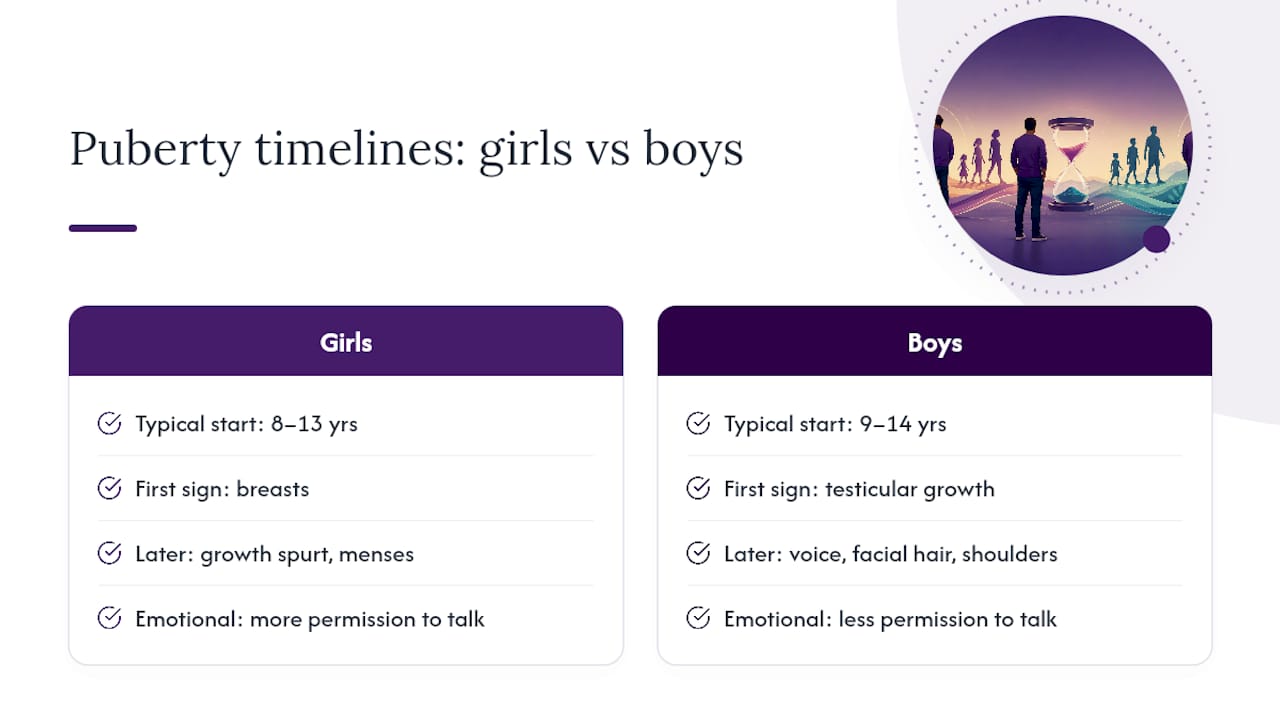
That gap matters. Boys navigating the teenage years without a consistent adult conversation partner tend to internalize confusion rather than ask questions. The fix mirrors what works for daughters: short, casual check-ins rather than one loaded conversation, and modeling that it’s normal to talk about body changes, mood shifts, and the general strangeness of growing up.
If you’re a single dad supporting boys through puberty alongside a daughter, resist the urge to treat one child’s puberty as the “big topic” and the other’s as an afterthought. Both need the same layered, ongoing approach, just with different specifics. The scripts change. The commitment to staying present and available doesn’t.
Where Single Fathers Get Stuck (and How to Get Unstuck)
The most common single dad parenting challenge here isn’t a lack of love. It’s a lack of a script, and sometimes a quiet fear of getting it wrong.
Many fathers hesitate because they never experienced a period personally and worry they’ll say the wrong thing or miss a cue their daughter is dropping. That hesitation, left unaddressed, often reads to a daughter as disinterest rather than uncertainty. The fix isn’t confidence. It’s action despite the discomfort: bringing up the topic even when you’re not sure you’re doing it right.
Another recurring issue is timing. Without a co-parent to flag “hey, she’s starting to show signs,” some single fathers miss the early window and end up reacting to a first period instead of preparing for one. Building a simple pouch and having one practiced response, covered earlier in this guide, closes that gap regardless of whether you catch every physical cue.
Finally, isolation compounds the problem. Single fathers sometimes assume they need to handle every conversation alone, when pulling in a trusted female mentor or the school nurse isn’t a failure. It’s a smart delegation of exactly the parts where you may genuinely be less equipped to relate. The dads who navigate this well aren’t the ones who know everything. They’re the ones who ask for a second set of hands early.
Helping Her Feel Good in a Body That’s Changing Fast
Body image during puberty forms early and sticks around. What you say, and what you don’t say, matters more than most dads realize.
Avoid commenting on weight, shape, or size at all, even positively. “You’re getting so tall” is fine. “You’re filling out” lands very differently than intended. Neutral, factual language about growth keeps the focus on development rather than appearance.
Praise effort and character over looks by default. “You handled that really well” builds different self-esteem than “you look great today.” Both have a place, but if looks-based comments dominate, she learns that’s the currency that matters most.
Model healthy talk about your own body too. Casual complaints about your weight or appearance teach more than any lecture about self-esteem ever will. Kids absorb the tone adults use about their own bodies and apply it to themselves.
When she expresses frustration about her changing shape, mirror it back without correcting it immediately: “It makes sense that feels strange, your body’s doing a lot right now.” Rushing to reassure (“you look great!”) can actually shut down the conversation, because it skips past what she’s actually feeling.
Books and media matter here too. If she’s consuming a lot of content that ties worth to appearance, a casual conversation about what she’s seeing, without banning it outright, keeps you in the loop rather than positioned as the enemy of her interests.
Hygiene and Self-Care Conversations That Don’t Feel Like a Lecture
Puberty brings new hygiene needs that can feel awkward to explain, but framing them as normal upkeep rather than a big deal makes all the difference.
Start with basics before periods even enter the picture: daily showers, deodorant, and clean clothes become more important once sweat glands and oil production ramp up. A simple, “Your body’s changing, so you might need to shower more often now,” said once and left alone, does more than a long explanation.
For period-specific self-care, walk through the practical routine rather than assuming she’ll figure it out: how often to change a pad, what a basic self-care routine looks like, and what’s normal versus what warrants a doctor visit. Keep it factual and matter of fact, the same tone you’d use explaining how to use a new appliance.
Skin changes, acne especially, deserve their own quick conversation. Reassure her it’s common and manageable rather than something to hide. A basic face wash and consistency matter more than an expensive product lineup.
Pro Tip: Keep a small stock of hygiene basics, deodorant, face wash, spare pads, restocked without her having to ask. Running out quietly becomes a source of stress that’s easy to prevent.
Normalize asking questions by asking a few of your own occasionally: “Do you need anything restocked?” said casually every few weeks keeps supply issues from becoming emergencies.
Talking About Consent and Relationships as She Gets Older
Puberty is also when relationship and consent conversations start mattering, well before dating becomes relevant.
Start with body autonomy basics early and simply: she gets to decide who hugs her, who she’s comfortable with, and that no one, including family, gets automatic access to her space or body. This groundwork makes later relationship conversations far easier, because the core concept, her choices about her own body matter, is already established.
As she moves into tweens and early teens, widen the conversation to include what respect looks like in friendships and eventually relationships: someone who listens when she says no, who doesn’t pressure her, who respects a change of mind. Real examples, from shows she watches or situations among friends, work better than abstract lectures.
Keep the tone curious rather than interrogative. “What do you think makes a good friend or boyfriend?” opens more doors than “you need to watch out for boys.” The first invites her thinking. The second positions you as an obstacle to work around rather than a resource to bring questions to.
Revisit this topic in small doses as she gets older rather than treating it as a single milestone conversation. The layered approach that works for puberty basics applies just as well here: short, repeated, low-pressure check-ins beat one serious sit-down every time.
A Single Dad’s Short Vignette: What Worked for Us
I built the pouch on a random Tuesday, no lecture planned, just packing a bag while my daughter did homework nearby. She asked what it was for. I told her straight, no big buildup: “For whenever your period starts. So you’re not stuck without it.”
She got quiet, then asked one question about the pain reliever. That was it. No dramatic talk, just one honest exchange.
Later that week I fumbled a follow-up conversation badly, got defensive when she pushed back on something small. I apologized that night. “I got that wrong earlier. Can we try again?” She said okay. That was the whole repair.
The lesson: it’s not about getting the big talk perfect. It’s about staying in the routine of showing up, again and again, even after you mess one up.
— The
Making the First Kit Simple: The Amethyst Box
Themonthliesbox built the Amethyst Box for exactly the moment this guide is about the point where you need a practical, ready-made first-period kit and don’t want to guess what belongs in it.

The box works through what Themonthliesbox calls the Amethyst Method, three phases: affirm, understand, and equip. The affirmation cards give her language for confidence when the topic feels awkward. The educational materials explain what’s actually happening in her body, in age-appropriate terms. And the practical supplies, sized right, packed right, mean you’re not standing in a store aisle guessing which pads fit a first-timer.
For a single dad, the real value is speed and confidence. Instead of building a pouch from scratch and hoping you picked the right items, the Amethyst Box arrives ready to hand over, doubling as a natural conversation starter and an on-the-go kit for her backpack. It doesn’t replace a trusted mentor or the school nurse, both still matter, but it removes the logistical guesswork so you can focus on showing up. Order one now and have it ready before you need it, not after.
Sources
- A parent’s guide to puberty — UNC HealthTalk
- When your little girl starts growing up: A dad’s guide to puberty — The Talk Institute
- Your daughter’s first period doesn’t have to be awkward — Parents
0 comments