

Puberty resets your teen’s internal clock, delaying sleep timing by one to four hours and slowing how fast sleep pressure builds through the day. That is biology, not laziness. Your daughter still needs roughly eight to ten hours a night. The highest-leverage moves are a consistent wake time, morning bright light, and a real wind-down that starts before screens take over the evening.
TL;DR:
- Puberty causes a one- to four-hour delay in teens’ internal clocks, making them stay awake later and reducing sleep pressure buildup.
- Teens need around eight to ten hours of sleep but often get less due to biological shifts and late bedtimes, especially if wake time is not kept consistent.
- Evening screen use and bright light further delay sleep onset by suppressing melatonin and aligning poorly with their shifted internal rhythms.
- Girls are at higher risk of insomnia during puberty, with symptoms increasing more sharply around menarche, driven by hormonal and stress-related changes.
- Stable wake times, morning light exposure, and gradual bedtime adjustments are key for improving sleep, while persistent sleep issues should prompt medical evaluation.
Table of Contents
- How puberty affects sleep: circadian delay and slower sleep pressure
- How many hours of sleep teens actually need
- Why insomnia risk climbs during puberty, especially for girls
- Sleep disorders in teens parents should recognize
- The real cost of short or mistimed sleep in the teen years
- A prioritized plan: what to change tonight, this week, and this month
- Mood swings and sleep: a two-way street
- Where puberty education and nighttime confidence meet
- The Monthlies Box: a practical companion for nighttime confidence
- Sources
How puberty affects sleep: circadian delay and slower sleep pressure
Two systems run your teen’s sleep, and puberty rewires both of them. The first is the circadian clock, the internal timer that tells the body when to feel alert and when to feel drowsy. The second is homeostatic sleep drive, the pressure that builds the longer you’re awake and gets released during sleep. Puberty pushes the circadian clock later and slows down how fast that pressure accumulates, which is why a 14-year-old can stay wide awake at 10 p.m. while her 9-year-old brother is asleep by 8:30.
Research on adolescent circadian and homeostatic regulation documents a phase delay of roughly one to four hours during puberty, backed by lab and field studies across five different species. That cross-species pattern matters. It tells you this shift is wired into mammalian development, not a byproduct of TikTok or too much freedom. Your teen isn’t choosing to stay up. Her biology is nudging her clock forward, hour by hour, as puberty progresses.
The homeostatic side compounds the problem. Younger kids build sleep pressure quickly and crash hard by evening. Teens build it more slowly, so by the time a 15-year-old should be winding down, her body hasn’t accumulated the same urge to sleep that it did a few years earlier. She can stay up later and still not feel sleepy, which sets up a dangerous mismatch with early school start times.
Melatonin timing shifts too. This hormone signals the brain that it’s time to sleep, and in adolescents, it tends to release later in the evening. Screens suppress melatonin more effectively in a teenager than it would in an adult or younger child. The practical fallout: screens and bright light after dusk don’t just distract your teen from bedtime, they biologically push her sleep onset later.
Interestingly, these changes can show up before you notice any physical signs of puberty. A longitudinal study summarized by the American Academy of Sleep Medicine found that sleep onset delayed and total sleep time reduced over two years in kids transitioning into puberty, and these shifts predicted physical pubertal development that followed. Sleep changes can be an early warning system, not just a symptom.
Statistic Callout: Adolescents show a circadian phase delay of 1 to 4 hours during puberty, a pattern documented across five mammalian species, per the PMC review on adolescent sleep regulation.
What this means for evening routines:
- Melatonin release shifts later, so bedtime resistance often isn’t defiance, it’s chemistry.
- Evening light exposure, especially from screens, delays sleep onset more in teens than in adults.
- Slower sleep-pressure buildup means your teen can look wide awake at 9 p.m. and still need to be asleep within the hour.
- These shifts can appear before other puberty signs are visible, so early changes in bedtime resistance are worth tracking alongside physical development, which you can read more about in signs your daughter is approaching puberty.
How many hours of sleep teens actually need
The National Sleep Foundation puts kids 6 to 13 years old at 9 to 11 hours a night, and teens 14 to 17 at 8 to 10 hours. Those ranges don’t shrink much as kids age into the teen years, even though bedtime keeps sliding later, which is exactly where the trouble starts.
Here’s the math parents miss: if your 15 year old falls asleep at 11:30 p.m. because her circadian clock has shifted, and she needs to wake at 6:15 a.m. for a 7:30 a.m. first class, she’s getting under seven hours. That’s two to three hours short of the recommended range, night after night, for an entire school year.
A workable template looks like this:
- Ages 6 to 13: bedtime around 8:30 to 9:00 p.m., wake time around 6:30 to 7:00 a.m., landing near 9.5 to 10 hours.
- Ages 14 to 17: bedtime around 10:00 to 10:30 p.m., wake time around 6:30 to 7:00 a.m., landing near 8 to 8.5 hours, the low end of what’s recommended even under ideal conditions.
Sleep architecture, the internal structure of light, deep, and REM sleep, also changes through adolescence. Deep, slow-wave sleep, the stage most tied to physical restoration, declines across the teen years. That decline is a normal part of brain maturation, but it means the sleep your teen does get needs to be well-timed and uninterrupted to do its job. Losing an hour of sleep at the front end, from a late bedtime, or the back end, from an early alarm, hits a system that already has less deep sleep to work with.
Why insomnia risk climbs during puberty, especially for girls
Insomnia doesn’t just become more common in adolescence, it climbs sharply for girls in particular, and the pattern lines up closely with pubertal stage rather than age alone.
A large school-based study tracked insomnia symptoms across Tanner stages, the standard scale doctors use to track physical pubertal development, and found a striking sex divergence. Girls showed a 3.6-fold increase in insomnia symptoms from Tanner stage 1 to stage 5, compared with a 2.1-fold increase in boys over the same span. The gap widens further around a specific milestone: girls showed a 2.75-fold jump in insomnia symptoms after menarche specifically, suggesting something tied to that transition itself, not just age.
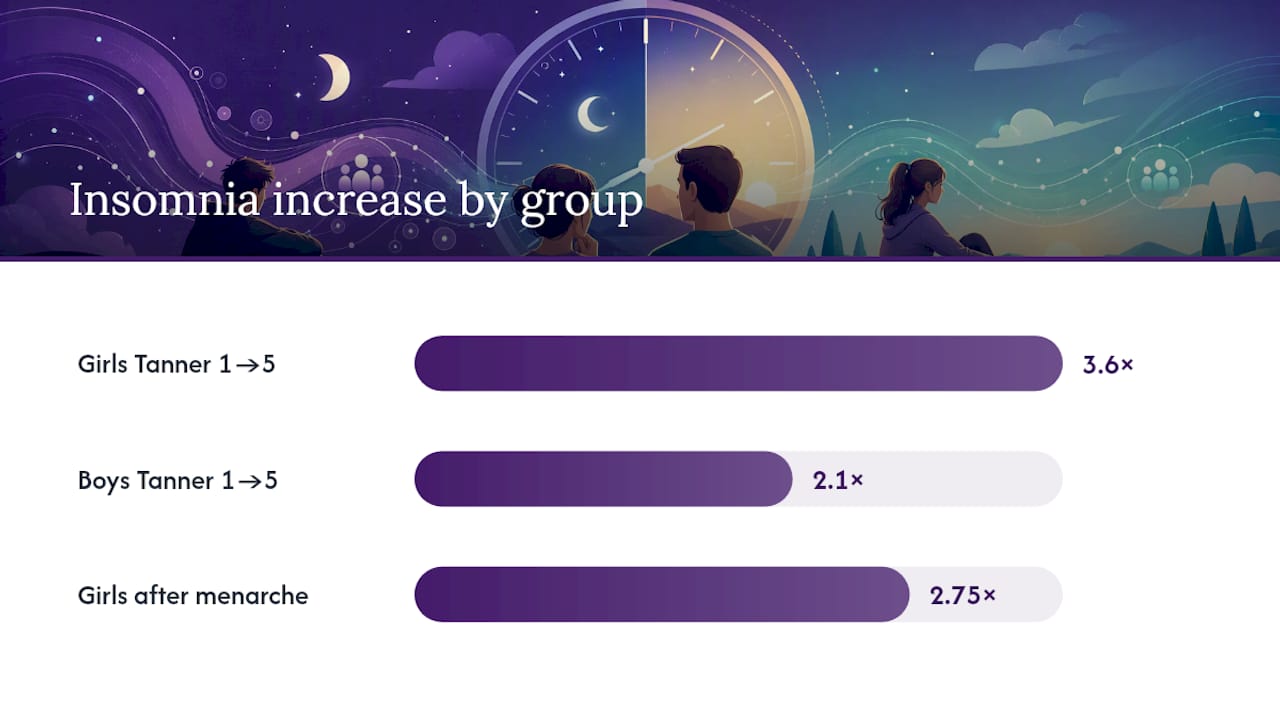
Statistic Callout: Girls’ insomnia symptoms rose 3.6-fold across Tanner stages 1 to 5, and 2.75-fold after menarche, according to a large-scale school-based study.
Several mechanisms likely contribute, though researchers are still untangling exactly how much each one matters:
- Fluctuating ovarian hormones around the menstrual cycle can affect sleep continuity and quality.
- Changes in the HPA axis, the body’s stress-response system, ramp up around puberty and can interfere with sleep onset.
- Girls may show different stress reactivity during this window, which compounds with the circadian and homeostatic shifts already reshaping sleep for both sexes.
It helps to know the difference between developmental circadian delay and true insomnia disorder. A teen with delayed circadian timing struggles to fall asleep early but sleeps fine once her body clock allows it, and sleeps in easily on weekends. A teen with insomnia disorder has trouble falling or staying asleep even when the opportunity and timing are right, and the problem persists regardless of schedule. That distinction should guide whether you adjust routines at home or bring in a clinician.
Sleep disorders in teens parents should recognize
Most teen sleep struggles fall into a handful of recognizable patterns, and knowing which one you’re dealing with changes what you should do next.
- Delayed sleep-wake phase disorder. The teen’s entire sleep window shifts later, often two hours or more past a conventional bedtime, with sleep quality staying normal once she actually falls asleep. She struggles to wake for school but sleeps fine on weekends when allowed to follow her natural rhythm.
- Insomnia disorder. Difficulty falling or staying asleep persists even with adequate opportunity and consistent timing. This is linked to depression and increased suicide risk in adolescents, which is why persistent insomnia deserves clinical attention rather than a wait-and-see approach.
- Obstructive sleep apnea (OSA). Watch for loud snoring, gasping or choking sounds during sleep, and unusual patterns in growth or weight. OSA in teens is often under-diagnosed because parents assume snoring is harmless.
- Restless legs syndrome. Look for complaints of creepy-crawly or itchy sensations in the legs, especially at bedtime, that briefly resolve with movement.
- Narcolepsy. Sudden, uncontrollable sleep attacks during the day, or cataplexy, a sudden loss of muscle tone triggered by strong emotion, are red flags that warrant a sleep specialist referral.
Certain signs should move you from home strategies to a doctor’s office without delay: noticeable decline in school performance, drowsy driving in older teens, or a marked shift in mood or behavior that tracks with the sleep problem. None of those are things to manage on your own.
The real cost of short or mistimed sleep in the teen years
Chronically short or badly timed sleep touches nearly every domain of adolescent functioning, and the effects tend to compound quietly before they become obvious.
Attention and academic performance are usually the first casualties. Teens running a sleep debt show measurably worse focus, slower processing, and lower grades, and the effect tends to build across a school week rather than showing up all at once. Mood takes a hit too. Poor sleep is tied to higher rates of anxiety and depressive symptoms in adolescents, and insomnia in particular carries an association with depression and elevated suicide risk that makes it worth taking seriously rather than dismissing as a phase.
Deep, slow-wave sleep is when the body releases most of its growth hormone. It’s reasonable to think that consistently cutting deep sleep short could interfere with that process, though the research connecting sleep loss directly to reduced growth outcomes in otherwise healthy teens isn’t conclusive enough to make a firm causal claim. The safer framing: protecting deep sleep protects a process your teen’s body relies on, even where the downstream effects on height and development aren’t fully mapped.
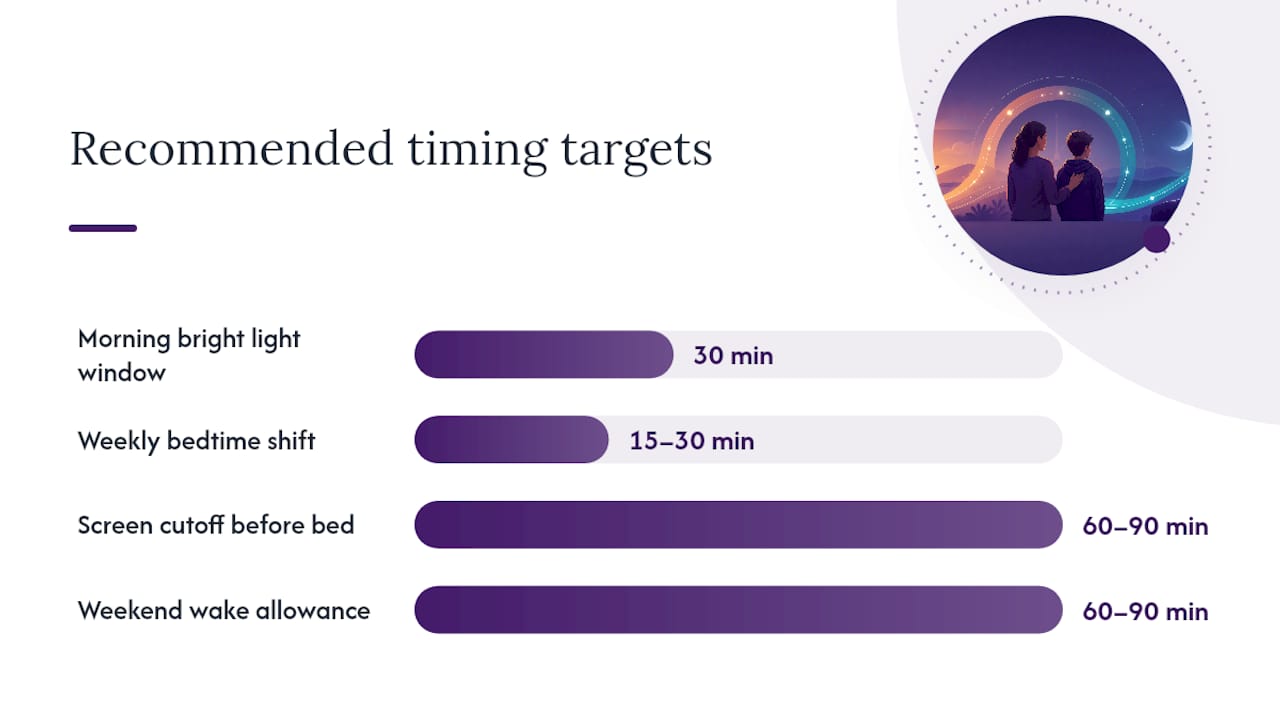
Weekend catch-up sleep, often called social jetlag, creates its own problem. Sleeping until noon on Saturday might feel like debt repayment, but it further destabilizes an already-delayed circadian clock, making Monday morning wake-ups even harder. Guidance from sleep researchers suggests keeping weekend wake time within 60 to 90 minutes of the school-day wake time to protect circadian stability, even when it’s tempting to let a teen sleep in for hours.
- Short sleep correlates with weaker attention, memory, and academic performance.
- Insomnia symptoms are linked to higher rates of depression and risk behaviors.
- Deep sleep supports growth hormone release, though direct effects on growth outcomes remain unclear.
- Large weekend sleep-in schedules worsen circadian misalignment rather than fixing it.
A prioritized plan: what to change tonight, this week, and this month
Fixing teen sleep isn’t about one dramatic rule change. It’s a sequence, and the order matters more than most parents expect.
- Anchor the wake time first. Pick one wake time and hold it seven days a week, even on weekends. This is the single most reliable lever on the circadian system, more effective than forcing an early bedtime alone.
- Add morning bright light within 30 minutes of waking. Open the blinds, step outside, or sit near a bright window during breakfast. Morning light is the strongest natural signal for resetting a delayed clock.
- Shift bedtime gradually, not abruptly. Move it 15 to 30 minutes earlier each week rather than demanding an hour-earlier bedtime overnight, which almost never sticks and just breeds conflict.
- Dim household lighting after dinner. Swap bright overhead lights for lamps in the two hours before bed to support natural melatonin release.
- Cut screens 60 to 90 minutes before lights-out. This is nonnegotiable given how sensitive teen brains are to evening light, but pair it with something to do instead, not just a ban.
Build a wind-down routine your teen will actually follow: light stretching, reading, a warm shower, or quiet music. Keep the bedroom cool and dark, and hold caffeine to mornings only, since teens metabolize it more slowly than adults and an afternoon soda can still be active in the system at 10 p.m.
Weekends deserve their own rule. Let your teen sleep in a little, but keep wake time within 60 to 90 minutes of the school-day schedule to avoid rebuilding the circadian delay you spent the week correcting.
Resistant teens respond better to negotiation than mandates. Bring her into the process: ask what part of the routine feels most doable, offer choices (lamp versus overhead light, book versus podcast), and frame consistency as something that gives her more energy for the things she cares about, not a punishment. Autonomy matters enormously at this age, and a plan she helped build is a plan she’s more likely to follow.
Pro Tip: Fix the wake-up time before you touch the bedtime. Most parents try to force an earlier bedtime first and hit a wall, because the circadian system responds far more reliably to a consistent wake time and morning light than to willpower at 9 p.m.
If insomnia symptoms persist for weeks despite consistent routines, or if you notice loud snoring, daytime sleep attacks, or a mood decline that tracks with poor sleep, it’s time to talk to a pediatrician or sleep specialist. Cognitive behavioral therapy for insomnia, known as CBT-I, shows real efficacy in adolescents, and a clinical evaluation typically starts with a sleep history, sometimes a sleep diary over one to two weeks, and occasionally a referral for an overnight sleep study if apnea or another physical cause is suspected.
For household-level support, a structured evening routine and consistent home organization around morning and evening transitions, like the ideas in organizing routines for a smoother school transition, can make the biological strategies above easier to sustain night after night.
Mood swings and sleep: a two-way street
Puberty’s mood shifts and sleep changes don’t just happen side by side, they feed each other. Hormonal fluctuations that drive irritability and emotional intensity also disrupt the sleep that would normally help regulate those emotions, and poor sleep in turn makes mood swings sharper and harder to manage the next day.
This shows up most clearly around the menstrual cycle, where hormonal shifts in the days before a period can disrupt sleep continuity for some girls, adding another layer on top of the circadian delay already reshaping her nights. Nighttime anxiety, worry about an upcoming first period, social stress, or general emotional intensity around this developmental stage, can also delay sleep onset independent of the biological clock shift. A teen lying awake replaying a stressful conversation from school is fighting both circadian biology and psychological arousal at the same time.
The practical takeaway: addressing emotional wind-down matters as much as addressing light exposure and screen time. A few minutes of talking through the day, journaling, or simple reassurance before lights-out can lower the psychological arousal that keeps an already-delayed clock even further from sleep. If nighttime worry seems to be a bigger driver than biology alone, resources like helping your daughter manage period anxiety address that emotional layer directly.
Where puberty education and nighttime confidence meet
Sleep science tells you what’s happening inside your daughter’s changing biology. It doesn’t tell you how to help her feel steady about the rest of what’s changing too, and that’s the gap Themonthliesbox was built to close.
Themonthliesbox is a character led puberty preparation brand built to give girls and parents real tools, not just information, for the transition into puberty and menstruation. The centerpiece is the Amethyst Box, which pairs affirmations and educational materials with practical supplies so a girl feels ready for her first period rather than caught off guard by it, including overnight scenarios that tend to fuel the most anxiety.
Everything is organized around the brand’s Amethyst Method: affirm, understand, and equip. That structure mirrors what good sleep coaching also requires, emotional reassurance first, real understanding of what’s happening in the body second, and practical tools third. A girl who feels equipped for her period is often a girl who worries less at bedtime, which is where puberty education and better sleep quietly overlap.
— The
The Monthlies Box: a practical companion for nighttime confidence
Sleep strategies handle the biology. What they don’t cover is the specific anxiety a lot of girls feel about nighttime period scenarios, waking up unprepared, worrying about leaks, or just feeling unsure about what her body is doing while she sleeps.

The Amethyst Box is built for exactly that gap. It pairs affirmation cards and educational materials with practical, tween-sized supplies so a girl has what she needs on hand and, just as important, feels ready rather than caught off guard. Reducing that low-grade nighttime worry can make the wind-down routines described above easier to stick with, since a calmer mind falls asleep faster than an anxious one.
To be clear, this is a confidence and preparedness tool, not a medical treatment. If your teen is dealing with persistent insomnia, loud snoring, or other red-flag symptoms covered earlier, see a pediatrician or sleep specialist first. For the everyday nervousness around growing up and first periods, though, explore the Amethyst Box or check out the LavenHaven self-care starter kit for a broader comfort-focused option.
Sources
Parents and clinicians wanting the primary evidence can start with the PMC review on adolescent circadian and homeostatic sleep changes, the AASM summary on sleep changes predicting puberty, and UCLA Health’s patient guidance on teens and sleep for condition-specific next steps.
This article is general information, not a substitute for advice from a qualified doctor. Consult a qualified healthcare professional about your own circumstances before acting on anything here.
- Adolescent Changes in the Homeostatic and Circadian Regulation of Sleep
- Emergence of sex differences in insomnia symptoms in adolescents: a large-scale school-based study
- Insomnia disorder in adolescence: Diagnosis, impact, and treatment
- Connection Between Onset of Puberty and Sleep Changes — AASM news item summarizing a longitudinal study
0 comments