

Most parents assume the first period just “shows up” one day. The truth is far more interesting. The role of hormones in first period timing and experience involves a carefully orchestrated system that starts years before any bleeding occurs. Understanding that system doesn’t just satisfy curiosity. It helps you recognize what’s normal, spot what isn’t, and show up for your daughter in ways that actually matter.
Table of Contents
- Key takeaways
- The role of hormones in first period biology
- Physical and emotional signs before the first period
- How environment and lifestyle affect hormone timing
- When to talk to a doctor
- My honest take on supporting girls through this
- Help your daughter feel ready, not caught off guard
- FAQ
Key takeaways
| Point | Details |
|---|---|
| Hormones start early | The hormonal process leading to menarche begins years before the first period arrives. |
| Multiple hormones work together | GnRH, FSH, LH, estrogen, and progesterone all play specific roles in triggering and regulating menstruation. |
| Environment affects timing | Stress, screen time, sleep, and diet can shift hormone levels and influence when puberty begins. |
| Early signs are hormonal | Vaginal discharge and breast development are hormone-driven signals that the first period is approaching. |
| Irregular cycles are normal at first | The hormonal system takes time to mature, so early cycle irregularity is expected, not alarming. |
The role of hormones in first period biology
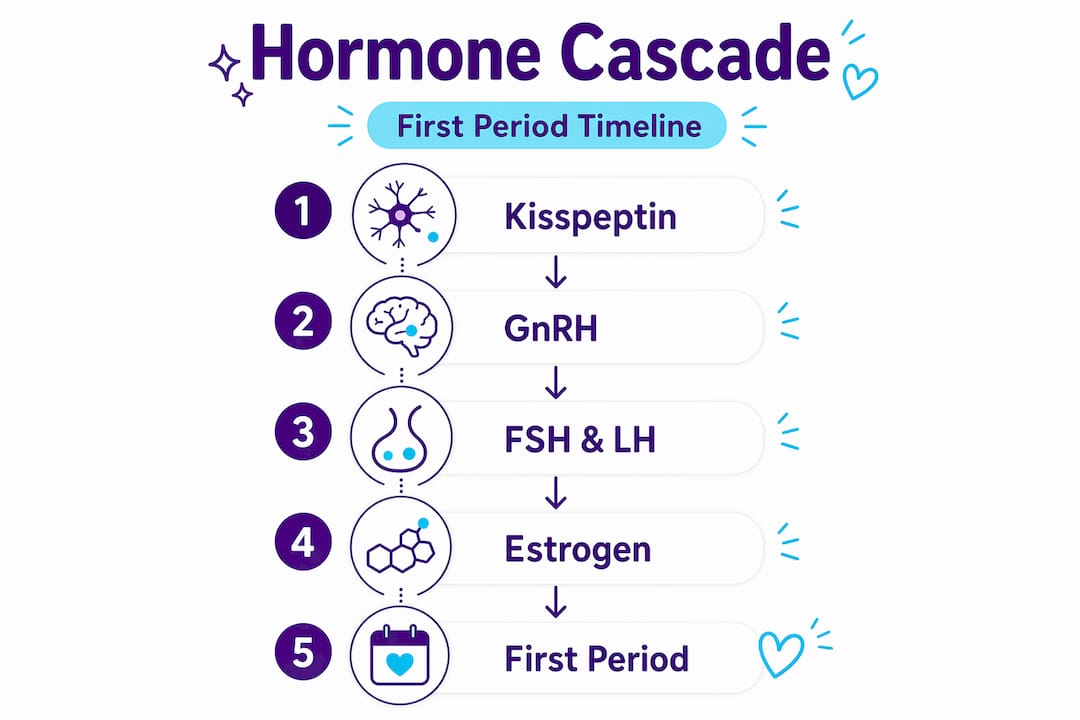
The first period, called menarche, is not a single event. It is the final step in a hormonal process that can take three to five years to complete. That process is run by a system called the hypothalamic-pituitary-gonadal (HPG) axis. Think of it as a three-part relay team where each player passes the signal to the next.
Here is how the relay works:
- The hypothalamus releases a hormone called GnRH (gonadotropin-releasing hormone) in rhythmic pulses. These pulses are the starting gun for puberty.
- GnRH signals the pituitary gland to release two more hormones: FSH (follicle-stimulating hormone) and LH (luteinizing hormone).
- FSH and LH travel to the ovaries, which respond by producing estrogen and, eventually, progesterone.
Kisspeptin neurons in the hypothalamus are what actually flip the switch on GnRH release. Without kisspeptin signaling, puberty simply does not start. Genetic issues in this pathway are one reason some girls experience delayed puberty.
There is also a metabolic piece most parents never hear about. Leptin, produced by fat cells, acts as an energy signal to the hypothalamus. When the body has enough stored energy, leptin levels rise and give the green light for GnRH pulsatility to begin. This is why girls with very low body weight sometimes experience delayed menarche. Their bodies are not yet signaling readiness.
Estrogen vs. progesterone: two different jobs
These two hormones are often mentioned together, but they do very different things in the first menstrual cycle.
| Hormone | When it rises | What it does |
|---|---|---|
| Estrogen | Early in the cycle | Thickens the uterine lining and drives physical development |
| Progesterone | After ovulation | Stabilizes the lining; drops sharply to trigger bleeding |
| FSH | Start of cycle | Stimulates egg follicle development in the ovaries |
| LH | Mid-cycle surge | Triggers ovulation |
The menstrual cycle is regulated by the interplay between estrogen and progesterone, both controlled by FSH and LH from the pituitary. When progesterone drops at the end of the cycle, the uterine lining sheds. That shedding is the period.
One more distinction worth knowing: adrenarche and gonadarche are not the same thing. Adrenarche happens years before menarche, when the adrenal glands start producing androgens. This causes body odor and pubic and underarm hair growth. Gonadarche comes later and involves the ovaries. Parents sometimes confuse these two stages, which leads to unnecessary worry.
Physical and emotional signs before the first period
Hormonal changes during puberty show up in the body long before bleeding starts. Knowing these signs helps you prepare your daughter, not just react.
Here are the most common pre-menarche signals, in rough order of appearance:
- Breast development. Rising estrogen triggers breast budding, usually the first visible sign of puberty. This can start as early as age 8 or 9.
- Pubic and underarm hair. Driven by adrenal androgens during adrenarche, not the ovarian hormones that cause periods.
- Body odor and increased sweating. Also linked to adrenal hormones. This is why some girls need deodorant years before their first period.
- Vaginal discharge. Clear or milky discharge is one of the most reliable early markers of rising estrogen. It typically begins 6 to 12 months before menarche.
- Growth spurts. Estrogen accelerates bone growth. Most girls hit their peak height velocity before their first period, not after.
- Mood shifts. Fluctuating estrogen and progesterone affect neurotransmitter activity, particularly serotonin. This is real and worth taking seriously.
On mood: the hormonal influence on teenage periods and emotions is genuinely complex. Mood changes in adolescence reflect both hormone fluctuations and external stressors like sleep disruption and social media pressure. It is not just “raging hormones.” It is hormones interacting with a full life. That framing matters when you are trying to support your daughter without dismissing what she feels.
Pro Tip: If your daughter has had vaginal discharge for six months or more, it is a good time to start keeping a period kit in her backpack. That discharge is her body’s way of signaling that menarche is close.
Early cycles are also often irregular. This is normal. The HPG axis takes time to mature, and early cycles may be anovulatory, meaning no egg is released. Irregular timing in the first year or two does not mean something is wrong with her hormones.
How environment and lifestyle affect hormone timing
This is where things get genuinely surprising. The timing of your daughter’s first period is not determined by biology alone. Where she lives, how much she sleeps, and how much screen time she gets all affect her hormone levels.
A recent cohort study found a clear difference between urban and rural girls:
| Factor | Urban girls | Rural girls |
|---|---|---|
| Estradiol levels | 38.5 pg/mL | 29.1 pg/mL |
| Leptin levels | 18.7 ng/mL | 12.4 ng/mL |
| Cortisol levels | 12.1 µg/dL | 9.3 µg/dL |
Urban girls experience earlier menarche on average, with measurably higher levels of estradiol, leptin, and cortisol. These are not small differences. They point to real environmental drivers.
Three of the biggest factors are:
Screen time and blue light. Blue light suppresses melatonin, the hormone that normally acts as a brake on the HPG axis at night. Less melatonin means fewer natural pauses in hormonal activity, which can accelerate puberty onset. This is one reason limiting screens before bed matters more than most parents realize.
Chronic stress. Elevated cortisol from ongoing stress can modify hormone pathways and push puberty earlier. Urban environments, with more noise, social pressure, and academic stress, consistently show higher cortisol in girls. This does not mean city life is harmful. It means stress management is a genuine health tool, not just a wellness trend.
Physical activity and sleep. Regular movement and consistent sleep support hormonal balance by regulating cortisol and supporting healthy leptin signaling. Girls who are physically active and well-rested tend to have more stable hormone patterns overall.
“Lifestyle and emotional context strongly modulate hormone effects, making urban environments a double-edged sword that accelerates puberty but can increase anxiety and body dissatisfaction.” — Research on urban-rural menarcheal timing
Pro Tip: A consistent bedtime routine, ideally with screens off 60 minutes before sleep, supports melatonin production and gives your daughter’s hormonal system the natural rhythm it needs.
When to talk to a doctor
Most of what happens during puberty is normal. But some signs deserve a medical conversation. Knowing the difference helps you act with confidence rather than anxiety.
Here is what to watch for:
- No period by age 15. Clinical guidelines recommend consulting a doctor if menarche has not occurred by this age. The normal onset range is 8 to 15 years, with the average falling between 12 and 13.
- Signs of puberty before age 8. Breast development or pubic hair before this age may indicate precocious puberty, which warrants evaluation.
- Bleeding that lasts longer than 7 days. This can signal a hormone production issue and needs assessment to prevent longer-term health effects.
- Cycles shorter than 21 days or longer than 45 days after the first year of menstruation.
- Cramps severe enough to interfere with school or daily activities. Mild cramping is normal. Pain that stops her in her tracks is not something to push through without support.
- Symptoms of hormonal imbalance such as significant acne, unexplained weight changes, or excessive hair growth in unusual places.
Delayed menarche or heavy bleeding can indicate underlying hormone production issues. Catching these early makes a real difference. You know your daughter. If something feels off, trust that instinct and get it checked.
My honest take on supporting girls through this
What I have seen, over and over, is that parents feel underprepared not because they lack love, but because they lack language. They know something big is happening in their daughter’s body. They just do not have the words for it.
Here is what I have learned: the phrase “raging hormones” does more harm than good. It dismisses real experiences and makes girls feel like their emotions are a malfunction. The truth is that their hormonal system is doing exactly what it is supposed to do. It is new, it is powerful, and it needs time to find its rhythm.
I have also found that parental support works best when it balances hormone awareness with acknowledgment of everything else going on. A mood swing is not always estrogen. Sometimes it is a hard day at school. Sometimes it is both. Holding that complexity without judgment is one of the most supportive things you can do.
The parents who navigate this phase most gracefully are the ones who start the conversation early, stay curious, and resist the urge to minimize. You do not need to have all the answers. You just need to show up, informed and present.
— Themonthliesbox
Help your daughter feel ready, not caught off guard
Understanding the hormonal journey is the first step. The next is making sure your daughter has what she needs when her body gets there.

At Themonthliesbox, we created the Amethyst Box specifically for this moment. It is built around our Amethyst Method: Affirm, Understand, and Equip. Inside, your daughter will find practical period supplies, educational materials, and confidence-building affirmations that make menarche feel like something to grow through, not something to fear. For families who want even more, the Deluxe Box adds extra self-care support to make her feel truly celebrated. Because she deserves to feel supported, not just prepared.
FAQ
What hormones trigger the first period?
The first period is triggered by the HPG axis, where GnRH stimulates FSH and LH, which in turn cause the ovaries to produce estrogen and progesterone. When progesterone drops at the end of the first complete cycle, the uterine lining sheds as menstrual bleeding.
What is the normal age range for a first period?
The average age for menarche is 12 to 13 years, but the normal range extends from 8 to 15 years. A doctor should be consulted if no period has occurred by age 15.
Why are early periods often irregular?
Early cycles are irregular because the HPG axis is still maturing and many early cycles are anovulatory, meaning no egg is released. This is a normal part of hormonal development and usually stabilizes within one to two years.
Can stress really affect when puberty starts?
Yes. Elevated cortisol from chronic stress can modify hormone pathways and contribute to earlier puberty onset. Studies show urban girls have measurably higher cortisol levels and earlier menarche compared to rural peers.
What signs tell you the first period is coming soon?
Vaginal discharge is one of the most reliable early signals, typically appearing 6 to 12 months before menarche. Breast development, body odor, and a growth spurt are also hormone-driven signs that the first period is approaching.
0 comments