

Menarche is defined as a girl’s first menstrual period, marking the point at which her reproductive system becomes active. It is one of the most significant milestones in female puberty, and understanding it helps you support your daughter with confidence rather than confusion. Menarche typically occurs between ages 10 and 15, with an average age of around 12 in developed countries. Knowing what to expect, and when, makes all the difference for both of you.
What is menarche and when does it typically occur?
Menarche, from the Greek words for “month” and “beginning,” is the clinical term for a girl’s first period. The normal age range spans 9–15 years, with most girls in the United States experiencing it around age 12 to 12.5. Arriving within that window is completely normal, so a daughter who gets her first period at 10 or at 14 is not an outlier.
Several factors influence the menarche timeline:
- Genetics. A mother’s age at first period is one of the strongest predictors for her daughter.
- Nutrition and body composition. A certain level of body fat is required to trigger the hormonal signals that start menstruation.
- Overall health. Chronic illness, intense athletic training, or significant stress can delay onset.
- Environment. Exposure to certain chemicals and light disruption may affect timing.
One important trend worth knowing: menarche age dropped significantly across the 20th century due to improved nutrition and living conditions, but it has now stabilized in developed countries at around 12.5 years. That stabilization is reassuring. It means the wide variation parents see in their daughters’ peer groups reflects normal biology, not a problem to solve.
Pro Tip: If your daughter has not started her period by age 15, schedule a visit with her pediatrician or gynecologist. Early evaluation rules out any underlying conditions and gives you both peace of mind.
What physical changes signal that menarche is approaching?
The body sends clear signals well before the first period arrives. Recognizing these signs of menarche gives you time to prepare practically and emotionally.
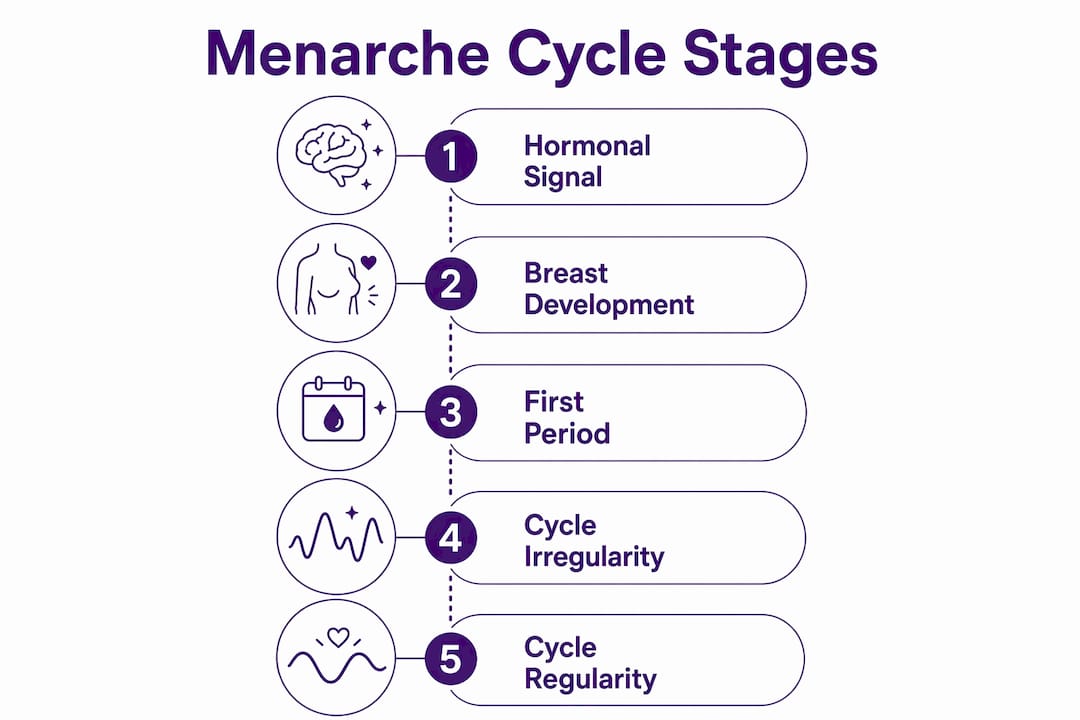
- Breast budding (thelarche). This is the most reliable early marker. Breast development precedes menarche by an average of 2–3 years, making it a better predictor of timing than age alone. If your daughter’s breasts began developing at age 9, menarche around age 11 or 12 is likely.
- Pubic and underarm hair. Hair growth in these areas follows breast budding and signals rising estrogen levels.
- Growth in height. A noticeable growth spurt, often 2–3 inches in a single year, typically peaks before menarche and slows after it.
- Vaginal discharge. A clear or whitish discharge often appears 6–12 months before the first period. This is normal and signals hormonal activity.
- Mood and emotional shifts. Rising estrogen and progesterone affect the brain, so emotional sensitivity before menarche is physiological, not behavioral.
The hormonal process behind these changes starts in the brain. The hypothalamus releases a hormone that signals the pituitary gland, which then tells the ovaries to produce estrogen. Rising estrogen thickens the uterine lining each month. When that lining sheds without fertilization, menstruation begins. Understanding this chain of events helps you explain the process to your daughter in plain, science-backed terms rather than vague descriptions.
Pro Tip: Track breast development as your starting point for timing conversations. If thelarche began, you likely have a 2–3 year window to prepare. Use that time to build a self-care routine with your daughter before the first period arrives.

What happens after menarche: cycle patterns and what to expect
The first period arriving does not mean the menstrual cycle is immediately regular. Post-menarche cycles are often irregular, ranging anywhere from 21 to 45 days between periods. This is normal biology, not a health concern.
| What parents observe | What it means | When to see a doctor |
|---|---|---|
| Cycles 21–45 days apart | Normal variation post-menarche | Not needed unless outside this range |
| Skipped periods for 1–3 months | Common in first 1–2 years | If absent more than 3 months after year 2 |
| Heavy flow lasting 7+ days | May need evaluation | Consult a gynecologist |
| Severe cramping | Could indicate dysmenorrhea | If it disrupts daily life |
Cycles can take up to 5 years to regularize after menarche. That means a 12-year-old who just got her first period may not have a predictable cycle until she is 16 or 17. Patience is not passive here. It is the medically appropriate response.
The biology behind each cycle is straightforward. Hormones prepare the uterus for a possible pregnancy by thickening the uterine lining. When no fertilization occurs, the lining sheds as menstrual flow. In the early years, the hormonal signals are still maturing, which is why cycles vary so much.
One fact many parents miss: ovulation can occur before the first period. This means pregnancy is biologically possible even before menarche. Age-appropriate reproductive education should begin before the first period, not after it.
Pro Tip: Start a simple period journal or use a cycle tracking app designed for teens. Tracking helps you recognize patterns over time and gives a doctor useful data if concerns arise.
How can parents support their daughters through menarche?
The most powerful thing you can do is talk about it before it happens. Open, shame-free communication transforms menarche from a frightening surprise into a manageable milestone. Girls who receive accurate information in advance report less fear and more confidence when their first period arrives.
Practical support looks like this:
- Start the conversation early. Aim to discuss puberty and periods before breast budding begins, ideally around ages 8–9. Use correct anatomical terms. Normalizing the language normalizes the experience.
- Provide age-appropriate resources. Books, guides, and educational materials written for preteens give your daughter something to return to privately. Knowing she can learn on her own terms builds confidence.
- Prepare a period kit. A small bag with pads, clean underwear, and a note from you, kept in her backpack, removes the fear of being caught unprepared at school. Read more about handling periods at school so she feels ready wherever she is.
- Acknowledge the emotions. Some girls feel proud. Others feel scared or embarrassed. Both responses are valid. Reflect her feelings back without judgment before offering information.
- Keep the conversation going. Menarche is not a one-time talk. Ongoing dialogue about cycle changes, cramps, and emotional shifts builds trust over years, not just one afternoon.
Reducing stigma starts at home. When you speak about menstruation matter-of-factly, your daughter learns to do the same. That confidence carries into her friendships, her school life, and eventually her healthcare decisions as an adult. For a deeper look at managing the emotional side of this transition, the emotional responses guide from Themonthliesbox walks you through common reactions and how to respond with care.
Pro Tip: If you feel unsure how to start the conversation, read a parent’s conversation guide first. Having a few specific phrases ready makes the talk feel natural rather than scripted.
Key Takeaways
Menarche is a normal, predictable developmental milestone that parents can prepare for with the right information, practical tools, and open communication.
| Point | Details |
|---|---|
| Menarche timing is normal across a wide range | Most girls experience their first period between ages 10 and 15, with 12.5 as the average. |
| Breast development predicts timing | Thelarche precedes menarche by 2–3 years and is the most reliable early signal for parents. |
| Irregular cycles are expected | Post-menarche cycles can range from 21 to 45 days and may take up to 5 years to stabilize. |
| Ovulation can precede the first period | Reproductive education should begin before menarche, not after, because pregnancy is biologically possible earlier. |
| Communication is the most effective preparation | Shame-free, ongoing dialogue before and after menarche reduces fear and builds long-term confidence. |
Menarche is a beginning, not a single event
Parents often treat menarche as the finish line of puberty preparation. It is actually the starting line of several years of hormonal development. The first period arrives, but the cycle takes years to mature. Emotions shift. The body keeps changing. That longer view changes how you show up for your daughter.
What I have seen, again and again, is that the parents who do best are the ones who stay curious alongside their daughters rather than delivering a one-time “talk” and considering the job done. Menarche is not a checkbox. It is an invitation to build a relationship where your daughter feels comfortable coming to you with questions she does not know how to Google.
The science also helps here. Reframing menarche as a multi-year process of gradual hormonal change shifts the focus from fear to ongoing support. When you understand that irregular cycles are physiologically normal, you stop worrying every time a period is late. When you know that menstrual biology is well understood, you can explain it simply instead of fumbling for words.
Give yourself permission to not have every answer. What matters most is that your daughter knows you are a safe place to ask.
— The
Themonthliesbox is here when you are ready to prepare
Knowing what menarche is gives you a head start. Having the right tools in hand gives your daughter one too.

The Themonthliesbox Amethyst Box is designed specifically for girls approaching their first period. It combines practical period supplies with affirmations and educational materials built around the Amethyst Method: affirm, understand, and equip. Every item inside is chosen to make this milestone feel supported rather than scary. If you have two daughters or want to share the experience with a friend’s family, the Bestie Bundle offers two boxes at a meaningful saving. Preparation is a gift you give before the moment arrives.
FAQ
What is menarche in simple terms?
Menarche is a girl’s first menstrual period. It marks the point when the reproductive system becomes active and is a normal part of female puberty.
What is the average age for menarche?
The average age is 12 to 12.5 years in developed countries, with a normal range of 9–15 years. Genetics and nutrition are the strongest influences on timing.
What are the first signs that menarche is coming?
Breast budding is the earliest and most reliable sign, typically appearing 2–3 years before the first period. Pubic hair growth, a growth spurt, and vaginal discharge also signal that menarche is approaching.
Are irregular periods after menarche normal?
Yes. Cycles ranging from 21 to 45 days are completely normal after the first period and can take up to 5 years to become regular. Consult a doctor only if periods are absent for more than 3 months after the second year.
When should parents start talking to their daughters about menarche?
Conversations about puberty and periods should begin around ages 8–9, before breast development starts. Early, ongoing dialogue reduces fear and helps girls feel prepared and supported.
0 comments