

Daughters avoid period talks primarily because of cultural stigma, embarrassment, and communication gaps that make menstruation feel like a topic that should stay hidden. A 2026 P&G survey found that 56% of girls feel unprepared for their periods because they feel too awkward to ask questions. That discomfort is not random. It is shaped by years of social messaging that frames menstruation as private, shameful, or even dangerous. Understanding why daughters avoid period talks is the first step toward changing that pattern. The good news is that parents hold more influence over this conversation than they realize.
Why daughters avoid period talks: the social and cultural roots
Menstrual stigma is the primary driver behind avoiding menstruation discussions. It is not just a feeling. It is a set of enforced social rules that tell girls to hide any sign of their period from the world around them.
Research shows that 48.4% of participants viewed menstruation as dangerous, and 58.2% viewed it as unclean. Those numbers reflect beliefs that get passed down through families, schools, and communities without anyone saying them out loud. Girls absorb these attitudes early, and they shape how safe a daughter feels bringing up her period at home.
Researchers call this the “menstrual concealment imperative.” Concealment becomes a survival strategy in school and social settings, where a girl who visibly struggles with her period risks ridicule or embarrassment. The pressure to stay quiet is not weakness. It is a rational response to a social environment that punishes openness.
Religious and cultural modesty norms add another layer. In many households, the body is treated as a private subject, and discussions about bodily functions carry a sense of impropriety. Girls raised in these environments learn quickly that silence is expected. That learned silence does not disappear when a parent tries to open the conversation.
| Social belief | Effect on communication |
|---|---|
| Menstruation is unclean | Girls feel shame and hide symptoms from parents |
| Periods are a private matter | Daughters avoid asking questions or seeking help |
| Talking about periods is embarrassing | Girls prefer silence over risking awkward reactions |
| Menstruation signals growing up | Some girls fear adult expectations and stay quiet |
Pro Tip: Normalize the word “period” in everyday conversation at home. The more casually you use it, the less loaded it becomes for your daughter.
How do family communication patterns affect daughters’ willingness to talk?
The way parents approach the first period conversation shapes every conversation that follows. Waiting until menarche to talk reinforces secrecy and anxiety. It signals to a daughter that periods are something to manage quietly rather than discuss openly.
Parents often make the mistake of treating the period talk as a single, formal event. Sitting a daughter down for “the talk” raises the emotional stakes and makes her feel like something serious and possibly alarming is happening. Formal sit-down talks often increase anxiety. Casual, low-pressure mentions woven into daily life work far better.
Generational shame also creates a vocabulary gap. Many parents grew up in households where periods were never discussed, so they lack the comfortable, natural language to talk about menstruation without sounding clinical or awkward. That awkwardness transfers directly to daughters, who pick up on parental discomfort and mirror it back.
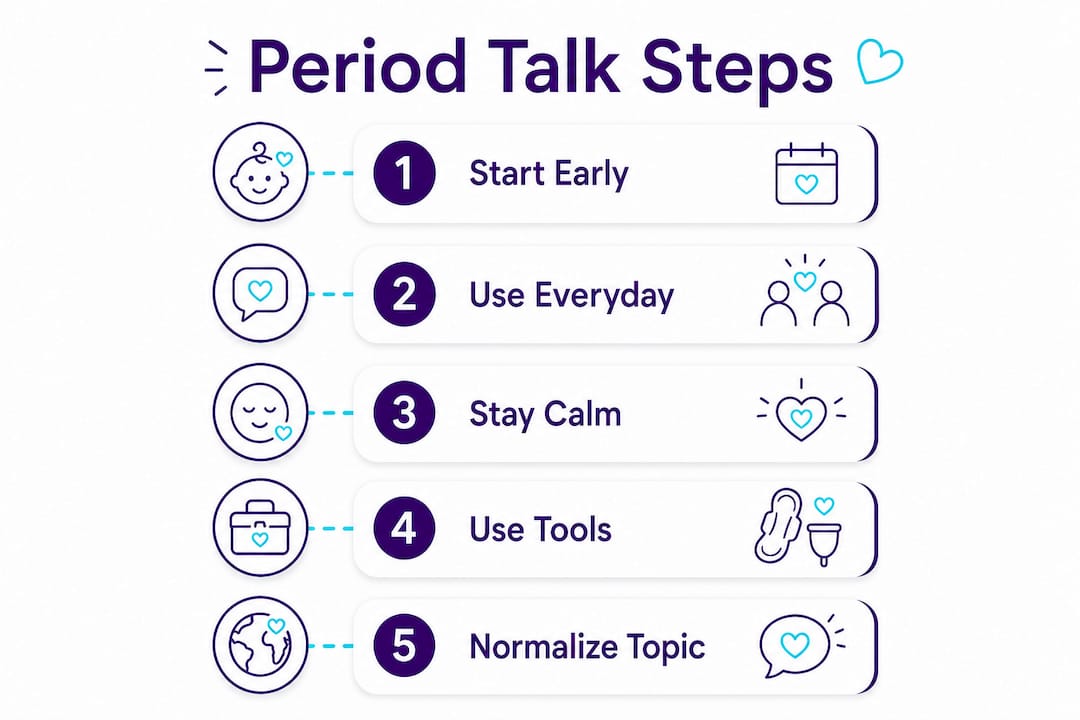
Effective communication strategies for parenting daughters and periods include:
- Start early. Begin age-appropriate conversations about body changes between ages 7 and 10, well before the first period arrives. Themonthliesbox has a detailed guide on when to start these conversations by age.
- Keep it casual. Mention periods naturally, the way you would mention a headache or a skincare routine.
- Use accurate language. Avoid euphemisms that make periods sound mysterious or shameful.
- Listen more than you speak. Ask open questions and let your daughter set the pace.
- Revisit the topic regularly. One conversation is never enough. Make it an ongoing, comfortable subject.
Pro Tip: Leave a period-related book or product visible in the bathroom. Physical cues normalize the topic without requiring a direct conversation.
Why do daughters hide or delay sharing news of their first period?
Girls hide their first period for reasons that are deeply personal and entirely understandable. The most common include embarrassment, a desire to process the experience privately, fear of parental overreaction, and uncertainty about what to say.

Avoidance of period talks is linked to learned modesty, not a lack of curiosity. A daughter who goes quiet about her period is not being difficult. She is responding to the social and emotional signals she has absorbed over years. She may also be testing the waters, watching how you react to smaller mentions before deciding whether to share something bigger.
Parental reactions matter enormously in this moment. A direct question like “Why didn’t you tell me?” can make a daughter feel interrogated rather than supported. It shifts the focus from her experience to your feelings, which is the opposite of what she needs.
Here is what to do when your daughter shares news of her first period:
- Stay calm. Your reaction in the first 30 seconds sets the tone for every future conversation.
- Validate her feelings. Say something simple: “Thank you for telling me. How are you feeling?”
- Focus on practical support. Ask what she needs, whether that is supplies, pain relief, or just a quiet moment.
- Avoid making it a big production. Celebrations can feel embarrassing for some girls. Follow her lead.
- Do not ask why she waited. That question creates defensiveness and closes the door on future sharing.
For more guidance on emotional responses at menarche, Themonthliesbox offers a parent-focused resource that walks through what girls typically feel and how to respond with care.
How can parents create an open environment for period conversations?
The most effective approach treats menstruation as a health topic, not a secret. Proactive, early framing of periods as a normal physical process reduces barriers to later conversations. Think about how naturally most families discuss skincare, sleep, or nutrition. Periods deserve the same casual, matter-of-fact treatment.
Fathers and other family members play a bigger role than most people expect. When a father mentions periods without discomfort, it signals to a daughter that her body is not something to hide from half the world. That normalization carries real weight.
Practical steps that build an open environment include:
- Keep period products visible and accessible in shared bathrooms.
- Reference menstruation in passing, the way you would reference any other health topic.
- Share age-appropriate information gradually rather than all at once.
- Acknowledge your own discomfort if it exists. Saying “I didn’t grow up talking about this, but I want us to” builds trust.
- Validate privacy. A daughter’s desire for some personal space around her period is healthy. Support does not mean requiring full disclosure.
Girls often feel more ready to discuss menstruation than parents expect. The real barrier is frequently parental discomfort, not the daughter’s reluctance. When you address your own hesitation first, the conversation becomes easier for both of you.
Pro Tip: If direct conversation feels hard, use a book, a podcast, or a product like the Themonthliesbox Amethyst Box as a conversation starter. A shared object gives you both something to talk about without the pressure of a face-to-face disclosure.
Key Takeaways
Daughters avoid period talks because of cultural stigma and parental communication patterns, and parents who normalize menstruation early and respond calmly create the conditions for lasting openness.
| Point | Details |
|---|---|
| Stigma drives silence | Cultural beliefs about menstruation being unclean or shameful are the root cause of avoidance. |
| Timing matters | Starting period conversations between ages 7 and 10 reduces anxiety and builds comfort before menarche. |
| Reactions shape trust | A calm, practical response when a daughter shares her period news encourages future openness. |
| Casual beats formal | Low-pressure, everyday mentions of periods work better than a single sit-down talk. |
| Parents set the tone | Parental discomfort is often the real barrier. Addressing it directly creates space for daughters to open up. |
What I have learned from watching parents get this right and wrong
The parents who struggle most with period conversations are usually the ones who treat it as a one-time event to get through. They prepare a speech, sit their daughter down, deliver the information, and consider the job done. Their daughters nod politely and then never bring it up again.
The parents who get it right do something much simpler. They mention periods the way they mention the weather. They leave products on the bathroom counter. They say “I got my period today” without drama. Over time, their daughters learn that this is just a normal part of life in their home.
What I find most striking is how often parents underestimate their daughters. Girls are frequently more ready for these conversations than their parents assume. The silence is not coming from the daughter. It is coming from the environment she has grown up in.
The most powerful thing a parent can do is acknowledge their own awkwardness out loud. Saying “I find this a little hard to talk about, but I want you to know you can always come to me” does more than any perfectly prepared speech. It shows your daughter that discomfort is not a reason to stay silent. It is something you can grow through together.
— The
Practical support that makes the conversation easier
Sometimes the right product opens a door that words cannot. Themonthliesbox was built for exactly this moment.

The Amethyst Box is designed to prepare girls for their first period through affirmations, educational materials, and practical supplies. It follows the Amethyst Method, which moves through three phases: affirm, understand, and equip. For families who want to celebrate and support rather than just inform, the Monthlies Deluxe Box adds a self-care experience that makes the whole conversation feel warm and positive. Both options give parents and daughters a shared starting point that feels supportive, not clinical.
FAQ
Why do girls feel embarrassed talking about periods with parents?
Girls feel embarrassed because cultural messaging frames menstruation as private and shameful from an early age. Research links this to learned modesty and a social environment that rewards concealment over openness.
At what age should parents start talking about periods?
Parents should begin age-appropriate conversations between ages 7 and 10, well before the first period arrives. Starting early reduces anxiety and makes menstruation feel like a normal health topic rather than a sudden, alarming event.
What should I say when my daughter hides her first period?
Stay calm, validate her feelings, and focus on practical support rather than asking why she waited. A simple “Thank you for telling me. What do you need right now?” is more effective than any prepared speech.
How does period stigma affect a daughter’s health?
The impact of period stigma includes delayed help-seeking, increased anxiety around menstruation, and reduced confidence in managing symptoms. Girls who feel shame about their periods are less likely to report pain or irregularities to a parent or doctor.
Can fathers help with period conversations?
Fathers play a meaningful role by treating menstruation as a normal health topic without discomfort or avoidance. When daughters see that both parents are comfortable with the subject, it removes the idea that periods are something to hide from men or boys.
0 comments