

The flow intensity of a girl’s first period varies widely, ranging from very light spotting to heavier bleeding, and this variation is completely normal. Understanding why first period is heavy or light comes down to one core fact: the hormonal system is still learning. Cycle lengths can range from 21 to 45 days in the early years, and flow differences follow that same unpredictability. As a parent, knowing what drives these differences helps you support your daughter with confidence instead of worry. Themonthliesbox was built for exactly this moment.
Why is the first period heavy or light? The biology behind it
The first period, known medically as menarche, is controlled by a hormonal feedback loop between the brain, the ovaries, and the uterus. That loop is brand new and not yet reliable. Early menstrual cycles are often unpredictable for 2 to 3 years as the hormonal system matures. This immaturity is the single biggest reason first period flow differences exist.
Here is what is actually happening inside your daughter’s body:
- Anovulatory cycles: Many early periods happen without ovulation. When ovulation does not occur, progesterone levels stay low. Low progesterone means the uterine lining may shed unevenly, producing either a very light flow or an unexpectedly heavy one.
- Estrogen fluctuations: Estrogen builds the uterine lining. If estrogen surges before the body can regulate it, the lining grows thick and sheds heavily. If estrogen stays low, the lining stays thin and the flow stays light.
- Hormonal feedback immaturity: The brain signals the ovaries through hormones called FSH and LH. In the early years, those signals are inconsistent. The result is a cycle that can look completely different from one month to the next.
- Spotting as a first period: Some girls experience only a few drops of blood the first time. Light flow is common in the first few years after menarche and does not mean anything is wrong.
Pro Tip: Remind your daughter that her first period is not a preview of every period she will ever have. The body is calibrating, and that takes time.
The first period is rarely a definitive start to a regular cycle. Intermittent bleeding and flow variability are expected as hormone regulation matures over months to years. Understanding the role of hormones in this process helps parents frame the experience accurately for their daughters.
How do lifestyle and environment affect first period flow?
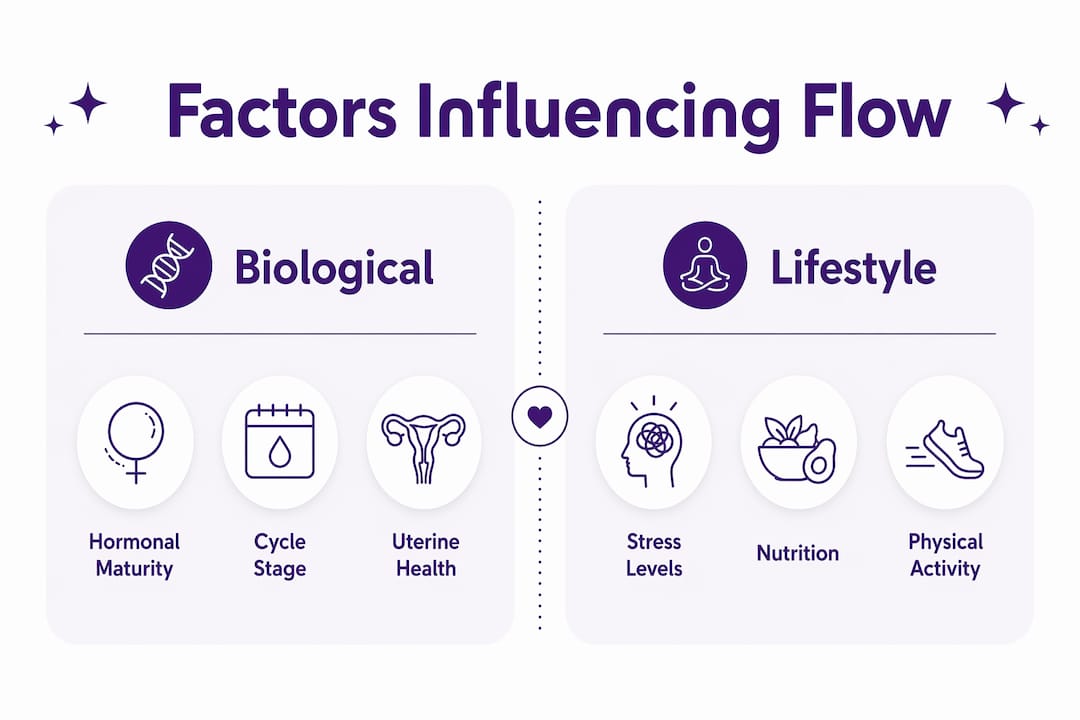
Biology is not the only factor shaping first period flow differences. Lifestyle and environment play a real role in how the body experiences early menstruation.
Nutrition, physical activity, stress, and sleep all influence the timing and experience of first menstruation, including how heavy or light the flow is. These are factors parents can actively support.
- Nutrition: A diet low in iron or calories can suppress hormonal output, leading to lighter or missed periods. Girls in intense athletic training sometimes experience very light flow because the body conserves energy.
- Physical activity: Moderate exercise supports hormonal balance. Extreme exercise, like competitive gymnastics or long-distance running, can reduce estrogen levels and thin the uterine lining.
- Sleep and screen time: Lifestyle factors like sleep affected by screen time influence early puberty and menstrual experiences. Poor sleep disrupts melatonin and cortisol rhythms, which in turn affect reproductive hormones.
- Stress: Emotional stress raises cortisol. High cortisol suppresses the hormones that trigger ovulation, which can make periods lighter, shorter, or delayed.
- Socio-economic factors: Access to nutritious food, safe spaces for physical activity, and healthcare all shape how puberty unfolds. Girls with limited access to these resources may experience more irregular or symptomatic first periods.
The takeaway for parents is practical. You cannot control your daughter’s hormonal timeline, but you can support the conditions that help her body regulate itself. Consistent sleep, balanced meals, and low-stress routines all contribute to a smoother early menstrual experience.
What are normal variations in first period flow, color, and length?
Parents often worry when a first period looks different from what they expected. The range of normal is much wider than most people realize.
| Flow characteristic | What is normal | When to pay attention |
|---|---|---|
| Period length | 3–7 days is typical | Longer than 7 days consistently |
| Cycle length | 21–45 days in early years | No period for more than 90 days |
| Blood color | Bright red to dark brown | Gray or tissue-like discharge |
| Flow volume | Spotting to moderate flow | Soaking a pad every 1–2 hours |
| Clots | Small clots are common | Large clots with severe pain |
Blood color is one of the most common sources of confusion. Brown blood results from oxidation due to slower flow. It is simply older blood that took longer to exit the body. Bright red blood moves faster and appears at peak flow days. Both are normal.
Spotting, which is very light bleeding that may not even require a pad, is a completely valid first period experience. Some girls have spotting for a day or two before heavier flow begins. Others have only spotting for their first several cycles.
Pro Tip: A simple period tracking app or a small notebook helps your daughter notice patterns without pressure. Tracking is about awareness, not expecting regularity.
Tracking early periods is more about building self-care habits than expecting a predictable schedule. The cycle often does not stabilize for several years, and that is completely within the range of normal. For more context on what to expect, the first period duration guide from Themonthliesbox walks parents through typical timelines clearly.
When should parents be concerned about heavy or light first periods?
Most first period variations are normal. A smaller number of cases do signal something worth discussing with a doctor.
The clearest warning sign for heavy bleeding is frequency of pad or tampon changes. Parents should seek medical evaluation if bleeding soaks through a pad or tampon every 1–2 hours for several consecutive hours. That level of flow goes beyond typical hormonal variation.
Other signs that warrant a conversation with a healthcare provider include:
- Bleeding that lasts longer than 7 days
- Periods occurring more than once a month
- Severe cramping that interferes with daily activities
- Significant fatigue or dizziness during a period
- Passing large clots, defined as larger than a quarter
Heavy flow caused by hormonal imbalances is common in teenagers but needs assessment if it is severe or persistent. Conditions like polycystic ovary syndrome, thyroid disorders, or bleeding disorders can all present during the early menstrual years.
On the lighter side, a period that never arrives after age 15, or one that stops for more than 90 days without pregnancy, also deserves medical attention.
“The goal is not to alarm your daughter but to stay informed together. When you approach her health with calm curiosity instead of fear, she learns to do the same. Open communication now builds the foundation for a lifetime of confident self-advocacy.”
How can parents support daughters through varied first period experiences?
The most powerful thing you can do as a parent is normalize the range. Irregularity in early cycles is normal and should be framed as part of a natural maturation process, not an abnormality. That framing reduces anxiety for both of you.
Practical support looks like this:
- Stock a variety of products. A girl with a light first period needs a thin liner, not a heavy overnight pad. Having options on hand removes the guesswork and the embarrassment.
- Talk before it happens. Girls who receive information about menstruation before their first period report less fear and more confidence. Use simple, accurate language.
- Encourage cycle awareness without pressure. Suggest she note the start date and any symptoms. Do not make regularity the goal. Awareness is the goal.
- Model calm. If you respond to her first period with anxiety or drama, she absorbs that. If you respond with warmth and practicality, she learns that this is manageable.
- Build a self-care routine. A warm compress, a favorite snack, and a comfortable space to rest are not luxuries. They are tools that teach her to care for her body.
Supporting a daughter through her first period by normalizing the experience and stepping back from dramatic narratives improves emotional outcomes. The parent’s guide to supporting your daughter from Themonthliesbox offers additional communication strategies grounded in this same approach.
Key Takeaways
First period flow varies because the hormonal system is still maturing, and most differences in heaviness or lightness are a normal part of that process.
| Point | Details |
|---|---|
| Hormonal immaturity drives variation | The brain-ovary-uterus feedback loop takes 2–3 years to stabilize, causing unpredictable flow. |
| Lifestyle factors matter | Sleep, nutrition, stress, and exercise all influence how heavy or light the first period feels. |
| Wide range is normal | Cycle lengths of 21–45 days and flow from spotting to moderate bleeding are all within normal limits. |
| Know the warning signs | Soaking a pad every 1–2 hours or bleeding longer than 7 days warrants a medical conversation. |
| Calm support builds confidence | Normalizing variability and preparing ahead reduces fear and builds lasting self-care habits. |
What I have learned from watching families navigate this moment
Parents often come to this topic expecting a clear answer: heavy or light, which one is right? The honest answer is that both are right, and neither tells you much about what comes next. The early menstrual years are genuinely unpredictable, and the families who handle them best are the ones who stopped waiting for regularity and started building comfort with uncertainty instead.
The misconception I see most often is that a light first period means something is wrong, or that a heavy one means something is seriously off. Neither is true in most cases. What matters far more is whether your daughter feels informed, supported, and safe enough to tell you when something feels different.
One thing I believe strongly: the conversation you have before the first period matters more than any product you buy. A daughter who knows what to expect, who has heard that variation is normal, and who trusts that she can come to you without drama, is already ahead. The practical stuff, the pads, the tracking, the self-care routine, all of that follows naturally when the emotional foundation is solid.
Irregularity is not a problem to fix. It is puberty doing exactly what puberty does.
— The
Themonthliesbox has everything she needs for her first period
Every girl’s first period is different, and her preparation should reflect that. Themonthliesbox curates first period self-care experiences designed to meet girls where they are, whether their flow is light, heavy, or somewhere in between.
The Amethyst Box includes age-appropriate products, affirmations, and educational materials built around the Amethyst Method: affirm, understand, and equip. It gives your daughter practical tools and the confidence to use them. For girls who need something portable and ready to go, the on-the-go period kit keeps essentials close no matter where she is. Preparation is the best gift you can give her right now.
FAQ
What is a normal first period flow?
A normal first period can range from light spotting to moderate bleeding and typically lasts 3–7 days. Cycle lengths of 21–45 days are common in the early years as the hormonal system adjusts.
Why is my daughter’s first period so light?
Light flow in the first period is normal and often occurs because early cycles are frequently anovulatory, meaning ovulation has not yet happened. Without ovulation, progesterone stays low and the uterine lining sheds minimally.
Can stress cause a light or heavy first period?
Yes. High stress raises cortisol levels, which suppresses the hormones that regulate ovulation and uterine lining development. This can result in a lighter, shorter, or delayed period.
When should I take my daughter to a doctor about her period?
Seek medical advice if her period soaks through a pad or tampon every 1–2 hours for several hours, lasts longer than 7 days, or does not arrive at all by age 15.
How long does it take for periods to become regular?
Most girls experience irregular cycles for 2–3 years after their first period. Full hormonal regulation and cycle predictability typically develop gradually over that window.
0 comments