

A first period, known medically as menarche, is defined as the first menstrual bleed a girl experiences, and it is completely normal for it to arrive later than expected. Most girls get their first period between ages 10 and 15, and the body spends years preparing hormonally before that moment arrives. Understanding why first period can be late helps parents stay calm, stay informed, and stay supportive. A delay is rarely a sign of something wrong. It is usually a sign that the body is still doing the work it needs to do.
Why first periods can be late: the biology behind the timing
The female body follows a specific hormonal sequence before menarche can occur. The hypothalamic-pituitary-gonadal axis, which is the communication system between the brain and the ovaries, must fully activate before menstruation begins. This process takes time, and it looks different in every girl. The role of hormones in triggering the first period is gradual, not sudden.
Estrogen is the key hormone that builds the uterine lining. When estrogen levels rise and fall in a cycle, that lining sheds as a period. But early in puberty, the brain and ovaries are still learning to communicate consistently. This is why first menstrual cycles are often irregular and anovulatory, meaning no egg is released, for up to 2–3 years after menarche. Irregular cycles right after the first period are not a problem. They are a sign that the hormonal system is still calibrating.
Physical signs appear well before the first period. Breast budding, clear vaginal discharge, and mood swings typically show up 1–2 years before menarche. These signs confirm that hormonal activity is happening, even when no period has arrived yet. Parents who notice these changes in their child can feel reassured that the body is on track.
- Breast budding is usually the first sign of puberty, appearing as early as age 8 or 9.
- Vaginal discharge often begins 6–12 months before the first period.
- Pubic and underarm hair typically follow breast development by several months.
- Growth spurts often peak just before menarche.
Pro Tip: Keep a simple note on your phone tracking when your child first shows signs of breast development. Most girls get their first period within 2–3 years of that milestone. This timeline gives you a practical reference point without any pressure.
What common factors cause a delayed first period?
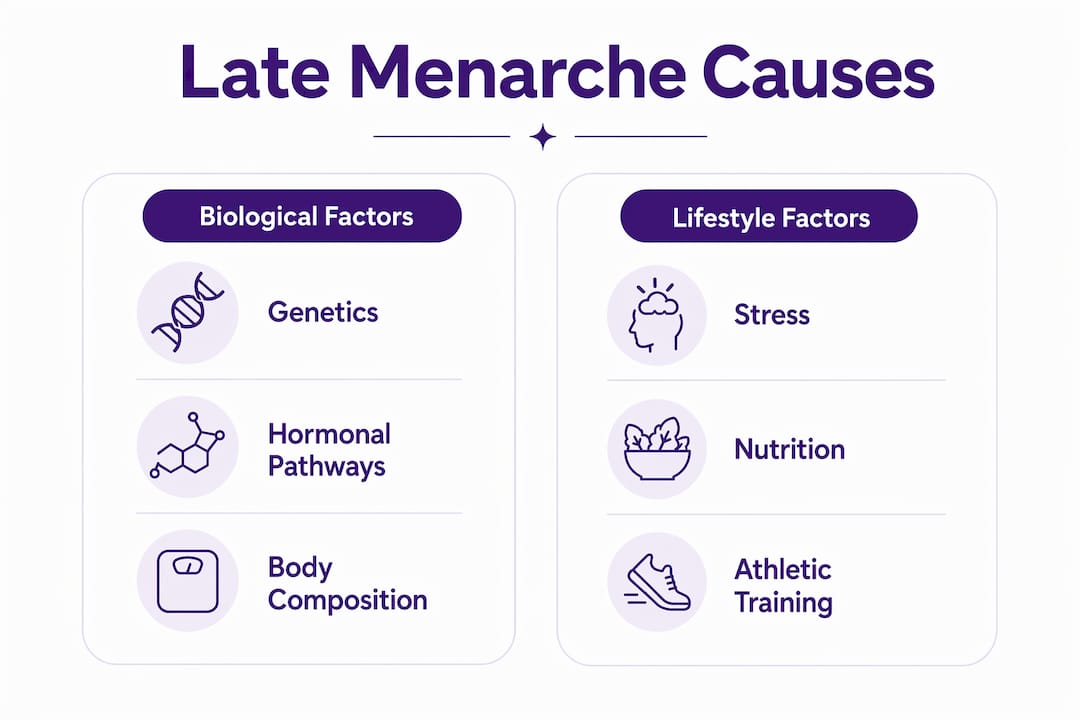
A first menstrual cycle delay has many possible causes, and most of them are not medical emergencies. Genetic factors, chronic conditions like diabetes or asthma, stress, excessive exercise, and low body weight all affect the hormone pathways that regulate menarche. Knowing which factors apply to your child helps you have a more informed conversation with her doctor.
Family history
A family history of late puberty is one of the strongest predictors of delayed menarche. Clinicians call this constitutional delay, and it is a normal variation, not a disorder. If you or your child’s other parent started puberty late, your daughter likely will too. This pattern runs in families and requires no treatment.
Body composition and athletic training
Body composition plays a direct role in puberty timing. Muscle, bone mass, and sufficient fat stores are all needed for the hormonal axis to activate properly. Girls who are very lean or who train intensively in sports like gymnastics, ballet, or long-distance running often experience delayed menarche. Low body fat reduces leptin levels, and leptin is the hormone that signals the brain that the body has enough energy reserves to support reproduction. When leptin is low, the brain delays the process.

Stress and lifestyle
High-stress environments disrupt the hormonal pathways that govern puberty. Social and environmental pressures can interfere with the brain signals needed to trigger menarche. Academic pressure, family stress, and major life changes all count. This does not mean stress alone will prevent a period indefinitely, but it can push the timeline back by months.
Nutrition and caloric intake
The body needs adequate calories and nutrients to support puberty. Girls who restrict food intake, whether due to dieting, food insecurity, or disordered eating, may experience a delay. This is not about weight alone. It is about whether the body has enough fuel to run its developmental processes.
Pro Tip: If your child is a competitive athlete or follows a restricted diet, mention this to her pediatrician at her next checkup. It gives the doctor important context for evaluating her development timeline.
When is a late first period a sign to seek medical advice?
Most delays are normal, but some require professional evaluation. Medical consensus defines a first period as delayed if it has not started by age 15, or if breast development has not begun by age 13. These thresholds exist to catch conditions that need treatment early. Reaching them does not mean something is definitely wrong. It means it is time to check.
Here are the key signs that warrant a call to your child’s pediatrician or gynecologist:
- No breast development by age 13.
- No first period by age 15, even with other signs of puberty present.
- A gap of more than 90 days between periods after menarche has already occurred.
- Severe pain, very heavy bleeding, or periods lasting longer than 7 days.
- Sudden stopping of periods after they have been regular.
| Situation | Recommended action |
|---|---|
| No breast development by age 13 | Schedule a pediatrician evaluation |
| No period by age 15 | Seek gynecological assessment |
| Periods absent for 90+ days post-menarche | Consult a doctor to rule out hormonal issues |
| Intense athletic training with no period | Discuss energy availability with a sports medicine doctor |
| Family history of late puberty only | Monitor and reassure; likely constitutional delay |
Conditions like polycystic ovary syndrome (PCOS), thyroid disorders, and anatomical differences can all cause delayed or absent periods. These conditions are treatable when caught early. The goal of seeking evaluation is not to alarm your child. It is to get answers and, in most cases, confirmation that everything is fine.
What should parents expect before and after the first period?
The years surrounding menarche bring a wide range of physical and emotional changes. Knowing what to expect helps you prepare your child and support her with confidence. The signs approaching the first period often begin quietly and build gradually over months.
- Irregular cycles are normal for the first 2–3 years after menarche. Cycles may range from 21 to 45 days during this time.
- Cramps are common. 50–75% of teens experience painful cramps in the early post-menarche years.
- Mood changes including irritability, sadness, or anxiety around the cycle are a normal part of hormonal fluctuation.
- Fatigue and headaches may appear in the days before or during a period.
- Light or irregular flow is typical for the first several periods.
Practical preparation reduces anxiety for both of you. Keeping period supplies accessible, including pads in a school bag, before any signs of menarche removes the fear of being caught unprepared. Start with pads, since they are the easiest for first-time users to manage. Talk openly about what a period looks and feels like so your child knows what to expect.
Emotional support and clear education reduce anxiety for girls experiencing delayed periods. Framing puberty as a gradual process, not a deadline, makes a real difference in how your child feels about her body. Knowing how to talk to your daughter about periods openly and without judgment is one of the most practical things you can do right now.
Pro Tip: Put together a small period kit for her school bag now, even if her period has not started yet. Include a couple of pads, a spare pair of underwear, and a note from you. It turns an anxious unknown into something she feels ready for.
Key Takeaways
A late first period is most often a normal variation in development, not a medical problem, and most girls start their period between ages 10 and 15.
| Point | Details |
|---|---|
| Normal age range for menarche | Most girls get their first period between ages 10 and 15; delays within this range are common. |
| Hormonal preparation takes time | The brain-ovary communication system activates gradually, causing pre-period signs years before menarche. |
| Common delay factors | Family history, low body fat, intense athletic training, stress, and nutrition all affect timing. |
| Medical thresholds to know | No breast development by 13 or no period by 15 warrants a pediatrician evaluation. |
| Preparation reduces anxiety | Keeping period supplies ready and talking openly helps your child feel supported and confident. |
What I have learned about supporting girls through delayed menarche
Working with families navigating puberty, the pattern I see most often is this: parents arrive worried, and they leave reassured. The delay itself is rarely the problem. The silence around it is.
Girls who have not gotten their period when their friends have often feel left out or broken. That feeling is real, and it matters. What helps most is not a medical answer. It is a parent who says, “Your body is doing exactly what it needs to do, just on its own schedule.” That sentence, said with calm confidence, does more than any pamphlet.
The variation in first period age is genuinely wide. A girl who starts at 10 and a girl who starts at 15 are both completely normal. The problem is that we rarely talk about the full range. We talk about averages, and averages make late developers feel like outliers.
My honest advice: track the physical signs, know the medical thresholds, and keep the conversation open and judgment-free. Do not wait for a problem to start talking. Start now, while there is nothing to worry about. That is when the best conversations happen.
— Themonthliesbox
Your child does not have to face her first period unprepared
When the first period finally arrives, the last thing you want is for your child to feel scared or caught off guard. Themonthliesbox was built for exactly this moment.

The Amethyst Box is a curated first period kit designed to affirm, educate, and equip your daughter before menarche arrives. It includes practical period supplies, affirmations, and educational materials that walk her through what her body is doing and why. For families who want a portable option, the On-The-Go Kit keeps essentials ready in her school bag at all times. Both are thoughtful, practical gifts that replace anxiety with confidence.
FAQ
What is the normal age range for a first period?
Most girls get their first period between ages 10 and 15. A first period is considered delayed if it has not started by age 15, or if breast development has not begun by age 13.
Can stress delay a first period?
Yes. High-stress environments disrupt the hormonal pathways that trigger menarche. Academic pressure, family stress, and major life changes can all push the timeline back by several months.
Does intense exercise cause a late first period?
Intense physical training, especially in sports like gymnastics or long-distance running, can delay menarche. Low body fat reduces leptin levels, which signals the brain to postpone reproductive development until energy reserves are sufficient.
How long are irregular periods normal after menarche?
Irregular cycles are normal for up to 2–3 years after the first period. The hormonal system takes time to establish consistent ovulation cycles, so skipped or delayed periods during this window are expected.
When should I take my daughter to a doctor about a late period?
Schedule an evaluation if your daughter has no breast development by age 13, no period by age 15, or if her periods stop for more than 90 days after menarche has already begun.
0 comments